


Dr Seshadri Ramkumar informs, advanced application of cotton has gained a spot in the larger science space where a wide range of projects in general science, water filtration, psychology, engineering, and biomedical sciences are competing.
Cotton advanced nonwoven product research gains recognition in science competition.
On February 27, 2026, elementary, middle, and high school students from many counties in South Plains participated in the South Plains Regional Science & Engineering Fair held in Lubbock. Projects ranging from robotics to AI in medicine, microplastics to advanced cotton textiles conducted by students were part of the competition.
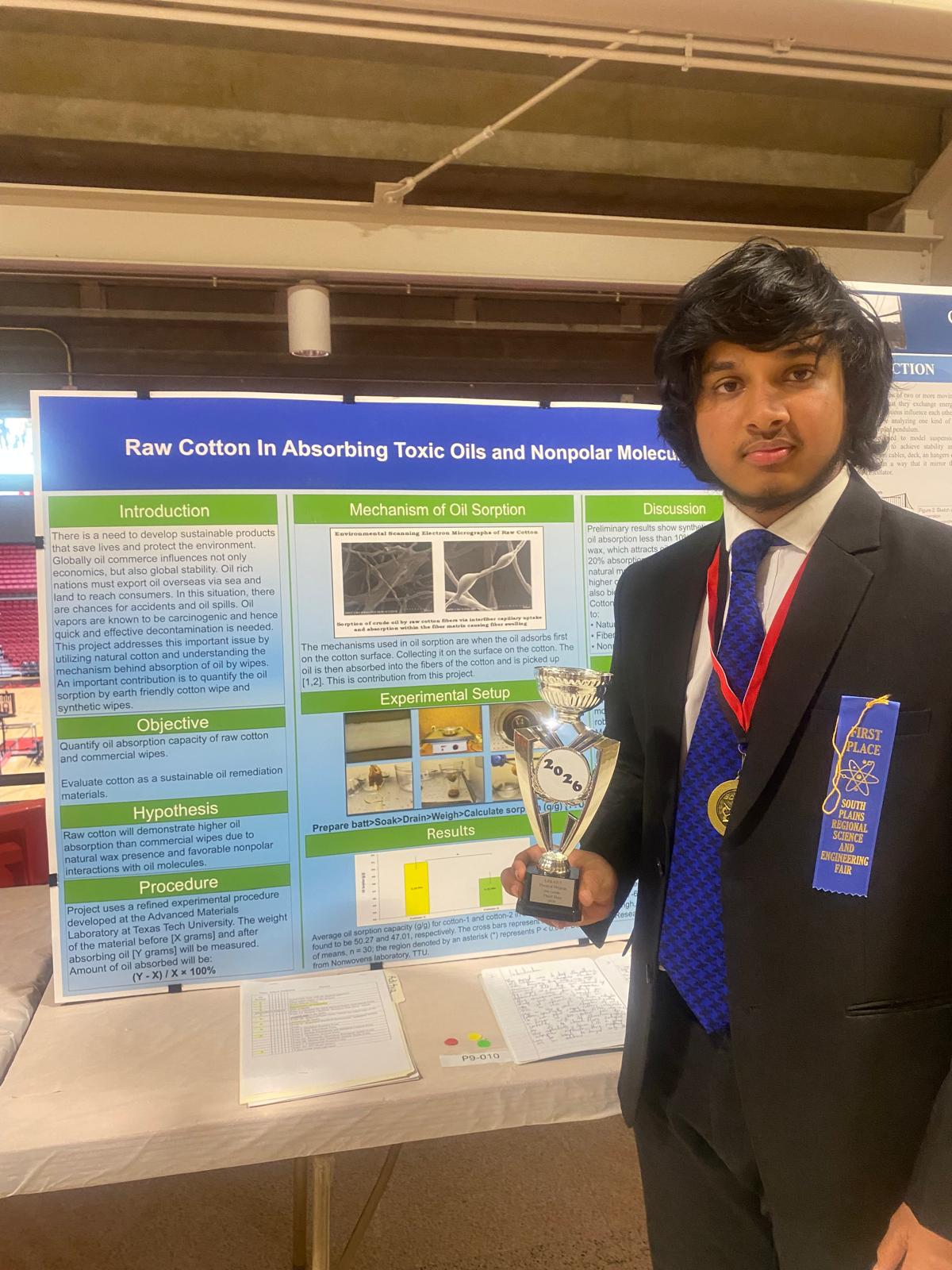
Aditya R, a 9th grade student at Lubbock High School is conducting research in the Nonwovens & Advanced Cotton Laboratory at Texas Tech University on proving the superiority of untreated cotton against synthetic wipes in absorbing oil. The goal of the project is to establish the sustainability attributes of cotton in environmental clean-up.
Aditya’s project on “Raw Cotton in Absorbing Nonpolar Molecules,” received Blue Ribbon First Place in the 9th grade in physical sciences category. It also advanced to “Trophy” stage and won a place to proceed to Texas State Science and Engineering Fair in March 2026.
Cotton being the backbone of the economy in Texas, it is pleasing to know that a cotton project that highlights cotton’s applications in saving lives and protecting the environment has advanced to the State level. Aditya also acknowledged earlier value-added cotton research conducted at the Advanced Cotton Laboratory, TTU emphasizing the need to take cotton beyond commodity marketplace.
“It is about discovery and learning. It is not about competition,” stated Professor Sung-Won Lee, Chairperson of the Department of Physics and Astronomy, TTU, during the award ceremony. Many organizations encouraged students by presenting Special Awards, which is noteworthy.
Advanced application of cotton has gained a spot in the larger science space where a wide range of projects in general science, water filtration, psychology, engineering, and biomedical sciences are competing.
Agriculture related projects conducted by high school students at The Center for Advancing Sustainable and Distributed Fertilizer Production, TTU such as electrolytic separation of hydrogen from ammonia, and water purification using electromagnetic methods were discussed by students at the science fair.
Based on the number of agriculture related projects presented, it is evident that stakeholders like commodity groups should encourage more students to participate in broad-based science fairs to bring visibility to sustainable agriculture and its value in society.
It is important to note that the recent science fair is the 70th annual edition, which highlights the importance of cultivating science and engineering interest among school students.
About the author:
Dr Seshadri Ramkumar is a Professor, Nonwovens & Advanced Materials Laboratory in Texas Tech University, Lubbock, TX, USA. You can contact him on Email: s.ramkumar@ttu.edu