


A new field of pediatrics decontamination is emerging with the proven nonwoven wipe technology that lends itself to different fibres with activated carbon for instantaneous bulk removal of agents and fine particles like opioids, says Dr Seshadri Ramkumar.
Children specific toxic chemical decontamination product and procedure developed.
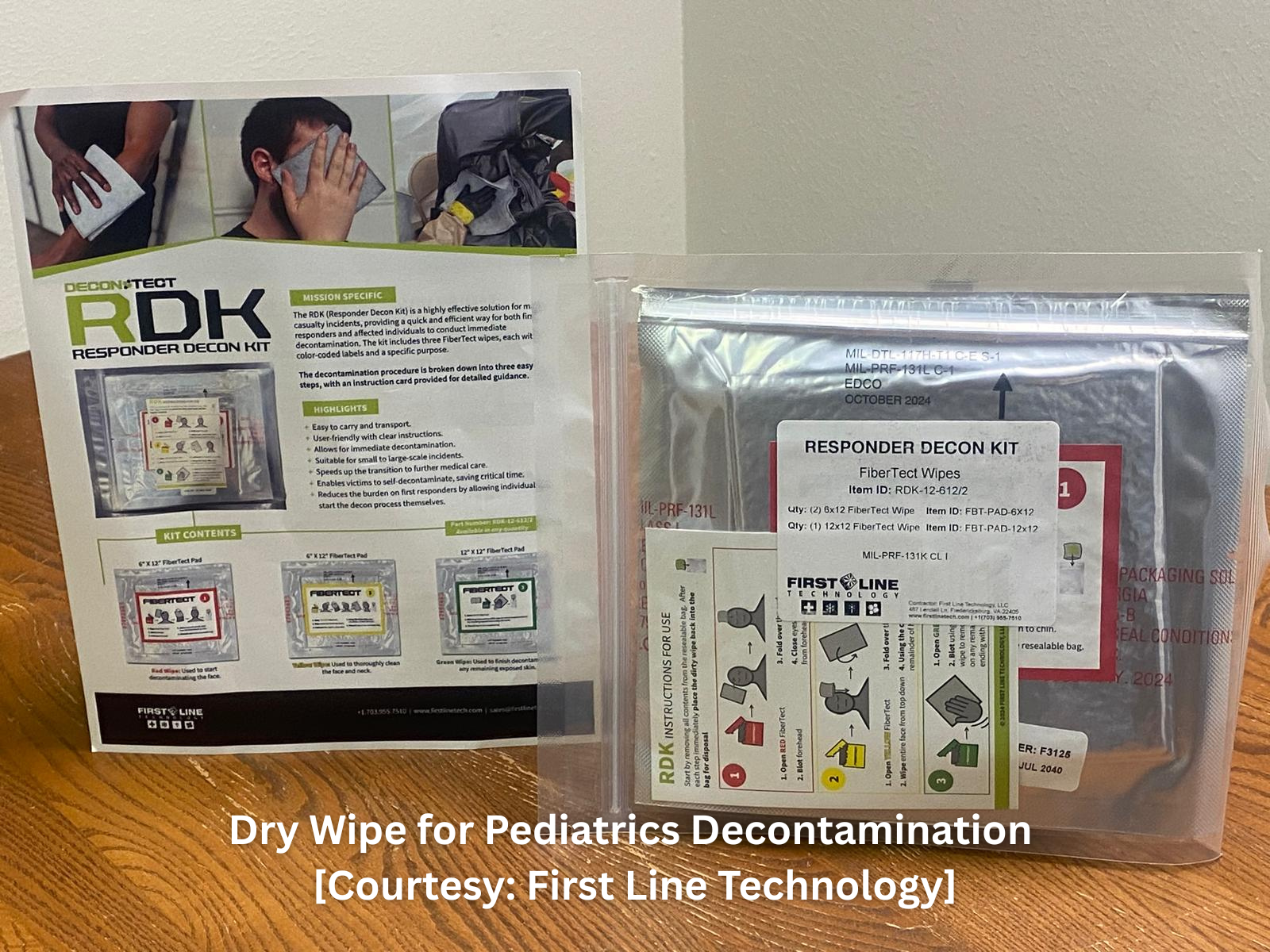
First Line Technology [FLT] recently announced a dry wipe technology procedure for wiping away toxic chemicals and particles from the skin and body of children helping with the safety of infants and children. This can be achieved using a skin friendly three-layered nonwoven wipe which is now a recognised dry wipe technology.
A new field of pediatrics decontamination is emerging with the proven nonwoven wipe technology that lends itself to different fibres with activated carbon for instantaneous bulk removal of agents and fine particles like opioids. This dry wipe is also part of Hybrid Decontamination procedure.
Dr Jayanthi Parthasarathy, Department of Radiology at Columbus, USA-based Nationwide Children’s Hospital, clearly explained the need for pediatrics decontamination. Dr Parthasarathy stated, “As with all medical devices adult sizes cannot be simply scaled down to their needs as seen in my personal experience treating both adult and pediatric population. In children in emergency scenarios, three things need additional consideration: 1) significantly larger skin surface area exposure, 2) high respiratory rate, and 3) proximity of the vital organs to the surface. Also, infants’ skin is much thinner than adults and chemicals permeate faster.”
Hybrid Decontamination has become a default process for effective decontamination. “This is the process that has been used countless times by emergency agencies to decontaminate small fentanyl releases after overdoses, clean police cars, police and EMS equipment, hospital rooms, etc.,” stated Corey Collings, Director of Technical and Training at FLT.
Paul Shaw of First Line Technology and a former US Army medic of 27 years highlighted the importance of dry decon and introduced it as viable and effective pediatric decontamination tool.
It is important to come up with pediatrics decontamination method for young people as children have high mortality risks. Toxic exposure at adult levels leads to worse outcomes in children due to different anatomical characteristics. “Children’s skin is not well developed and has more surface area to body mass, which necessitates quick decon,” stated Paul Shaw. Water decontamination increases the absorption of toxins, which may be problematic. Dry decon can effectively remove 80-95 per cent of toxin in one minute and the process is about four times quicker than wet process which can take 15-20 minutes.
“A dry decon approach using materials such as FiberTect provides a rapid, low-logistics, low-runoff solution that can reduce exposure, limit secondary contamination, and improve survivability while minimising additional stress on the child. In many cases, speed matters more than perfection in the first few minutes of exposure,” added Paul Shaw.
“Children are also not capable of effective self-decontamination and families being in a highly anxious mental status, additional effective support from them may not be forthcoming. All the above factors cumulatively lead to faster penetration of toxic material from the skin and reach the vital organs faster than adults demanding the care giver in the emergent situation seek quick and effective decontamination,” pointed Dr. Jayanthi Parthasarathy. These factors demand effective children friendly decontamination process and products.
FLT has developed Personal Decontamination Kits [PDK] which has FiberTect nonwoven dry wipe as a key component. These kits can be conveniently used for wiping toxins from infants to adults and are field deployable.
“Numerous agencies are using the First Line PDK as a standard response for dealing with Fentanyl contamination on surfaces. This PDK kit is issued to every police officer in many jurisdictions,” stated Corey Collings.
FLT also offers training courses for first responders, law enforcement, and hospital responders in adopting hybrid decontamination techniques.
FiberTect is a patented invention from the Nonwovens & Advanced Materials Laboratory at Texas Tech University. First Line Technology has effectively translated the technology to many sectors saving lives including that of children when exposed to chemical toxins.
About the author:
Dr Seshadri Ramkumar is a Professor, Nonwovens & Advanced Materials Laboratory in Texas Tech University, Lubbock, TX, USA. You can contact him on Email: s.ramkumar@ttu.edu