


The Indian textiles and clothing industry has been facing severe challenges in the aftermath of demonetisation, GST implementation, and economic slowdown across the globe, US-China trade war and recently the Corona virus in China. Though there is a steady growth in the domestic market, the exports got stagnated; rather there is 4 per cent negative growth during the last four years. China has started cutting down its production, outsourcing and created huge space in the international market. This opportunity has been fully exploited by small countries like Bangladesh, Vietnam, etc., and pushed back India into fifth position in the global textile trade from the second position that it had been retaining for several years.
The global textiles market of cotton and man-made fibre is in the ratio of 30:70 while it is reverse in India. In the total Indian textile exports, cotton textiles account 80 per cent due to the price advantage of the home grown cotton, while it is only 20 per cent in the manmade fibre segments due to expensive raw material price. The indigenous man-made fibres especially polyester fibre, the future engine of growth have been expensive due to the anti-dumping duty levied on basic raw materials especially PTA. In the recent budget, the Government has boldly abolished the anti-dumping duty on PTA thus creating a level-playing field. PTA accounts 70 per cent of the raw material to produce polyester; the anti-dumping duty on PTA varied from $27 to $160 per metric tonne
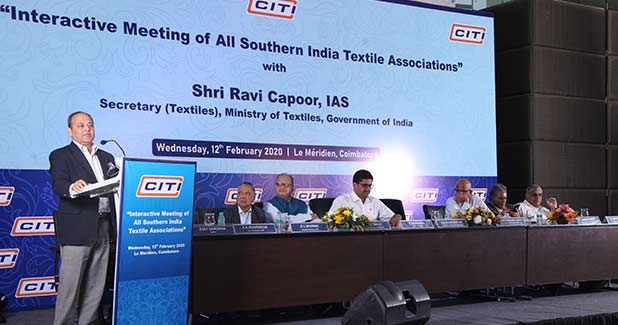
T Rajkumar, Chairman, Confederation of Indian Textile Industry (CITI) has said that CITI organised the interactive meeting with Secretary, Ministry of Textiles on February 12, 2020 at Hotel Le Meridien, Coimbatore. Around 200 industrialists representing the entire textile value chain from South India and also the members of National Committee for Textiles & Clothing (NCTC) attended the meeting. He said that Ravi Capoor, Secretary (Textiles) and Joint Secretary, Nihar Ranjan Dash participated in the interactive meeting. He said that all the Associations thanked the Prime Minister, Union Minister for Textiles and Secretary (Textiles) for the bold decision of removing the anti-dumping duty levied on PTA. He said that this initiative has enabled the indigenous fibre and filament manufacturers to reduce the price considerably. Rajkumar has stated that the country has been suffering with surplus production capacities across the value chain that created during the last four years with huge investments that could be utilised for polyester textile manufacturers.
The Secretary (Textiles) in his address strongly advised that the textile industry especially in Tamil Nadu to grab the opportunities by diversifying into polyester segment to boost exports. He appreciated the sustainable initiatives taken by Tirupur and Coimbatore by implementing zero liquid discharge to protect the environment, predominantly using non-conventional energy to avoid carbon food print, apart from complying various labour and other social statutes. He advised Tirupur Knitwear Cluster to brand its garments and products under sustainable programme that might fetch much larger margin globally and Government would extend all necessary support to promote the brand.
The Secretary (Textiles) also indicated that the Government would address all the structural issues in its new National Textile Policy that might be announced in a couple of months by making the basic raw materials available at international price, encourage scale of operation by developing 10 mega textile parks with over 1000 acres of land closer to the ports, giving plug and play facilities including the necessary safeguard measures in the labour laws. Ravi Capoor also indicated addressing the power cost, credit cost and its availability; the government would also make efforts to expedite conclusion of FTAs with EU, UK and other countries to boost the exports.
T Rajkumar has stated that the Government has identified the textile industry as the thrust area and in real terms “Make in India†facilities without any imports right from fibre to finished goods, ensures inclusive growth by providing jobs to all skill levels especially the rural masses and women folks. T Rajkumar has stated that the Government would also announce a Scheme to set up dedicated textile parks for technical textiles, textile machinery manufacturing with the state-of-the-art technology spares, accessories, parts to promote import substitution thereby reducing the capital cost substantially as India is currently depending on imported technology barring spinning sector. He has said that the Government is also exploring the possibilities of setting up R&D centres with the State-of-the-art facilities for each segment of the textile industry.
On behalf of National apex bodies, Dr A Sakthivel, Prem Malik, M Senthil Kumar, Rakesh Mehra and Ajay Sathana participated in the interactive meeting.