


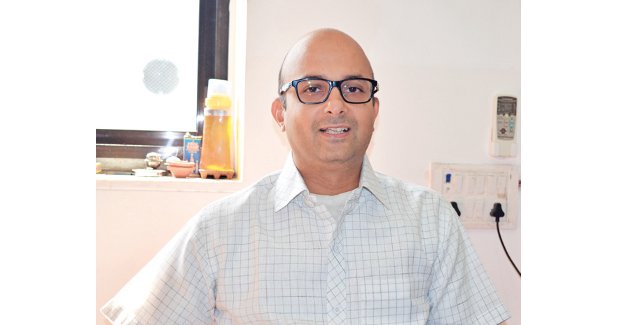
After working in industrial sector for a few years, Amit Narke, an electronics engineer, rather decided to associate with an electrifying movement called ‘organic cotton farming’ and 100 per cent organic cotton garment manufacturing.
To begin with he started with cotton trading. Amit used to buy organic cotton from farmers at a fair price and sell it in the Southern market. Upon an advice from his friends in industry, he ventured into manufacturing of garments from 100% organic cotton fibre under the name Quanta Impex in 1996. Later, Purecotz Eco Lifestyles Pvt Ltd was incorporated in 2000.
“I did my engineering in electronics from VJTI Mumbai. I worked for some years but I did not find any charm in the said job. I am from Nagpur region. I came across Vidharbha Organic Farmers Association (known as VOFA) at Yeotmal, who were engaged in ‘organic cotton farming’ movement. I immediately felt like getting in touch with something that I really love. Since childhood I love farming, I love nature. I went deep into their movement and I found they were growing cotton traditionally yet ingeniously. That really attracted me.
I started my business in the year 2000 at Umbargaon, with 1500 sq feet space housing 20-25 machinery and employing 30 persons for manufacturing garments. Now the company has 60,000 sq feet factory with all production facilities such as embroidery, stitching, cutting, printing, heat transfer printing, fusing, etc. We employ about 500 people. We also set up garment printing unit.
Amit Narke, Managing Director, Purecotz Eco Lifestyle Pvt Ltd, speaks about organic cotton and his mission:
Tell us about organic cotton movement:
It’s an interesting activity. Even the buyers from abroad often prefer to visit the organic cotton farms and see their passion filled activities. And I also visit once in a year since I love to see their work.
Organic cotton product manufacturing is safe for workmen as it creates less dust particles as compared to other products which bring chest and respiratory illness to workmen working factories. Also farm workers also suffer due to use of pesticides and farm land gets infertile due to use of chemicals which also kills all living earth organisms required for crops. As per the GOTS compliance, there is traceability of whatever we are doing in the entire product cycle – seeding to product finishing.
In our organic cotton product cycle, there is a win-win situation; in the entire supply chain – right from farmers to manufacturing and marketers, everybody is getting their due. True cost is reflected at all stages of the product. It is not like farmers are getting penny for their hard work and entrepreneurs are flourishing.
I quote here an Organic Cotton Organisation’s (www.aboutorganiccotton.org) views which say that an organic cotton farming system is one that sustains the health of soils, ecosystems and people. It relies on ecological processes, biodiversity and cycles adapted to local conditions rather than the use of artificial elements such as pesticides and other chemicals that cause adverse effects. Organic farming combines tradition, innovation and science and promotes fair relationships and a good quality of life for everyone involved.
What is your products range?
About 90 per cent of our production is kids wear, and the rest men’s and women’s wear that include t-shirts, sweaters and tops for women. For kids, we make kids wear, bed sheets, pillow covers, bootees/socks, small toys, purses, bags, towels, etc.
What’s so great about these products?
All these are made using 100 per cent organic cotton yarn. Understanding the sensitive skin of babies, we make sure that all the products are non-allergic, soft, skin-friendly and comfortable. Moreover, we make sure that the entire offered range matches with the international quality standards and are made in accordance with the globally-accepted norms and GOTS compliance.
Why 100 per cent organic cotton?
Organic cotton is grown in a natural way, just like it used to be grown during the pre-chemical/industrialisation era. The difference is that now the farmers grow it in a more organised way to ensure that all necessary compliances are met and they achieve better yield and price. Organic is such that from the stage of seeding to final production of garment and after product usage, it comes back to the nature and get absorbed since the organic product is perishable, compostable, degradable and recyclable.
On the other hand, the man-made fibres products – be it polyester, nylon, rayon, etc. – are not perishable and they remain on earth even after disposing off as waste for longer time just like plastic and PVC products thus harming the nature.
Organic cotton products get the stamp of certification from GOTS, which is the process-based certification. The entire process of garment making – right from seed, farming to final product – is being checked and monitored for compliance. Whereas other certification such as Oeko-Tex certification is product based hence checking is done for residues.
The non-organic farming of cotton involves use of pesticides, chemicals, fertilizers. And since it is now mostly GMO (genetically modified organism), the seeds are impotent and farmers have to buy seeds from the companies.
What about the competition between organic and non-organic cotton products?
Yes, non-organic farming cotton yields more per hectare, as compared to organic farming. Non organic cultivation yields about 25-40 per cent more crop than organic farming. There is surely 10-20 per cent price difference between organic cotton and non-organic cotton products (cheaper). Although the growth of our sector is slow, organic cotton products command premium as farmers themselves get better pricing for their output.
So, as organic product entrepreneurs, we face competition within ourselves as well as with the man-made fibre and non organic cotton products. But the trend will slowly change and we want more and more people switch to organic products so that more area of land is brought under organic cotton cultivation.
What is your future plan?
Our aim is to bring more land under organic cotton cultivation. We expect to bring to 25 million sq m in next four years, which is now about 8 million sq m. This will happened when there is awareness among people to use eco friendly organic cotton products.