


With more than 140 years history, Konica Minolta is one of the leading companies of photo-films and cameras. The company’s product portfolio comprises versatile product series covering all areas of digital imaging. Its high-speed bizhub PRO and bizhub PRESS production printing systems perform at top speeds in colour and/or black & white, while its range of black & white and colour KIP printers answers every imaginable wide format printing need.
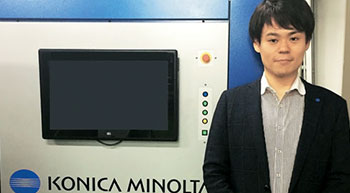
Hayato Kobayashi, Sales Division Textile Sales Group, Inkjet Business Unit, Konica Minolta, speaks to the ITJ on the growth of the company in digital printing space. Excerpts.
With the rapid growth of digital printing technology, give us briefly the growth of your company in this field.
We have original power and technologies for growth in textile fields. We develop printers, print-heads and inks by ourselves, and provide our support system that is overwhelmingly superior to competitors.
We founded Italy and China Blanch in 2014 for following up main market. In ITMA2015 at Milan, we released three new printers – have all line-up (from scan-type to super high speed single-pass type) printers to meet diverse requests of customers.
What do you think are the big benefits of your company’s specific technology and machinery?
From advanced single-pass printer, NASSENGER SP-1:
1)Downtime minimisation to eliminate opportunity loss
2)Newly designed IJ head with small droplet + grayscale, easy ink priming
3)Missing nozzle detection
4)Missing nozzle compensation
5)Automatic calibration by advanced camera system
From advanced scan type printers – NASSENGER 10 and NASSENGER 8:
1)Common technologies with our flagship model NASSENGER SP-1 are applied for the best performance
2)Emulation mode of NASSENGER SP-1 for sample printing
3)Combination of scan type and single-pass offers sample print + mass production
Where are your markets located – globally? What are your future strategies?
Globally our current major market with strong presence are preponderantly Europe, in particular Italy, and now expanding to Turkey, China, and domestic market Japan, where we are located.
Our future important markets include India, South East Asia including Vietnam, Indonesia, Thailand, and South and Latin Americas.
How important is India’s market in your scheme of things? How are you developing it?
Konica Minolta is covering Indian market with dealers. We have started Indian market with offering entry models and middle-range models, as we believe it is a necessary step for this market to accumulate digital experiences with a small investment rather than to rush investing huge money to copy the success of European companies. Now, India seems ready to take off. We believe it is a perfect timing now to introduce newest products to India.
What changes and developments do you foresee in digital printing for the future?
Digital printing would be able to offer shorter lead time, volume flexibility and design flexibility. These effects should provide huge benefit to the fabric buyers. This benefit should be reflected to the “price (= value added)†of the printed fabric from the printing process.
The fashion industry would enjoy “avoiding risk of obsolete stockâ€Â, â€Ânot missing the opportunity of sales†through “shorter lead timeâ€Â, “volume flexibility†and “design flexibility†enabled by digital printing. This benefit should be shared with everybody involved in the textile value chain including printing factory and to should be finally reflected to the selling price of the fabric in order to cover a bit higher cost.