


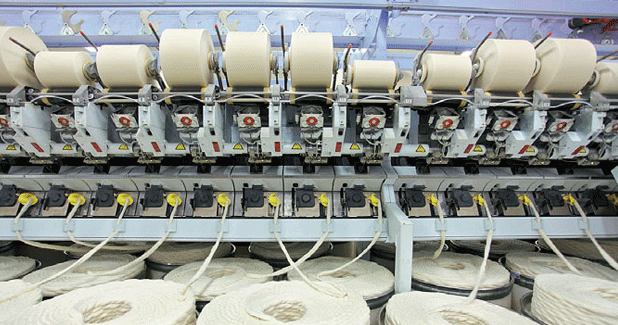
The predominantly cotton-based textile industry has become highly competent in terms of operational efficiency with the state-of-the-art technology, skilled manpower, high productivity, high quality, etc. But the external factors are curtailing its growth and the industry is facing yet another long drawn recession for the last 15 months. Spinning and powerloom industry are the worst affected.
Though various state governments have announced attractive textile policies and aggressively marketing for attracting investments, these policies have become a major threat for the existing capacities to compete with the new capacities being created. In the absence of a level-playing field due to higher rates of duties for Indian textile products in various major international markets, higher raw material cost, high cost of funding and high transaction cost, the industry is not in a position to achieve its potential growth rate.
Under these circumstances, it is very essential for the Central Government to come out with a policy initiative to strengthen the competitiveness of the Indian textile industry. This would enable the industry to achieve the growth rate of 25 to 35 per cent in the short run and 20 per cent growth rate in the long run. This industry could achieve a business size of $500 billion by 2025 from the current level of $110 billion, if the right policies are in place. T Rajkumar, Chairman, The Southern India Mills´ Association (SIMA), has appealed to the Prime Minister to announce slew of policy initiatives to create a level playing field for the mother industry of the Nation which employs over 110 million people to compete in the globalised environment and achieve the envisaged growth rate. T Rajkumar stated that the industry could achieve over Rs 3 lakh crore investments during the last 15 years and it has potential to attract Rs 2 lakh crore in the next five years, if the right policies were in place. He stated that taking advantage of the surplus cotton, spinning capacity, fabric production capacity could be converted into a significant amount of foreign exchange which could greatly help the government to overcome the balance of payment issue. Tariff barriers T Rajkumar stated that Vietnam and Cambodia have zero duty access and Pakistan has zero duty access for fabrics and 5 per cent duty for garments and made-ups in China while the Indian yarn attracts 3.5 per cent duty, fabric attracts 8.5 per cent duty and made-up and garments attracts 14 per cent duty. He stated that Pakistan, Bangladesh and Cambodia have zero-duty access in European Union and Bangladesh and Cambodia have zero-duty access in the US. He pointed out that the global recession had pushed the Indian textile industry to the corner and India had become the least preferred Nation in textile trade due to higher rates of duties. T Rajkumar appealed to the Centre to expedite Free Trade Agreements with China, EU and other countries on a war footing and create a level playing field to enable India to grab the opportunities emerging in these countries particularly China which had already started cutting down its production. He pleaded the PM to extend 3 to 5 per cent incentive under Merchant Export Incentivisation Scheme (MEIS) as an interim relief till the FTAs are signed to enable the Indian textile industry to compete in the global market and fully utilise the production capacity. Raw material policy SIMA Chairman heavily criticised the cotton trade policy of Cotton Corporation of India (CCI), which have been doing significant damages to the Indian textile industry particularly the SMEs, and favouring only the multinational cotton traders. He pointed out that CCI had procured major portion of good quality cotton produced in Telangana, Andhra Pradesh and parts of Maharashtra and hoarding the cotton for several months which made mills in these states to source cotton from other states and also could not fulfill the customer requirements. He als