


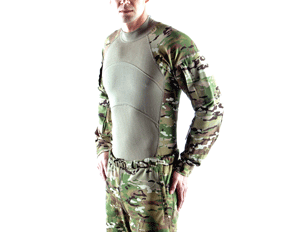
Camouflage textiles not only help protect armed forces from visual and IR detection but also-with regards to their heat and sweat management capabilities-ensure that the soldiers can perform to the best of their abilities even in extreme climatic conditions, reveals Ashok Athalye.
Clothing is an integral part of human life and has a number of functions; protection, adornment and status. Traditionally, textiles are used for various applications covering apparel (suiting, shirting, dress material, scarf, etc.), home furnishing (table mats, bath mats, bed sheets, upholstery, carpets, curtains, etc.) and technical functions (industrial belts/filters, automobile, medicine, agriculture, etc.). With increase in population, improved standard of living and growing industrialisation the overall demand for textile material for the various end use applications is rapidly rising. Protective clothing is one area, which encompasses both the apparel as well as the technical functions and is emerging as one of the fastest growing textile segments.
Protective clothing refers to garments and other fabric related items designed to protect the wearer from harsh environment, which may result in injuries or death. Thus, primarily this comprises all those textile-based products, which are used principally for their performance or functional characteristics rather than their aesthetic or decorative purposes. Presently the protective textiles segment is about 1.5 per cent of the total textile market with an estimated value of $5.2 billion and the consumption is expected to grow at 10-12 per cent per year.
Defense forces are the major users of protective textiles. The military wear has to exhibit unique performance characteristics due to the diverse hostile conditions under which it has to function. The ultimate success of combat troop depends not only on the physical fitness or the superiority of the arms and ammunition but also on the comfort, mobility and protection provided by the clothing. Fabrics are tailored to provide protection against operating weather conditions (heat, cold, wind, and rain) as well as detection from the surrounding terrain to achieve soldiers mobility, concealment and survival by camouflage effect. Efficiency of a camouflage is to allow clothing and military objects to blend into surrounding environment and blurry the characteristic contours of an object that can no longer be perceived against its background.
The global requirement of camouflage fabrics is anticipated to be more than 350 million metres annually for about 35 million soldiers, which includes army, air force, navy, coast guards and para military forces. Also, the camouflage textiles are used for concealing equipment like tents, jeep/truck covers, etc.
Camouflage textiles
The military camouflage textiles concept was initiated during the First World War, making the soldiers and military equipment hard to see. The idea was developed further and the textile usage was increased during the Second World War. However, its use has rapidly increased after the Gulf War of 1991 and today military of almost all countries are using camouflage clothing. A wide variety of camouflaged textile patterns have been developed to suit the need to match different kinds of combat terrain such as woodland, snow, and desert.
Camouflage clothing gives a unique effect to the personnel or equipment by making them appear as a part of the natural surroundings. This provides concealment that allows soldiers, military vehicles, or other objects to remain unnoticed by blending with their environment. Camouflage uniforms enable soldiers to blend into their surroundings and so minimise their risk of being seen by an enemy.
Camouflage patterns aim to visually disrupt the shape of the body, so that the body outline is less easily recognised, and also to provide colours or areas of light and dar