


The current scenario demonsrates that almost four-fifths of the total printing is being done on the screens, aver Shruti Gupta, Bhawna, Jyoti Kumari, Kamil Malik, and Khyati Singh.
Block printing is an ancient craft form of Rajasthan that is being practiced since time immemorial. Rajasthan has a long and distinguished tradition of printing with finely carved wooden blocks. The block printing of Rajasthan in India was exported in a large number from India. This method, though laborious, is actually quite simple and merely calls for precision.
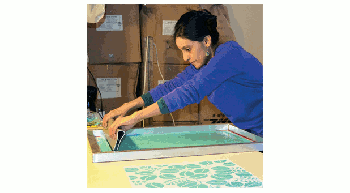
Printing is done at several places in Rajasthan and each place has historical, cultural and geographical impact and influences on the craft of hand printing. Regional variations do exist and each region has a distinctive style of its own. Block printing can be distinguished into two categories: Sanganeri and Bagru prints. Although much difference is not noted, the background colour of the fabric marks the difference between the two. The Sanganeri prints are done on a white background and the Bagru prints are essentially done on a background of red and black. Screen printing is a printing technique that uses a woven mesh to support an ink-blocking stencil to receive a desired image. The attached stencil forms open areas of mesh that transfer ink or other printable materials which can be pressed through the mesh as a sharp-edged image onto a substrate. A fill blade or squeegee is moved across the screen stencil, forcing or pumping ink through the mesh openings to wet the substrate during the squeegee stroke. Basically, it is the process of using a mesh-based stencil to apply ink onto a substrate, whether it be t-shirts, posters, stickers, vinyl, wood, or other material.
Screen printing is also a stencil method of print making in which a design is imposed on a screen of polyester or other fine mesh, with blank areas coated with an impermeable substance. Ink is forced into the mesh openings by the fill blade or squeegee and onto the printing surface during the squeegee stroke. As the screen rebounds away from the substrate the ink remains on the substrate. It is also known as silkscreen, serigraphy, and serigraph printing. One colour is printed at a time, so several screens can be used to produce a multi-coloured image or design.
Methodology
The objective of conducting this study is the documentation of block and screen printing craft practiced by the chippa community in Jaipur, Rajasthan in order to do that, a descriptive study was planned a questionnaire was included with both open and closed-ended questions. The sampling method undertaken was cluster sampling. these questions focused upon demographic details history and processes involved with craft along with colours. motifs and products. Authentic data was collected by interviewing and photographic documentation around 30 workers were interviewed.
Result and discussion
This is despite the fact that the number of units and the employment generated among the two sub-sectors of screen and hand block printing are almost equal.About 30 years ago, block printing was the only method of production for both utility products and exclusive items. With the changing scenario market demanded utility products in large volumes in short period. As an result screen printing gain recognition in mid 1970s, which was capable of producing in large quantities at much lower cost and time than block printing. This method of production easily took over the industry in terms of volume of production in utility items. Exclusive items with ethnic designs and eco-friendly dyes remained comparative advantage for block printing. But block printers did not change themselves with changing scenario and remained competing with the utility products. It was outsiders (mainly the Khatri community) who took the growing market demands w