


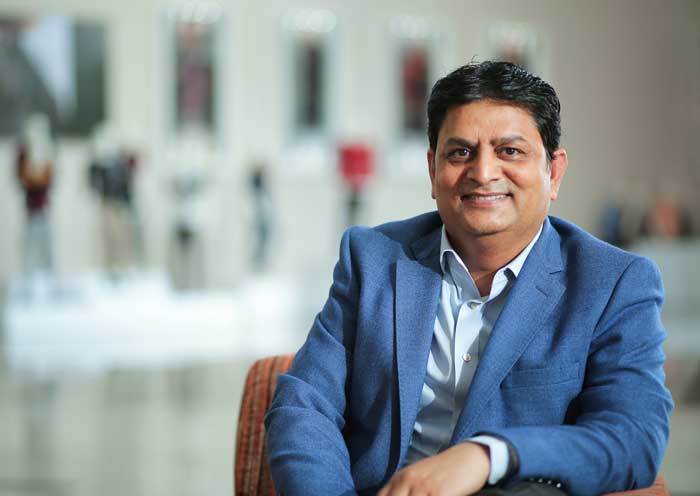
The future of apparel sourcing will be defined by resilience, traceability and accountability—not cost alone, says Dr Naresh Tyagi.
The global apparel industry is navigating its most severe stress test in a generation. Shipping disruptions have stretched lead times by 20 to 40 per cent. Labour shortages are driving manufacturing costs in Bangladesh and Vietnam up by 15 per cent annually. Tariff escalation, geopolitical fragmentation and tightening sustainability legislation are simultaneously making legacy sourcing models obsolete. Seventy-six per cent of global fashion executives now identify tariffs as the defining commercial risk of 2026 (McKinsey, State of Fashion 2026). Global brands are not merely diversifying, they are fundamentally rethinking what a reliable supply chain partner looks like.
The answer they are arriving at is not the cheapest partner. It is the most integrated, resilient and verifiably responsible one — a partner who controls the supply chain from fibre to finished garment, absorbs volatility without breaking, and can prove the sustainability of every input in the chain. That description has one geography at its centre: India. The question is not whether India is that partner. It already is. The question is whether the industry will deploy that advantage at the scale and speed the moment demands.
Integrated supply chain
Bangladesh’s rise to the second-largest apparel exporter has been built on assembly — it imports the vast majority of its yarn, fabric and inputs from China. Vietnam is equally assembly-dependent. Both are structurally exposed the moment upstream inputs are disrupted, material specifications change, or traceability regulations demand farm-to-shelf data. China, despite its formidable scale and technology, now carries geopolitical risk premiums that are systematically repricing it out of diversified Western sourcing strategies.
India’s competitive position is architecturally different — and architecturally superior. India offers a fully integrated textile value chain encompassing cotton cultivation, man-made cellulosic fibre (MMCF) production, synthetic yarn, spinning, weaving, dyeing, processing and finished garment manufacturing within a single sovereign ecosystem. This is not a cost advantage. It is a resilience architecture: when a global input is constrained, when a regulation demands upstream traceability overnight, or when a brand needs to shift specifications at speed, India can respond end-to-end. No competitor at comparable scale can. India’s textiles and apparel exports reached $35.14 billion in FY26, with a national target of $100 billion by 2030. McKinsey’s State of Fashion 2025 ranks India the top-ranked sourcing destination for American brands over the next five years — a recognition earned not by wage arbitrage, but by supply chain depth.
The triple engine
India’s competitive advantage is not reducible to integration alone. Three reinforcing forces compound it into a durable structural lead that will accelerate, not diminish, during periods of global uncertainty:
- Unmatched manufacturing base. India’s textile sector employs over 45 million workers directly and supports 100 million livelihoods — the second-largest employment base after agriculture (IBEF, 2026). This is not low-cost labour at risk of wage inflation; it is a deep, diversified, multi-skilled manufacturing ecosystem spanning fibres, yarns, fabrics, processing and garments across specialised clusters — Tirupur for knitwear, Surat for synthetics, Ludhiana for hosiery, Ichalkaranji for weaving, Panipat for recycling. That cluster diversity means India can serve every product category globally, simultaneously. No single labour-cost shock can disrupt it wholesale.
- A skilled and increasingly technical workforce. SAMARTH 2.0 has placed 3.55 lakh workers — 88 per cent of them women — into textile roles, building a workforce capable of operating sophisticated digital and automated production systems. The Tex-RAMPS scheme (November 2025) deepens research and innovation capacity. As global brands shift from commodity garments to higher-value, specification-intensive products, India’s technical skills base becomes an increasingly decisive sourcing criterion. Skill, not just scale, is now the differentiator.
- Technology and innovation at the frontier. Seventy per cent of Indian textile companies have initiated AI-driven supply chain programmes against a global norm of 49 per cent (Fashion for Good, 2025) — delivering cost reductions of up to 25 per cent and inventory optimisation of up to 35 per cent. AI-led demand forecasting, real-time factory monitoring, IoT-enabled quality control and digital material passports are converting India’s manufacturing depth into a data-intelligent, predictively reliable supply chain. Tirupur has achieved near-Zero Liquid Discharge at cluster scale. Panipat processes 7,793 kilotons of textile waste annually — Asia’s largest recycling complex. The PM MITRA Parks provide world-class plug-and-play infrastructure for next-generation manufacturing investment. When global headwinds intensify, technology-enabled Indian clusters become more competitive, not less — because they can flex, adapt and deliver in ways that rigid, import-dependent competitors cannot.
The new condition of market access
- The EU’s Digital Product Passport (DPP) mandatory for textiles by 2027–28 requires every garment sold in Europe to carry verified data on material origin, chemical inputs, recyclability and lifecycle impact.
- The CSRD and CSDDD directives require European brands to trace and remediate adverse impacts across their entire upstream supply chains, effectively exporting EU ESG standards to every supplier in their base. India’s carbon trading framework (2026–2030) targets a 30 per cent sectoral emissions reduction.
For assembly-led geographies, end-to-end traceability across third-country inputs is structurally unviable, while India’s integrated value chain makes it inherently achievable and commercially decisive. Suppliers who can provide auditable data on emissions, certified material origins, and verified labour standards will secure long-term contracts, while others will be phased out. This is not a future shift but the current market reality—responsible supply chains are no longer a differentiator, but the minimum entry requirement, and India is best positioned to deliver at scale.
The strategic imperative
- Instrument every tier with data-Digital material passports, IoT upstream monitoring and third-party audit trails across Tier 2 and Tier 3 must become standard operating procedure. Companies that build these pipelines in 2026 will hold a structural advantage that late movers cannot close by 2028.
- Scale the cluster model nationally-Tirupur’s ZLD and Panipat’s recycling scale are proof points, not exceptions. Shared renewable energy, common effluent treatment and co-invested traceability platforms must be replicated across every major cluster funded jointly by industry, government and global brand partners.
- Build MSMEs into the architecture, not around them -Over 70 per cent of India’s apparel units are MSMEs. Government capacity grants, brand co-investment in supplier capability and the scaling of the SU.RE certified vendor model (600-plus vendors, 2025) must ensure the resilience dividend is broadly captured — not concentrated in large units alone.
- Lead the global narrative with verified proof-India’s supply chain story its integration, its cluster achievements, its AI adoption, its circularity infrastructure is world-class. It must be told at world-class volume, backed by certified data and anchored in industry-government co-authorship.
Resilience is the new cost
The future of apparel sourcing will be defined by resilience, traceability and accountability—not cost alone. India’s fully integrated fibre-to-garment ecosystem, supported by a 45 million-strong workforce across specialised clusters, delivers scale, flexibility and supply continuity that assembly-led competitors cannot match. Strengthened by skilled capacity, R&D, rapid AI adoption, ZLD implementation, digital traceability and large-scale recycling, India is evolving into a data-intelligent, circular supply chain hub. Crucially, tightening global regulations such as EU DPP, CSRD and CSDDD are converting sustainability into a commercial imperative—structurally favouring India’s end-to-end traceable model. Responsible supply chains are now the baseline for global market access, not a premium differentiator. In this reset, India is not just a participant—it is uniquely positioned to define the future of responsible apparel sourcing, provided it executes with speed, scale and strategic intent.
About the author:
Dr Naresh Tyagi is a veteran sustainability strategist with more than three decades of experience spanning materials science, textile value chains and ESG-linked business transformation. As Chief Sustainability Officer of Aditya Birla Fashion and Retail (ABFRL), he leads sustainability strategy across raw materials, climate action, circular economy and supply chain policy engagement. He is a recognised voice in India’s national conversation on responsible textile manufacturing and contributes to industry-government policy dialogue at the highest levels.