


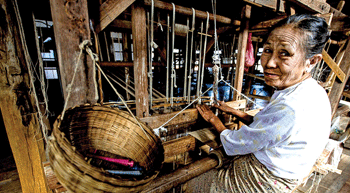
The history of textile is almost as old as that of human civilization and as time moves on the history of textile has further enriched itself. In India, the culture of silk was introduced in 400 AD, while spinning of cotton traces back to 3000 BC. In China, the discovery and consequent development of sericulture and spin silk methods got initiated at 2640 BC while in Egypt the art of spinning linen and weaving developed in 3400 BC. The discovery of machines and their widespread application in processing natural fibres was a direct outcome of the industrial revolution of the 18th and 19th centuries. The discoveries of various synthetic fibres like nylon created a wider market for textile products and gradually led to the invention of new and improved sources of natural fibre.
The 18th century saw the start of the industrial revolution and with it a series of technological improvements that caused an extraordinary structural change in the way society and work was organised. This had its effect on the textile industry that grew out of the industrial revolution as mass production of clothing became a mainstream industry. Several inventions occured in a relatively short timeframe. These new advances in clothing production, manufacture and design resulted in new wheels, looms, and spinning processes changing the manufacture of clothing forever. The spinning wheel, the first piece of textile machinery ever used, was developed in India. By the 13th century, there were spinning wheels in use in Persia and China, but they were not in general use in Europe until the 14th century when the Saxony Wheel, which used a foot pedal to turn the spindle, was introduced in Germany. This incorporated the use of a flyer originally invented by Leonardo da Vinci in 1519. The initial enhancement in the early spinning machines however, took place only in 1738 when Lewis Paul and John Wyatt discovered the roller method of spinning. Other developments included the improvement of the loom with the flying shuttle, which John Kay partnered in 1733, and the invention of the water frame by Richard Arkwright in 1769.
Clothing manufactured during the industrial revolution formed a big part of the exports made by Great Britain, accounting for almost a quarter of the total exports and growing exponentially in the period between 1701 and 1770. The centre of the cotton industry in Great Britain was Lancashire. These exports of clothing were however to get displaced in the late 19th century when Platts the largest British textile machinery maker of that period, became one of the leading exporters of textile machinery and ring frames particulary in the 1880s, thereby helping the mechanisation of the textile industries of the rest of the world. By 1913, the UK contributed to 56 per cent of the world textile machinery export.
The textile industry is undergoing a major reorientation towards non-clothing applications of textiles, known as technical textiles, which are growing roughly at twice rate of textiles for clothing applications and now account for more than half of total textile production. The processes involved in producing technical textiles require expensive equipment and skilled workers and are, for the moment, concentrated in developed countries. Technical textiles have many applications including bed sheets; filtration and abrasive materials; furniture and healthcare upholstery; thermal protection and blood-absorbing materials; seatbelts; adhesive tape, and multiple other specialised products and applications.
During the industrial revolution, fabric production was mechanised with machines powered by waterwheels and steam-engines. Production shifted from small cottage based production to mass production based on assembly line organisation. Clothing production, on the other hand, continued to be made by hand. Sewing machines emerged in the 19th century streamlining clothing production. In the early 20th century workers in the clot