


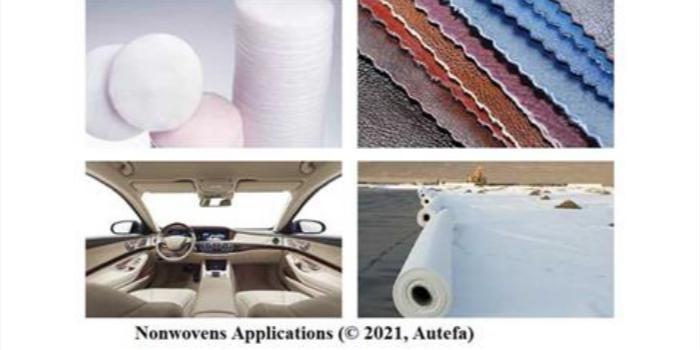
With more than 4,000 years of collective experience, Swiss Textile Machinery member firms have built on a bedrock of technological strength. Naturally, much of that heritage is vested in ‘traditional’ textile processes such as spinning, weaving and finishing – but there’s another side to the success story, with three of those companies earning growing reputations in the boom sector of nonwovens.
Originally conceived as a low-cost, high-volume alternative to knitting and weaving, nonwovens was already expanding its market boundaries by the 1970s with new applications in ‘disposables’ such as diapers, hygiene and teabags.

Industry update
In the past five decades, the nonwovens business has exploded in all directions, reaching a global market worth $ 40.5 billion in 2020, projected to grow to $ 53.5 billion by 2025. This annual growth rate of 5.7% (MarketsandMarkets, Nonwoven Fabric Market Report) is based on countless new applications and expansion into durable, as well as additional disposable, products.
Major growth drivers include the hygiene sector, and filtration media for power plants and air conditioning systems. Especially during the peak of the COVID pandemic in 2020 and 2021, demand in the hygiene sector multiplied. Worldwide capacities for both meltblown and spunlace production rocketed compared to a normal business year. Swiss Autefa Solutions, for example, significantly benefited from this trend, notably with the launch of a fully-automatic machine for producing face masks.
The automotive industry is the second big growth area, with many new applications being pioneered. The trend to electric and hybrid vehicles has helped this, as nonwovens reinforced with carbon fibres are widely used as battery housings.
Swiss nonwovens competence
Innovative applications across all sectors have driven the rapid evolution of sophisticated nonwovens machinery. Today’s trends demand higher productivity, sustainability and Industry 4.0 compatibility – demonstrated by the full equipment portfolio of Swiss Textile Machinery member Autefa Solutions, which is now recognized as a leading name in the nonwovens industry. With V-Jet Futura, the company recently sealed the link in its product range between web forming and drying technology. This latest Hydroentanglement Machine, together with the SQ-V Square Drum Dryer, embodies advanced technology combined with significant reductions in energy consumption compared to other process solutions.
A vital contribution to nonwovens production is offered by Rieter subsidiary Graf, a leading supplier of clothing and combs for carding and combing processes in spinning and nonwovens. Graf’s Hipro card clothings – suitable for any man-made fibres in the nonwovens sector – are the answer to demands for higher productivity. Their superior performance delivers up to 10% higher throughput and greater carding efficiency compared to conventional clothings. The