Close Menu
Indian Textile Journal
  • Home
  • Textile Machinery
    • Allied Equipment and Accessories
    • Automation
    • Dyeing, Processing & Finishing
    • Knitting
    • Printing
    • Spinning
    • Weaving
  • Tech Textiles
  • Sustainability
  • Resources
    • Trade Fair
    • Events
    • Videos
  • Interview & Opinion
  • Subscribe Now
  • Advertise
  • Digital
  • Apparels & Garments
  • Fibres & Raw Materials
  • Home Textiles
  • Industry Update
Facebook X (Twitter) YouTube LinkedIn
Indian Textile Journal
Epson
  • Home
  • Textile Machinery
    • Allied Equipment and Accessories
    • Automation
    • Dyeing, Processing & Finishing
    • Knitting
    • Printing
    • Spinning
    • Weaving
  • Tech Textiles
  • Sustainability
  • Resources
    • Trade Fair
    • Events
    • Videos
  • Interview & Opinion
  • Subscribe Now
  • Advertise
  • Digital
  • Apparels & Garments
  • Fibres & Raw Materials
  • Home Textiles
  • Industry Update
Indian Textile Journal
Home » Sustainability – Prime Focus for the US Cotton Industry
Industry Update

Sustainability – Prime Focus for the US Cotton Industry

By January 20, 20211 Min Read
Share Facebook Twitter LinkedIn WhatsApp Copy Link

Since
Covid-19, it has been observed globally that sustainability has been one of the
topics that has gained attention among the brands, retailers and consumers. On
one hand, there has been a shift in consumers’ choices for more sustainable
products, and on the other hand brands and retailers are choosing sustainable
practices throughout their supply chains.

The
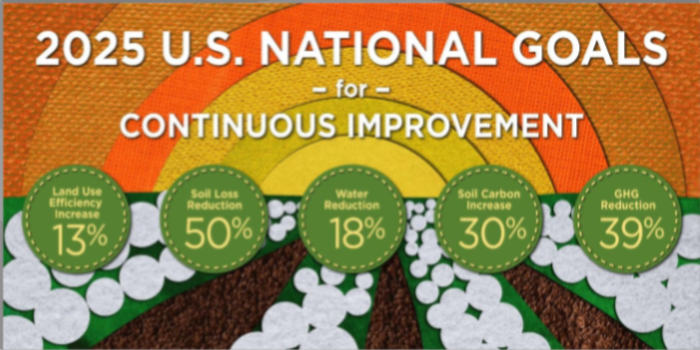
US cotton industry has always had a sustainability-focused approach and has one
of the most comprehensive systems for monitoring and measuring the key metrics
to reduce environmental impact. The 16,000 cotton farms in the United States
have been committed to continuous improvement for decades. For the past 35
years, US cotton production used less water per bale, reduced greenhouse gas
emissions, reduced energy consumption, all while reducing land use per bale.
Minimal tillage, GPS and sensor-driven precision agriculture and the growing of
winter cover crops are the practices adopted for improved soil health, reducing
loss and erosion and increasing soil carbon levels.

Previous ArticleRieter’s G37 meets all needs for efficient production
Next Article Datacolor launches benchtop spectrophotometer series

Related Posts

Applications now open for the next global cycle of the International Woolmark Prize

August 5, 2026

VisionSpring intervention boosts garment worker productivity by 6%, study shows

August 5, 2026

Filatex India Q1FY27 profit rises 21% to Rs 490 mn

August 3, 2026
Recent Posts
  • GHCL Textiles Q1 FY27 PAT jumps 191% to Rs 390 mn
  • Applications now open for the next global cycle of the International Woolmark Prize
  • Heimtextil expands bed, bath & living portfolio with ‘Comfort & Connect’ launch
  • VisionSpring intervention boosts garment worker productivity by 6%, study shows
  • The loom gets a laboratory
  • Industry leaders call for bold vision and global growth in Indian retail
  • How Trützschler’s CL-X is revolutionising cotton ginning and preparation
  • Filatex India Q1FY27 profit rises 21% to Rs 490 mn
Facebook X (Twitter) YouTube LinkedIn
  • About us
  • Contact us
  • Privacy Policy
  • Terms and Conditions

SISTER PUBLICATIONS

Construction World Equipment India Industrial Product Finder Infrastructure Today

© 2026 Indian Textile Journal. All Rights Reserved.

Type above and press Enter to search. Press Esc to cancel.