


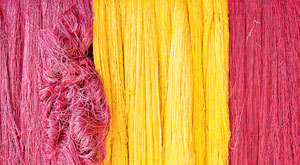
What are the dyeing process and the dyestuffs used for dyeing of silk hanks? M Das, S Basak, Kartick K Samanta, SK Chattopadhyay, S Das and P Pandit report elaborately on these aspects and also discuss practical problems and remedies in processing of silk hanks.
Silk, unlike other natural fibres, has special attributes of lusture, fineness, astheticness and it is one of the most important fibres in the textile and sericulture industry. Although silk is very famous, popular and useful in South American and European countries, however some of the industries of India and other sub-continental countries processed silk hanks, make attractive, costly fabric from it and most of them have been exported. Therefore for fulfilling the customer satisfaction and requirement all over the world, maintaining quality and quantity of silk fabric production is very important. However Indian silk industrial scarcity is due to the fact that they are suffering with many technical and quality-related difficulties to process silk hanks on a large scale.
Material
Silk yarns used in the industry
Different quality silk yarns were used in the industry. Details of the yarns are used for processing are given below.
- Filature…. 20/22 den, 2 ply (warp)& 40/44 den, 4 ply (weft)
- Doupian….. 120/122 den
- Noil
- Native
- Kora warp and weft
Machine used for processing: Hank degumming and dyeing machine are shown in Fig1
Degumming process of silk yarns
Silk is the only natural fibre filament. As per the structure is concerned silk contains around 70-76 per cent fibroin and 24-30 per cent sericin gum, fat and wax. Fibroin portion of the silk structure are centered, crystalline in nature and composed of protein û CONH group. Another part covered and protects the fibroin portion is amorphous gummy sericin layer. Actually sericin is soluble glycoproteins, consist of long chain carbon (C30H40N10O16), which hindered the absorbency of silk yarns. Therefore for improving absorbency and dye-uptake, degumming process was carried out. Soap, soda ash were used as main chemical in degumming recipe. Chemical dissolution of sericin glycoproteins is obtained partly by dispersion of neutral soap and partly by hydrolytic effect of alkali.
Filature quality degumming
- Stain removing agent….2gpl
- Fatty acid…………………..2 gpl
- Vegetable based soap….5 gpl
- Mild alkali ……………………2gpl (warp)/ soda ash…4 gpl (weft)
- Wetting agent…………….1gpl
Process
Warp quality filature silk hanks were degummed at 90¦ C for 30min and the degummed bath pH was maintained 9.5-10, whereas for the weft yarns degumming condition was 90¦C, 40 min and the amount of alkali used are 4 gpl with pH maintained as 10.5. As shown in the Fig 2 both the cases material: liquor ratio was maintained 1:17. After degumming cycle hanks are evaluated visually and finalised by hot wash and cold wash. Detailed of the process sequence are shown below.
As far the doupian and native silk qualities are concerned, degummed condition was maintained with 95¦C for 60 min. Here pH was 10.5 with soda ash. It might be due to the coarser count of the doupian yarn, which restricts the penetration of the chemicals inside the fibre of the yarn. More alkaline pH might help to swell the silk yarns and help to degum it.
Kora quality degumming
Kora is yet another attractive silk quality, which has not<