


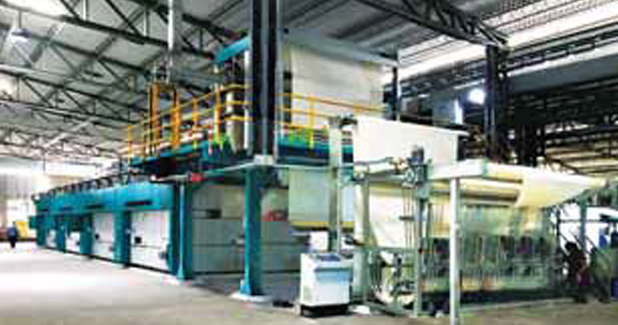
Menzel Engineering India’s “H-Control†Model H – 900 Hot Flue for drying after dye application combined with/without infrared pre-drying zone. Ecology and Economy are of greatest importance in present times, and their significance is very relevant for sustenance of textile industry. “H-Control†facilitates dyeing that would produce a simple, quick and economical, continuous dyeing process for cellulosic fibres and their blends with synthetic fibres with minimal chemical usage. The most significant and unique feature of this process is that it does not require separate fixation step, i.e., steaming, curing or dwell time, which is essentially associated with the conventional dyeing methods in practice.
Continuous dyeing process – H-Control:
Application Process – Dyestuff
H- Control (Pad Dry Humdifix) – Reactive
Pad Dry – Reactive, Vat, Disperse and Pigment
Pad Dry Thermofix – Reactive
Pad Dry Thermosol – Disperse / Reactive, Disperse / Vat
It is a continuous dyeing process, which fixes the reactive dyes onto cotton/cellulose fibres in one step by drying (humidifixing) in controlled steam /air condition. (It is a dry process only, pad steam process is avoided). The process can be summarised as under:
Pad àDry/Humidifix (two to three minutes at 110 – 130 degree Celsius under 25 to 30 per cent volume. Relative humidity – Steam injection) àWash off àDrying.
Comparison of different chemicals on H-Control vis-à-vis conventional dyeing methods for reactive colour.
H-Control:
- Dye liquor: reactive dyes, wetting agent (if required), anti-migrating agent (if required)
- Chemical liquor: Soda ash up to 10 gpl shade and soda ash + NaOH for > 10 gpl shade. (Concentration/dosage of alkali will be based on dyestuff manufacturer recommendation).
Conventional dyeing method(s):
Chemical liquor:
Pad dry pad steam process – 250 gpl salt
Pad dry thermofix -100 – 150 gpl urea
Pad batch – u pto 100 gpl urea and up to 110 gpl silicate
Thus, ecological/chemicals benefits of H-Control are:
- Salt is not required
- Sodium silicate is not required
- No urea in effluent or no urea fumes
Process advantage and fabric benefits:
- Reactive dyeing process is completed in two to three minutes at 110 to 130 degree Celsius
- Migration effects are minimised since dyes are fixed before fabric is completely dried
- Soft fabric handle since curing/baking for fixation (in case of pad dry thermofix process) produces harsher handle
- Better diffusion on regenerated cellulosic fibres viz: viscose/Tencel when compared with pad dry/pad cure process
- No batching sequences/processes, can avoid moiree effect (if any, observed on CPB process)
Mechanical benefits:
- Additional steamer is not required
- Batching/rotation station(s) are not required
- Versatile equipment (can be used for drying/fixing/curing/Thermosolising)
- Infrared dryer can be optional (may be required for heavy fabrics)
Chamber construction of H-Control:
- Uniform AirFlow (proper distribution of air in both upper and lower jet nozzles)
- Uniform temperature
- Very effective insulation (150 mm rock wool) to reduce thermal energy consumption
- Filter screens can be cleaned during machine operation, thus no downtime
Heating systems available:
- Steam
- Oil