


ITMF’s International Production Cost Comparison (IPCC) is designed to trace the implications of the growing capital intensity in the primary textile industry. This publication describes manufacturing and total costs of yarn/fabric broken down into various cost elements at different stages of the textile value chain. The 2018 edition adds the segment “Finishing†to the historical cost analysis in spinning, draw texturing, weaving, and knitting. For the first time also, the geographic coverage counts Pakistan and Bangladesh besides Brazil, China, Egypt, India, Indonesia, Italy, Korea, Rep Turkey, USA and Vietnam.
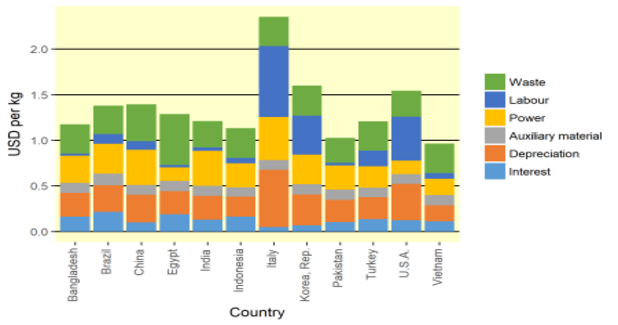
The goal of the report is to allow for a better appreciation of the relative importance of the cost elements and their respective influence on the total costs. In the category Spinning Ring/NE30 for example, the report shows that countries with high manufacturing cost (ie, in USD/kg of yarn, Italy = 2.35, Korea = 1.60, USA = 1.54) also have the higher share of labour cost (respectively 33 per cent, 27 per cent, and 31 per cent). The share of power in two of these countries, however, equals the sample average. It reaches 21 per cent in Italy and Korea and 10 per cent in the USA, a level comparable to that measured in Egypt.
Transforming this NE30 yarn in a woven ring yarn fabric shows a similar pattern in labour costs in Italy, Korea, and the USA but a different picture for power costs, where each country’s relative share to total manufacturing costs is now below sample average. The share of power drops to 17 per cent in Italy and Korea and 9 per cent in the USA, while the sample average rises at 26per cent. This average is driven up by Indonesia, India, Brazil, Pakistan, and China where the share of power cost to total manufacturing cost is between 30 per cent and 40 per cent. The data on the transformation of the same NE30 yarn in a knitted ring yarn fabric shows that the labour shares are equal to the of power shares in China, Brazil, and Egypt (ie, 20 per cent, 14 per cent, 6 per cent, respectively) and that labour is relatively more expensive than power in USA, Italy, and Korea (about 14, 8, and 4 times higher, respectively) or relatively cheaper in India, Bangladesh, and Pakistan (3, 3.5, and 4 times lower, respectively).
The report further presents the cost of transforming the former woven fabric into a finished woven fabric (Continuous Open Width). On average, the share of labour and power to total manufacturing costs in this category are very similar (13 per cent and 14 per cent, respectively). Strong geographical discrepancies nevertheless exist, especially with respect to labour costs with a spread of 14 cent/m. This reflects the difference in labour costs between Bangladesh (1 cent/m) and Italy (15 cents/m). The spread in power cost is measured at 4 cents/m, which corresponds to the difference between the cost of power in Egypt or Vietnam (ie, 3 cents/m (USD)) and in Brazil or Italy (ie, 7 cents/m (USD)).
The IPCC further covers the categories of Spinning Rotor/NE20, Texturing (75den/72F), Weaving Rotor Yarn Fabric, Weaving Textured Yarn Fabric, Knitting Rotor Yarn Fabric, Knitting Textured Yarn Fabric, Finishing – Knit – Continuous Open Width (COW), and Finishing – Knit – Discontinuous (JET).