

ITAMMA event highlights innovation push amid textile export challenges
With TEXFAIR as its platform, ITAMMA brought industry leaders together to emphasise innovation and employee empowerment as key pillars for the textile sector’s future.
Industry leaders called for innovation and workforce empowerment as key drivers for growth during the ITAMMA Awards (2024–25) held at Jenny’s Club in Coimbatore.
S Krishnakumar, MD, Sulochana Cotton Spinning Mills & Deputy Chairman, The Southern India Mills & Association (SIMA), highlighted the growing role of technology, stating that “the time has come to perform by way of innovation taking advantage of AI,” signalling a shift toward digital transformation in the textile machinery sector. Echoing the importance of human capital, D Venkadesan said that “true innovation comes from empowered employees,” stressing the need for organisations to foster a culture of ownership and creativity.
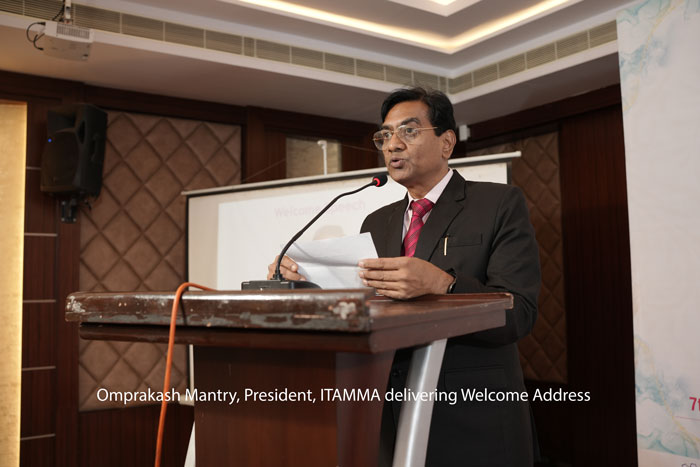
In his welcome address, ITAMMA President Omprakash Mantry highlighted the challenging global environment impacting India’s textile industry. He noted that geopolitical and economic uncertainties—including disruptions in the Red Sea, persistent inflationary pressures, and rising protectionist tariffs—have constrained exports, leading to reduced orders and tighter margins during 2025–26.
Mantry pointed out that textile exports to the US are projected to contract by 9–10 per cent in 2026 due to punitive tariffs, with key hubs such as Tirupur facing an estimated revenue loss of around Rs 150 billion. Additionally, the Red Sea conflict has escalated shipping costs, further slowing trade with major markets like Europe and the US.
Chief Guest, S Krishnakumar, MD, Sulochana Cotton Spinning Mills & Deputy Chairman, The Southern India Mills & Association (SIMA) delivered Chief Guest Address.
Despite these headwinds, India is targeting $100 billion in textile exports by 2030. The industry is leveraging China+1 strategies, newly signed Free Trade Agreements with the UK and UAE, and increased investments in sustainability to enhance competitiveness. A recently finalised 18 per cent tariff reduction with the US. and upcoming FTAs are expected to provide a boost against competitors such as Bangladesh and Pakistan.
The sector is also diversifying its markets while focusing on value-added and eco-friendly products to meet evolving global standards, particularly in the European Union. Government initiatives, including production-linked incentives (PLI) and infrastructure upgrades, are being rolled out to strengthen manufacturing capabilities.
While India currently holds around 4 per cent of the global textile market and experienced an export dip in 2024, the long-term outlook remains positive, supported by strong domestic demand and shifting global sourcing trends. Analysts expect modest growth for the sector in 2026
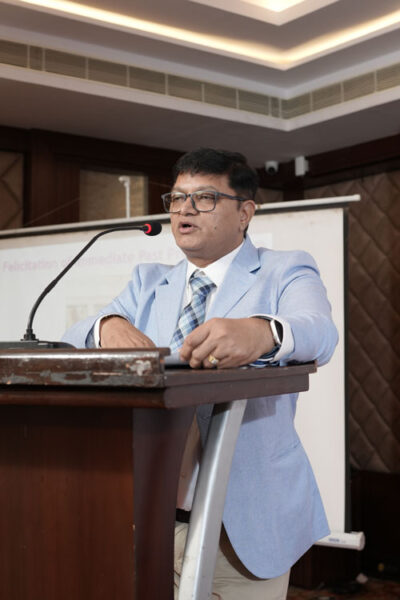
Farewell Speech delivered by Bhavesh Patel, immediate Past-President, S Krishnakumar said, “On behalf of the entire textile industry particularly the textile industry in South India, I highly appreciate the yeomen services provided by the textile machinery manufacturers, spares and accessories manufacturers and suppliers, especially the Members of ITAMMA and the services provided by ITAMMA to its Members since 1948. On behalf SIMA and the entire textile industry, I admire the dedicated leadership and contributions made by the Immediate Past President of ITAMMA, Bhavesh Patel. His expertise, involvement and advice should continue as the Past President not only to ITAMMA but also to the industry. I congratulate and compliment the recipients of Awards in today’s function.
I appreciate the awards committee of ITAMMA for thinking innovatively and bringing several awards based on the contributions made by each-manufacturing unit and recognising every year. In my opinion I don’t think any other organisation will be having so many award categories, notably Make in India, Recognition of patterns, export excellence award in each segment and also overall export performance etc., are some of the unique initiatives of ITAMMA that would constantly drive and motivate the industrial units to improve their performance and become a lead player in each area.
Friends yesterday at the inaugural function of TEXFAIR there was a mention about the continuous recession being faced by the Textile Industry and its impact on the Textile Machinery and its spares and accessories manufacturers and suppliers As rightly mentioned by the Presidents of ITAMMA and TMMA, in my opinion, the Indian Textile Industry has totally come out of the bad period and the industry is poised to achieve double digit growth rate in a short span of time. The Ministry of Textiles has envisaged attracting USD 100 billion by 2030. In order to make it a reality, the union budget 2026-27 has announced 5 Mega Schemes apart from announcing Mission for cotton productivity in the previous budget and boldly addressing several structural issues like removal of Anti-Dumping duty on all MMF raw materials, slotting entire MMF value chain in 5 per cent GST slab and concluding 3 Mega FTA agreements with UK US and EU. In addition, PM Mitra Park Scheme PLI Scheme, NTTM Scheme etc., would also accelerate the investments and global competitiveness of the Indian Textile Industry.
Therefore now the time has come to perform by way of innovation taking advantage of Artificial Intelligence and other modern technologies and make India to become the Global Leader in Textiles and clothing manufacturing.
With these few words I once again thank the organisers for providing me an opportunity to participate in this memorable event.”
Guest Speaker- D Venkadesan, CEO, Sri Jayajothi and company, Rajapalayam made his presentations on “Innovation is Not Technology – It is People”
