


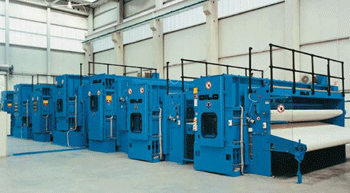
As the leading specialist DILO offers a complete production range for all needle looms with all working widths, stroke frequencies, needle densities and needling technologies.
Within the DI-LOOM model series the DI-LOOM S machines are used for needling at higher speed. Of course, DILO sets the trend towards improved productivity by increasing the stroke frequency, needle density and the through-put.
In connection with our feeding systems CBF, CBF T, ZBS the machines of the DI-LOOM S model series are even suitable for pre-needling.
The model series DI-LOOM S comprises various different types, which meet all technological requirements. All kinds of needling, needling from top, from bottom or from both sides, with one, two or four needle boards.
To produce felts with minimum draft, a DI-LOOM S or SB machine used as a pre-needler has optimised cross-sectional forms of stripper and stitching plates. The stripper plate has outlets in the direction of the material flow through which the fibre fly is able to pass easily to improve dedusting by making use of the air flow caused by the needle beam. Upon request the needle looms of the DI-LOOM S model series may be equipped with a de-dusting device DI-DUST to prolong the cleaning intervals.
As a special accessory the quick release clamping system is also available for stripper and stitching plates to improve accessibility for cleaning of the drillings. For machines with two or more boards the penetration depth and stripper plate gaps may be adjusted individually. The final position is controlled electrically to avoid damage by displacement.
In contrast to the DI-LOOM model series the parts of the machine frames of the DI-LOOM S and DI-LOOM SB model series are even stiffer to provide sufficient protection against vibrations. A larger number of eccentric modules support the needle beams in smaller distances.
The machines of the DI-LOOM S and DI-LOOM SB model series are renowned for highest stability and being virtually free of vibrations.
Feeding system and pair of draw-off rollers are assemblies standing separately, which are fixed to the ground independently from the machine frame. They carry the safety guards which are closed mechanically and controlled electrically. The safety guards also serve to reduce the sound emission.
The pressure rollers on the pair of feeding rollers and the pair of draw-off rollers are controlled pneumatically and can be adjusted precisely to the thickness of the material.
The needle loom itself is mounted on spring elements and vibration is not transmitted to the floor. The machine does not require any foundation and can be put onto the industrial floor.
Standard working widths range from 1.5-7 metres, rising in 0.5 metre increments. Depending on the stroke length, stroke frequencies of up to 2,000 strokes per minute are achieved. Thus, the machines of the DI-LOOM S and DI-LOOM SB series vary from the slower DI-LOOM model series with stroke frequencies of up to 1,200 strokes per minute, meet the requirement for high productivity of standard machines for the consolidation of flat needle felts. Highest stroke frequencies exceeding 3,000 strokes per minute are achieved by the DI-LOOM SC model series.
The needle beam is made of a high-strength, bending and torsion resistant aluminium profile. To avoid steps with differences in the penetration depth between parts of the needle board, which would result in tracking marks in the material, the needle beam consists of one piece up to a working width of 7 m.
The pneumatic quick release clamping system allows an exchange of the needle board within one minute, as it can be released and removed, sliding like a drawer. A positioning pin adjusts the board quickly and correctly so that the needles are centred towards the edge of the holes. Fast exchanges of the needle board avoid longer, cost intensive machine down