


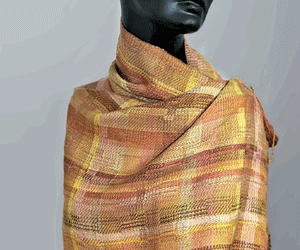
Dyeing regenerated cellulosic materials is not done in a straightforward one-step process, says Alkesh Darji, who describes the various key stages in the dyeing of regenerated cellulosic materials and reviews the likely problems/concerns being faced at each stage.
Wet processing engineering is one of the major streams in textile engineering referring to textile chemical processing engineering and applied science. The other three streams in textile engineering are yarn manufacturing engineering, fabric manufacturing engineering and garments manufacturing engineering. Wet process is usually done on the manufactured assembly of interlacing fibres, filaments, and/or yarns having substantial surface (planar) area in relation to its thickness, and adequate mechanical strength to give it a cohesive structure. In other words, wet process is done on manufactured fabric. The processes of this stream are involved or carried out in aqueous stage and thus it is called wet process which usually covers pretreatment, dyeing, printing and finishing.
The global textile market has been growing year by year at a drastic rate, but the cotton supply has not increased at a similar rate. This creates a gap between demand and supply in the supply chain. The gap can only be filled by regenerated cellulosic fibres due to their natural origin and similar properties. This fact is being reflected in recent market trends of consumption of regenerated cellulosic fibres. Viscose, Modal and Excel, the commercial names of regenerated cellulosic fibres, ie, Viscose, High Wet Modulus and Lyocell, are products of Birla Cellulose of the Aditya Birla Group. The raw material used to make these regenerated fibres is wood pulp. This is sourced from harvested trees and is, therefore, a renewable resource. Regenerated cellulosic fibres absorb moisture and are fully biodegradable. The comparative properties of regenerated fibres with cotton fibre are summarised as follows:
Regenerated cellulosic fibres are the backbone of the world´s textile trade apart from cotton. They have many qualities and countless end uses, which make them one of the most abundantly used textile fibres in the world. However, these fibres are very sensitive compared to the synthetic fibres as far as their general wet processing or dyeing is concerned. Quite frequently, the critical concerns in dyed materials are not due to the actual dyeing process but due to some latent defects introduced from previous production and processing stages. Often, the root-cause(s) of a problem in the dyed material can be traced. This monograph will address critical concerns in the dyeing of regenerated cellulosic textile materials in fabric form.
Concerns in dyeing with reactive dyes and direct dyes
Reactive dyeing
Reactive dyes are one of the most commonly used application class of dyes for regenerated cellulosic materials. Two important aspects of reactive dyeing, namely, dye variables and system variables., are discussed in this section, along with important characteristics of reactive dyeing such as exhaustion, migration and leveling, fixation and colour yield, and washing-off and fastness. A significant portion of this section also deals with the concerns of the reproducibility and difficulties in obtaining right-first-time dyeing.
Dye variables in reactive dyeing
The major dye variables that affect reactive dyeing are dye chemistry, substantivity, reactivity, diffusion coefficient and solubility. Each of these will be briefly discussed below.
Dye chemistry: Reactive dyes have a wide variety in terms of their chemical structure. The two most important components of a reactive dye are the chromospheres and the reactive group. The characteristics govern