


A challenge for yarn clearers
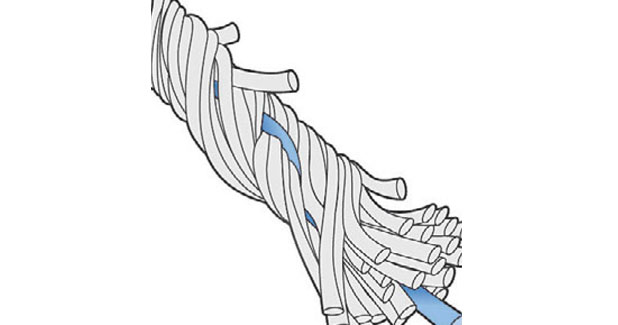
Core yarns, which are used for woven and knitted stretch fabrics, consist of at least two different components.
Stretch fabrics become more and more popular in clothing industry. Not only sports fashion but also day-to-day garments have a better fit and retain their shapes, when elastic yarns are used. The so-called core yarns, which are used for stretch fabrics, are a challenge for the textile industry. For example during yarn clearing, which eliminates yarn faults during winding, faults in core yarns have to be detected very reliable. Optical yarn clearers, like the Zenit+ from Loepfe, offer the superior method for this application.
Garment made of elastic yarns offer a better comfort, they fit better, and retain their shapes. Core yarns, which are used for woven and knitted stretch fabrics, consist of at least two different components.
During production a staple fibre ´ e.g. cotton ´ is spun around an elasthane filament. Today, duo-core yarns made of three components, which are used for high quality denim, are a challenge for the spinning and winding process.
Clearing of core yarns
The structure of core yarns is a special challenge during quality control. One of the typical faults is the so-called strip-back. Due to a slippage between the inner elasthane filament and the staple fibre the core is not completely covered with the cotton fibres. As elasthane and cotton have different characteristics during dyeing, these faults can become visible in the end product. The yarn clearer Zenit+ from Loepfe with the optional LabPack is able to identify these faults very reliably. The yarn clearer utilises an optical method to identify thin and thick faults during winding.
The detection of dark foreign fibres is also realised with an optical method. An additional triboelectric sensor detects synthetic foreign matter, e.g. polypropylene originating from packaging material.
Superior optical method
Due to its optical method the Zenit+ guarantees a fast and reliable detection of typical yarn faults. Even the above-mentioned faults in core yarns can be identified. This gives the Zenit+ an advantage compared to capacitive yarn clearers, which basically detect only the overall mass of the yarn. The Zenit+ can also monitor the splicing joints resulting in yarns with only perfect splicing joints. The yarn clearer monitors every single splicing joint and classifies them. The classification enables the monitoring of the splicing process itself, and thereby identifies splicers, which are permanently producing non-optimal splice joints.