


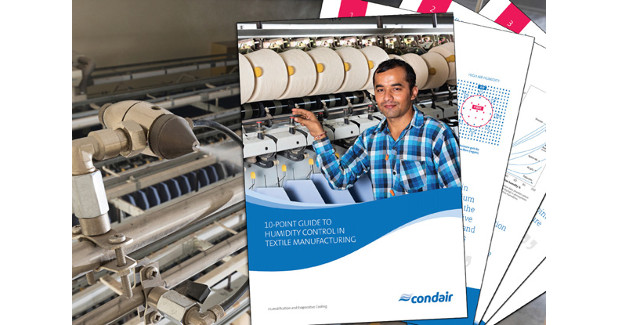
Condair’s easy-to-follow 10-point guide helps production managers understand the impact of air humidity on textile processing and a best practise approach to managing it.
The guide is free to qualifying individuals and
can be obtained from the company’s website at
www.condair.co.in/textileguide.
Every textile is affected by the relative humidity of the environment in which it is produced, particularly natural fibres. Low air humidity can dry a fibre causing its internal moisture content to fall below the optimum processing level. When this happens, a fibre’s tensile strength is impaired, it becomes less flexible and more brittle.
This causes an increase in thread breaks during processing, leading to machinery needing to be manually rethreaded, machine downtime and reduced efficiency. This tying-off during weaving increases loom stop marks, resulting in a lower quality fabric. Drier fibres during spinning causes a higher hairiness of the yarn, lower strength and a low pilling resistance. This all contributes to a reduced market value for the end product.
Alongside these issues, a low relative humidity can reduce yield by around 4 per cent directly from product weight loss. A 4 per cent drop in moisture content will require 4 per cent more product to be manufactured to meet a required production weight.
Condair’s 10-point guide to humidity control in textile manufacturing explains how to avoid problems such as these by correctly managing humidity levels across a complete textile facility. Production managers can learn how to determine what the correct relative humidity ought to be for different types of textile and manufacturing process. The guide presents how this level of air humidity can be precisely achieved across a factory and how much moisture will need to be added to the air to maintain it. Other issues tackled in the guide include how to successfully combat electrostatic and reduce airborne lint and fly.
As a global leader in humidification technology, Condair has developed successful humidity control strategies for textile manufacturers around the world. This document presents some of this experience in an accessible and concise format.
The Condair Group is the world’s leading specialist in humidification and evaporative cooling, with energy efficient, hygienic and innovative technologies for commercial, industrial and heritage applications. Condair is represented in India by Regent Machine & Servicing, which offers system design, manufacture, supply, installation, commissioning, maintenance and spares. Find out more by visiting the company’s website:
www.condair.co.in.
Humidification specialist, Condair, has produced a 10-point guide for textile manufacturers looking to enhance their productivity through better management of air humidity. Evaporative losses from fibres during textile processes such as spinning, carding, winding and weaving can cause a manufacturer many issues. Condair’s easy-to-follow 10-point guide helps production managers understand the impact of air humidity on textile processing and a best practise approach to managing it.
The guide is free to qualifying individuals and
can be obtained from the company’s website at
www.condair.co.in/textileguide.
Every textile is affected by the relative humidity of the environment in which it is produced, particularly natural fibres. Low air humidity can dry a fibre causing its internal moisture content to fall below the optimum processing level. When this happens, a fibre’s tensile strength is impaired, it becomes less flexible and more brittle.
This causes an increase in thread breaks during processing, leading to machinery needing to be manually rethreaded, machine downtime and reduced efficiency. This tying-off during weaving increases loom stop marks, resulting in a lower quality fabric. Drier fibres during spinning causes a higher hairiness of the yarn, lower strength and a low pilling resistance. This all contributes to a reduced market value for the end product.
Alongside these issues, a low relative humidity can reduce yield by around 4 per cent directly from product weight loss. A 4 per cent drop in moisture content will require 4 per cent more product to be manufactured to meet a required production weight.
Condair’s 10-point guide to humidity control in textile manufacturing explains how to avoid problems such as these by correctly managing humidity levels across a complete textile facility. Production managers can learn how to determine what the correct relative humidity ought to be for different types of textile and manufacturing process. The guide presents how this level of air humidity can be precisely achieved across a factory and how much moisture will need to be added to the air to maintain it. Other issues tackled in the guide include how to successfully combat electrostatic and reduce airborne lint and fly.
As a global leader in humidification technology, Condair has developed successful humidity control strategies for textile manufacturers around the world. This document presents some of this experience in an accessible and concise format.
The Condair Group is the world’s leading specialist in humidification and evaporative cooling, with energy efficient, hygienic and innovative technologies for commercial, industrial and heritage applications. Condair is represented in India by Regent Machine & Servicing, which offers system design, manufacture, supply, installation, commissioning, maintenance and spares. Find out more by visiting the company’s website:
www.condair.co.in.