


Compressed air is the most inefficient utility available to the industries, wasting as much as 80 per cent of the compressor’s input energy in various forms of loss. A compressor’s energy costs exceed its capital cost just within a few months of operation and hence if the facility’s compressed air system is not monitored closely it can lead to substantial losses. True to the famous saying, “If you can’t measure, you can’t improveâ€Â, proper measurement of compressed air generation, distribution and end uses can open up a box of opportunities for improvements and energy savings.
Can a factory be operated without knowing the quantity of products produced or delivered? If this sounds silly, ask the same question about your factory’s compressed air system. Do you know the actual quantity of compressed air produced by your compressors? Or do you know what is the real demand of your production machines? Leaving out the exorbitant safety margins that are considered when the system was designed.
What to measure?
Compressed air systems cannot be managed if they cannot be measured. Important measurements and calculations include those of:
• Flow (CFM) • Pressure (psi) • Power (kW) • Energy (kWh) and • Rupees
It is important to invest in, or rent, accurate, reliable equipment that meets the needs of what is to be accomplished. Training in the use of the tools is necessary for successful measurement of compressed air system performance and safety precautions need to be taken. Alternately, you can work with an independent organisation that has no intention to market capital equipment but has the necessary equipment and experience.
Measuring flow: To begin with, the compressor’s actual output has to be measured along with its energy consumption, to evaluate the real specific energy consumption of the compressor. Most of the times these measurements indicate the need for servicing to get the compressor’s rated delivery. Remember, an inefficient compressor can cost you heavily in energy costs. Having a regular check on the compressor efficiency can avoid the need to purchase additional compressors and can result in high energy savings.
Tools required: Thermal mass flow meter that compensates for pressure and temperature variations. Flow should be measured during various shifts and after performance improvement measures are implemented. Measuring flow will give key information on how much air a compressor is providing. Flow measurements can also show how much air an end use is consuming. If flow is reduced, sometimes a compressor can be turned off. Measuring pressure: Pressure measurements need to be taken to give feedback for control adjustments, determine pressure drops across components and determine system operating pressures.
Tools required: General industrial pressure sensors with +/- 0.5 per cent full scale accuracy and 0-16 bar range can be used. High accuracy pressure sensors when connected to data loggers can result in a series of measurements over time at a point in the system. Taking a measurement and establishing a point of reference is important for comparison after improvements are made in the system.
Measuring power and energy: By measuring power, the energy consumption and cost of operating a compressed air system can be estimated.
Power = The rate at which work is done, commonly measured in units such as kilowatt (kW) and horsepower (hp).
Energy = The amount of power applied over a period of time, measured in units of kWh.
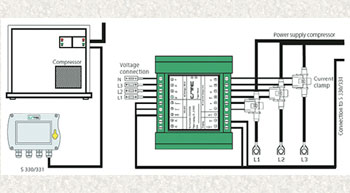
Tools required: The power meter should measure the actual power consumption in kW and accumulate the energy consumption in kWh of three-phase load. Additionally other parameters such as current, voltage, cos phi, etc. should be measured as well. Data logging of flow along with power and energy with reliable data loggers would help understand the specific power consumption of the compressors.
Assessing the cost of compressed air in rupees: Money spent on energy is calculated by converting kWh to rupees. Once compressed air energy use/saving is calculated (in terms of kWh), dollars can be estimated using average Rs/kWh rates, or more complicated calculations can be made using actual electricity rates, which probably include energy charges, demand charges, ratchets, on-peak/off-peak rates, seasonal variations, etc. You need to understand your electricity rate structure, your electricity bill and how the compressed air system is impacting the bill. Calculations on how much is spent on compressed air should always be tied back into production by calculating rupees spent on compressed air per unit of production.
The article is authored by Hidhay K, Managing Director – Asia Pacific, Systel Energy Solutions (India) Pvt Ltd. He can be contacted at: hidhay@systel.asia.