Close Menu
Indian Textile Journal
  • Home
  • Textile Machinery
    • Allied Equipment and Accessories
    • Automation
    • Dyeing, Processing & Finishing
    • Knitting
    • Printing
    • Spinning
    • Weaving
  • Tech Textiles
  • Sustainability
  • Resources
    • Trade Fair
    • Events
    • Videos
  • Interview & Opinion
  • Subscribe Now
  • Advertise
  • Digital
  • Apparels & Garments
  • Fibres & Raw Materials
  • Home Textiles
  • Industry Update
Facebook X (Twitter) YouTube LinkedIn
Indian Textile Journal
Epson
  • Home
  • Textile Machinery
    • Allied Equipment and Accessories
    • Automation
    • Dyeing, Processing & Finishing
    • Knitting
    • Printing
    • Spinning
    • Weaving
  • Tech Textiles
  • Sustainability
  • Resources
    • Trade Fair
    • Events
    • Videos
  • Interview & Opinion
  • Subscribe Now
  • Advertise
  • Digital
  • Apparels & Garments
  • Fibres & Raw Materials
  • Home Textiles
  • Industry Update
Indian Textile Journal
Home » B&R’s Blackout mode enables high machine availability
Spinning

B&R’s Blackout mode enables high machine availability

By March 1, 20202 Mins Read
Share Facebook Twitter LinkedIn WhatsApp Copy Link


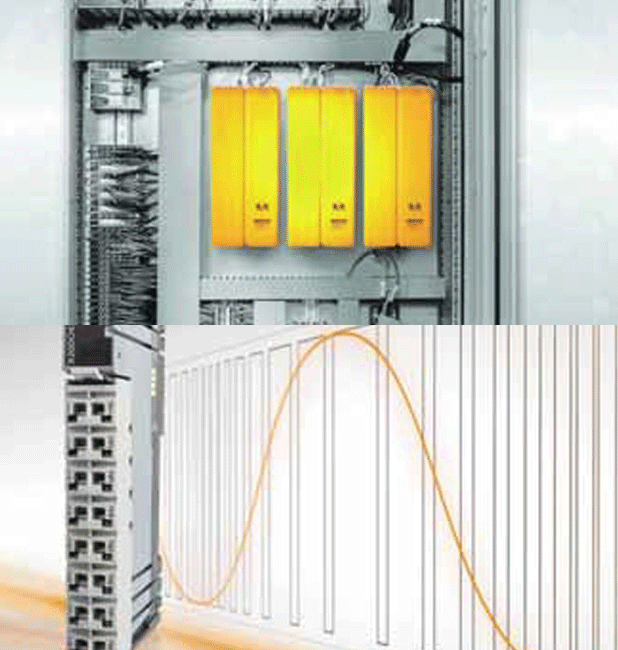
The B&R drive technology portfolio now offers a Blackout mode that ensures safe machine control in the event of a network failure. Machine downtime can be avoided without costly redundancy solutions to ensure maximum machine availability.

The Blackout function enables the safe variants of B&R servo drives (ACOPOSmulti, ACOPOSmotor or ACOPOS P3) to continue operation in the event of a network failure. Safety functionality remains intact.


Blackout mode allows configuration of simple safety sequences. Applications in lower-level systems continue execution even after a network failure. For example, axes can be brought to a stop or moved to a defined position.

B&R introduces new digital output module with pulse width modulation


B&R’s new digital output module X20DO4332-1 has integrated pulse width modulation and is a cost-effective alternative to motor modules. In addition, the module offers a dither function that prevents valves from sticking.


Pulse width modulation (PWM) is mainly used for controlling larger loads, such as motors. Instead of using electronics to regulate a continuous input voltage down to the desired motor voltage, the motor is controlled by the width of the switching pulses. This process saves a considerable amount of energy.


With its dither function, the module also prevents valves from sticking. This is particularly common when valves are held for extended times at a constant position, especially in liquids. The dither function oscillates the valve slightly around the position setpoint to prevent it from sticking. The X20 module is equipped with four outputs with three-wire connections and offers a nominal output current of 2 A.


B&R is an innovative automation company with headquarters in Austria and offices all around the world. On July 6, 2017, B&R became a business unit of the ABB Group. As a global leader in industrial automation, B&R combines state-of-the-art technology with advanced engineering to provide customers in virtually every industry with complete solutions for machine and factory automation, motion control, HMI and integrated safety technology. With Industrial IoT communication standards like OPC UA, POWERLINK and openSAFETY as well as the powerful Automation Studio software development environment, B&R is constantly redefining the future of automation engineering. The innovative spirit that keeps B&R at the forefront of industrial automation is driven by a commitment to simplifying processes and exceeding customer expectations.

Previous ArticleWith automation solutions, Saurer takes next step toward automated factories
Next Article Industry should focus on long-term goals

Related Posts

Rieter transforms with major man-made fibre acquisition

July 17, 2026

Seven years of proven performance: Consistent effluent quality, stable flux & permeability, and exceptional operational reliability

June 25, 2026

From Waste Fabric to New Yarn: Why Material Origin Matters in Textile Recycling   

June 23, 2026
Recent Posts
  • CMAI’s 83rd National Garment Fair sets record with 48,500 trade buyers
  • Myntra integrates AI throughout customer discovery, seller onboarding, and product development
  • Rieter transforms with major man-made fibre acquisition
  • Chhattisgarh secures Rs 9.73 bn in new textile investments
  • Karl Mayer’s RJ 4/2 EL redefines body mapping and creative design
  • Vector Consulting Group launches report on how ecosystem reform could add $7 bn to India’s garment exports
  • TechnoSport expands logistics footprint with new 64,000 sq ft facility in Hosur
  • Woolmark showcases innovation and sustainability in Indian Textiles at Bharat Tex 2026
Facebook X (Twitter) YouTube LinkedIn
  • About us
  • Contact us
  • Privacy Policy
  • Terms and Conditions

SISTER PUBLICATIONS

Construction World Equipment India Industrial Product Finder Infrastructure Today

© 2026 Indian Textile Journal. All Rights Reserved.

Type above and press Enter to search. Press Esc to cancel.