

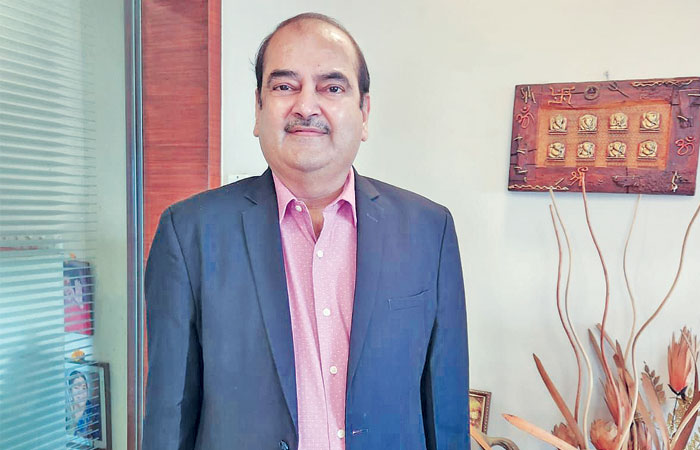
Avinash Misar: High performance fibres need pilot plants and not lab scale R&D
As India accelerates its push into technical textiles, the real test lies in moving beyond mid-stream strengths to master high-performance fibres and advanced materials that underpin global competitiveness. In this in-depth conversation, Avinash Misar, Director, Texport Syndicate and Past Chairman, ITTA, speaks to Divya Shetty about India’s position in the global technical textiles value chain—highlighting progress, persistent import dependencies, structural barriers in upstream manufacturing.
How would you assess India’s current position in the global technical textiles value chain, particularly in high-performance segments such as aramids, composites, carbon fibre and specialty nonwovens? Where are we still largely import-dependent?
Technical textiles sector in India is the fastest growing segment in textiles. The market forecast and the targets expected by the Ministry of Textiles, GoI is a very strong indication of the growth story in India.
The country is strong in the mid and downstream technical textiles products in the area of agro textiles, geo textiles, protective textiles, speciality industrial fabrics, medical / hygiene non-woven textiles, and few others.
The growth in Indian technical textiles is mainly from mid-stream and downstream technical textiles product. However for upstream high performance products like para-aramids, meta aramids, speciality polyester, carbon fibre and high end speciality non-woven / resins. India is largely import dependent, as domestic capability is at pilot / ideation stage.
Our downstream composite industry is competent and many Indian SME and large players make carbon composite parts for automotive, sports, defence, aero components, thereby contributing value addition. These also include firms doing moulding, CFRP part production and R&D.
We are largely import dependent on para aramid fibres, which are used significantly for ballistic, industrial and speciality uses. India is fastest growing buyer of these fibres and supply is dominated by global producers namely – Hoysung, Teijin, DuPont and the likes. Similarly, carbon fibre is relied on imports from USA, Europe, Japan, Korea.
High performance resin systems and speciality chemicals namely advanced epoxy, prepregs, high temperature resins and so on are typically important. This unavailability constraints top end composite systems performance and certification.
Despite strong domestic demand and policy support, why have most Indian players remained concentrated in commodity or mid-value technical textiles? What are the key structural barriers—technology, R&D, scale, capital, or skills?
The Indian players remain concentrated in the commodity and mid value technical textiles for the primary single most reason of technology and IP barriers.
Para aramids, carbon fibre, all require proprietary polymer chemistry, processed control, know-how, patents and all this are controlled by the global leaders through IP by protecting through IP the trade secrets, processes, supplier lock ins.
In the scenario as above, despite Indian firms capability to replicate processes, the industry is not able to progress in maturing up in the upstream manufacturing activities of speciality fibres. It also goes without saying that the licensing from incumbents is prohibitively expensive, even if available.
It is significant to note that high performance fibres need pilot plants and not lab scale R&D.
Continuous production testing and failure tolerant iterations is the key. Hence, this is an area of Government Industry joint projects / defence funding projects, which support end to end irreversible non stop funding with an appetite for long gestation.
This scenario does not fit in the financial expectations of an investor, where long gestation is absolutely a NO.
The risky upstream bets is hence not a cup of tea for the industry by and large. Multiple other challenges like advance skill shortage, demand pull, etc. also play a key role.
How adequate is India’s R&D, testing and certification ecosystem for developing high-end technical textiles that meet global standards? What gaps must be addressed to shorten product development and approval cycles?
Our adequacy of R&D, testing and certification Eco system for high end technical textiles is much lower as compared to global leaders. However, for mid value technical textiles, we are better off.
We lack globally competitive fast track certifications of aramids, carbon fire systems, advanced composites and other speciality fibres. The gap is not in the basic research, but in pilot scale infrastructure, accredited testing depth, certification harmonisation and integrated qualification path ways, resulting inadvertently long duration delay of development cycles in India.
Despite the great work done in the DRDO, CSIR & IIT to generate knowledge and prototypes, most R&D stops at lab scale.
The bottom line which drives is that India does not lack scientific capability in technical textiles however it lacks globally competitive bridge between lab discovery and certified industrial product.
Only pilot scale validation, deep testing and quick harmonised certification will get India moving in high end technical textiles.
Do initiatives such as PLI, NTTM and PM MITRA Parks sufficiently encourage investments in advanced materials and processes, or does moving up the value chain require a different policy and industry collaboration model?
The growth of technical textiles has been supported incredibly the ministry of textiles, govt. of India, with initiatives such as PLI, NTTM & PM Mitra Park.
All the above initiatives and interventions have been excellent to scale production, where technology already exists.
PLI has been a great accelerator, NTTM had been a great enabler and PM Mitra has been a wonderful platform. It is indeed a great boon for the growth of technical textiles.
With time as we move ahead in technical textiles, creating upstream capabilities in advanced fibres, polymers and processes. As well moving into aramids, carbon fibre, aero space composites and other speciality fibres, we require a mission driven, risk sharing, defence and OEM anchored collaboration model.
The key difference of advanced materials will always be that it is seen as capability driven, break through processes, activity of national importance, and mission based with rightful gestation period.
Looking ahead, what strategic shifts—technology partnerships, skill development, backward integration, or global collaborations—will be essential for Indian manufacturers to compete with China, Europe and the US in high-value technical textiles?
Finally, forward looking strategy is India to compete high value technical textiles with a capability and mission mind set dwelling on deep technology partnerships with backward integration into fibres, precursors and resins.
The next decade India will have to do structural repositioning of industry, policy and capital as required.
The focus will have to be break IP barriers, enable execution, de risk investment and sustain long cycles.
Our competence to produce industrial plus defence grade carbon fibre, para aramid with global certification and exporting these materials globally would be the final success.
