


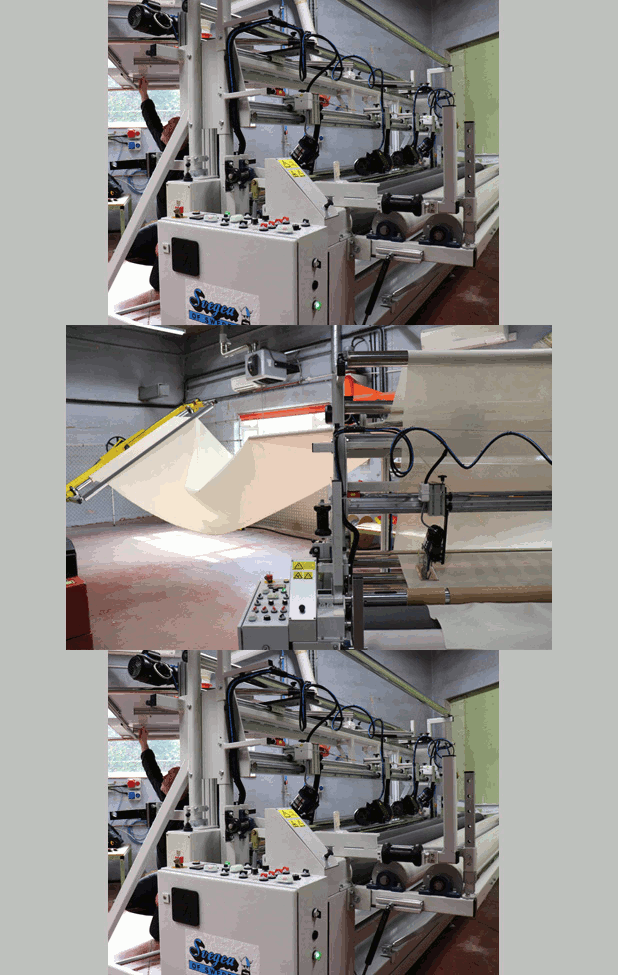
Arville Textiles has recently taken delivery of a new wide-width bias cutting and winding line in order to meet the demand for advanced technical textiles that are employed in a range of components by the aerospace and automotive industries.
The line is being supplied by Svegea of Sweden, a member of TMAS, the Swedish textile machinery association.
Bespoke products
Privately-owned Arville, which is headquartered in Wetherby, West Yorkshire, UK, is currently going from strength-to-strength in the supply of bespoke products for specialised markets, based on its long-standing and highly-integrated expertise in design, circular and flat weaving, coating and fabrication, at five plants in the north of England.
“We have achieved a 30 per cent increase in turnover over the past three swiss replica watchesyears and we are on track to achieve a further 10 per cent growth this year, despite the uncertainty that Brexit is causing for us here in the UK,†says Arville’s head of marketing Andy Smith. “We are building on this success with a solid investment programme that has seen the installation of new weaving looms, warping equipment and a new finishing stenter, as well as the new bias cutting and winding line from Svegea.
†Originally founded back in the 1950s as a weaver of heavyweight cotton fabrics for uniforms for the public transport services industries in the UK, Arville has been training its focus on niche and highly-specialised technical textile applications since the advent of synthetic fibres.
Today, it supplies bespoke fabrics to over 50 countries, with its major customers involved in manufacturing high performance products and components for the aerospace, automotive, medical, filtration, personal protection and industrial sectors.
“Our approach is always to determine exactly what customers require in terms of performance and function, by exploring all the potential parameters in respect of weight, tensile strength, chemical and thermal resistance, etc.,†says Smith.
“The aim is to design something that meets the customer’s needs exactly. We enjoy a challenge so the more complex and demanding it needs to be, the more we can leverage our technical expertise. We cast a very exacting eye over the manufacturing process, ensuring that ISO processes are applied throughout, with stringent quality assurance checks to back this up. Our integrated approach of design, weaving, coating and fabrication makes us unique in the UK.â€Â
From apparel to technical
By coincidence, Svegea of Sweden was founded around the same time as Arville, and now has over 60 years of experience in exclusively designing, manufacturing and installing the highest quality collarette and band cutting machines, as well as other specialised systems such as the new installation at Arville.
Svegea’s cutting machines have traditionally been employed to make components for apparel such as waistbands, cuff and neck tapes and other seam reinforcements, but increasingly, the emphasis has been on products for technical end-uses.
The special bias cutting machine which is being installed at Arville is based on an ingenious system in which circular woven materials are fed to the cutter via a revolving winder and slit at angles, so that both the warp and weft of the weave are skewed at specified angles rather than just in the vertical and horizontal directions, as is usual.
This allows the slit fabrics to drape and form much more easily to the complex shapes of components such as circular rubber hoses and special diaphragms and seals which are employed in the aerospace and automotive industries, and for which they act as critical reinforcements.
“Our ability to produce tubular fabric which is cut on the bias allows us to provide textiles which not only have improved drape and elasticity properties for complex and intricate shapes, but also offers ways to reduce our customers’ production costs by eliminating unnecessary wastage from the manufacturing process.†says Andy Smith. “Pre-cutting the fabric to a specific bias reduces extra handling of the fabric in further processes, saving our customers both valuable production time and costs.â€Â
“This is a much bigger and wider bias cutter than we usually supply, but it’s a good example of the number of specialised machines we are now installing in Europe where we are definitely experiencing a boom,†adds Hakan Steene, managing director of Svegea of Sweden. “Even in our traditional area of collarette machines for apparel making up, Industry 4.0 is seeing new business arise in developed markets where for many years it has been uncompetitive.â€Â
“Svegea continues to find major niche markets for its advanced cutting systems which go way beyond their original intended purpose,†says TMAS Secretary General Therese Premler-Andersson. “The company is a great example of the TMAS attitude of being always open to new ideas and applying fresh thinking based on many years of engineering know-how.â€Â