


India has shown that mask mandate in the country has helped with reducing the number of daily COVID-19 cases, says, Prof Seshadri Ramkumar.
Face masks play a valuable supportive role in the fight against COVID-19 and air pollution.
Recent collaboration between our team from the Nonwovens & Advanced Materials Laboratory, Texas Tech University and an undergraduate student from Bengaluru, India has shown that mask mandate in India helped with reducing the number of daily COVID-19 cases.
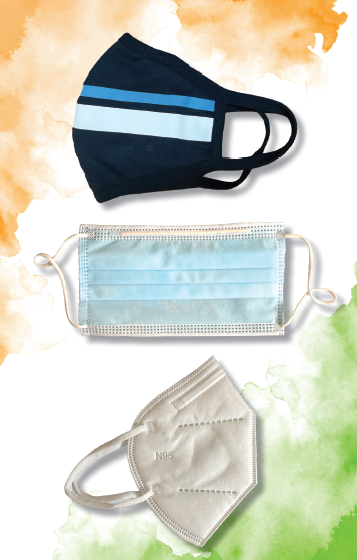
Cotton face coverings, surgical masks and N95 types are being used by public in India.
The work did not isolate the influence of different type of face masks as there were no specific data available on this aspect. Public uses different face masks depending on the availability and choice.
Building on over two-decades of outreach effort to promote the technical textiles sector in India, during this past summer, I enticed, Shreyas Ganesh, a computer science major from PES University, Bengaluru to work on the project to analyse the effect of mask mandates on COVID-19 during January to May 2022.
During the mask mandate period (January 1 to March 31, 2022), usefulness of masks in reducing the spread was visible after some period as expected due to the nature of the virus. During this 3-month period, there was an average decline of about 2920 daily cases. As the mandate was lifted during April 1 to April 23, 2022, cases per day spiked from a period of decline in the previous months. Again, as the mandate was reinstated, data indicated a decline in daily cases, showing the positive effect of masks as a supportive countermeasure.
Vaccination is a proven preventive measure against viral communicable diseases as is the case with COVID-19. As viruses like SARS-CoV-2 can mutate into different variants, additional measures prove useful such as the use of face coverings.
The work has recently appeared as Cover Page article in the peer-reviewed Technical Association of Pulp and Paper Industry’s Open Access TAPPI Journal.
https://imisrise.tappi.org/TAPPI/Products/22/OCT/22OCT521.aspx
The journal has recognised the collaborative study with Indian flag’s tricolour background on the cover of the October 2022 issue.
The work highlights the value of advanced textiles such as filters in enhancing human health as well as the need for multidisciplinary research efforts to grow the global textiles industry.
United States’ Department of Defence and Cotton Incorporated, supported by the U.S. cotton growers are funding multiple research projects looking at functional and sustainable advanced textiles. Recently, India’s Ministry of Textiles through its National Mission on Technical Textiles is supporting multiple research projects to boost the advanced textiles sector.
About the author:
Dr Seshadri Ramkumar is a Professor, Nonwovens & Advanced Materials Laboratory in Texas Tech University, Lubbock, TX, USA.