Close Menu
Indian Textile Journal
  • Home
  • Market and Economy
    • Apparels & Garments
    • Fibres & Raw Materials
    • Home Textiles
    • Industry Update
  • Textile Machinery
    • Allied Equipment and Accessories
    • Automation
    • Dyeing, Processing & Finishing
    • Knitting
    • Printing
    • Spinning
    • Weaving
  • Tech Textiles
  • Sustainability
  • Resources
    • Trade Fair
    • Events
    • Videos
  • Interview & Opinion
  • Subscribe Now
  • Advertise
  • Digital
Facebook X (Twitter) YouTube LinkedIn
Indian Textile Journal
Epson
  • Home
  • Market and Economy
    • Apparels & Garments
    • Fibres & Raw Materials
    • Home Textiles
    • Industry Update
  • Textile Machinery
    • Allied Equipment and Accessories
    • Automation
    • Dyeing, Processing & Finishing
    • Knitting
    • Printing
    • Spinning
    • Weaving
  • Tech Textiles
  • Sustainability
  • Resources
    • Trade Fair
    • Events
    • Videos
  • Interview & Opinion
  • Subscribe Now
  • Advertise
  • Digital
Indian Textile Journal
Home » Rieter systems aiding sustainable yarn production
Sustainability

Rieter systems aiding sustainable yarn production

By May 1, 20212 Mins Read
Share Facebook Twitter LinkedIn WhatsApp Copy Link

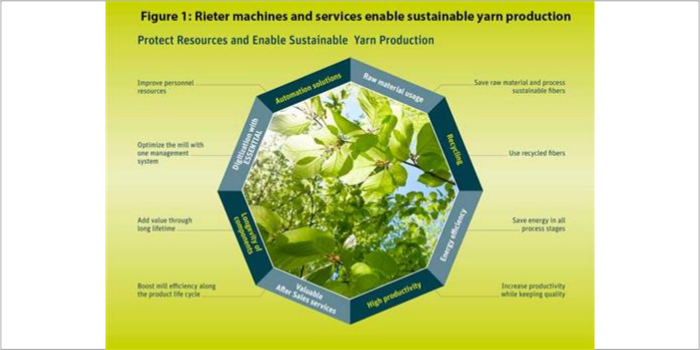
When developing sustainable machines, systems, and services, Rieter considers the entire life cycle of the machines. The focus here is on saving energy and optimum use of resources, as well as efficient and economical production to remain competitive (refer Figure 1).

Sustainable Raw-Material Utilization

Rieter spinning technologies ensure good utilization of raw materials, which can optimize fiber consumption. Rieter systems can be used to process bast fibers or recycled fibers into rotor yarns or ring yarns. These types of fiber are playing an increasingly important role in yarn production. Rieter is driving these innovative solutions for the sustainable use of raw materials.

Rieter offers customized, economical solutions for preparing bast fibers such as flax or hemp for short-staple spinning mills (Figure 2). Preparation is an important precondition for spinning the bast fibers. For the preparation process, Rieter cooperates with the German company Temafa. The machines enable fibers to be extracted from straw bales. The fibers are shortened and refined until they are similar to cotton fibers in length and fineness. This process is called cottonizing. The prepared fibers are best spun using a rotor spinning machine. Rotor yarn offers advantages over ring yarn in terms of elongation, hairiness, and downstream processing.

Figure 2: Rieter offers a spinning process that cottonizes bast fibers and produces high-quality rotor yarns

Previous ArticleSavio’s splicing solutions offer better results and control
Next Article PyroTex specialty fiber: An innovation for Covid times

Related Posts

Andritz at Index26 to showcases next-gen nonwoven technologies driving sustainability

April 15, 2026

ICT hosts national textile contest on sustainable innovation

April 8, 2026

Navi Mumbai textile facility turns waste into livelihoods under SBM-U 2.0

April 7, 2026
Recent Posts
  • MiRooh unveils cosmic candy bedroom collection
  • CMAI hosts AI Masterclass to guide clothing businesses into the digital era
  • PDS earns Great Place to Work recognition in 10 countries
  • NITMA welcomes cotton import duty waiver
  • Cotton imports exempted from customs duty
  • Trident Group and ICAR-NINFET explore tie-up for natural fibre home textiles
  • Bharat Tex 2026 mobile app launched
  • Atlas Copco RePower Centre boosts compressor lifecycle solutions
Facebook X (Twitter) YouTube LinkedIn
  • About us
  • Contact us
  • Privacy Policy
  • Terms and Conditions

SISTER PUBLICATIONS

Construction World Equipment India Industrial Product Finder Infrastructure Today

© 2026 Indian Textile Journal. All Rights Reserved.

Type above and press Enter to search. Press Esc to cancel.