


Come October, even the sofa knows something is happening. The house begins behaving differently. There are more people at the dining table, conversations run past midnight, doors remain open longer and the living room suddenly has to accommodate cousins, friends, neighbours and the occasional guest nobody remembers inviting.
I think festive interiors should respond to this change in tempo. For me, that does not mean giving the house a seasonal makeover. I would rather change a few fabrics than fill every surface with decoration. Textiles can alter a room almost instantly, and unlike overtly festive objects, they continue to belong there after the last mithai box has disappeared.
The trick is not to make everything richer at once. If the sofa is upholstered in a substantial fabric, I might introduce cushions in silk or a fine embroidered cotton. Against a very polished interior, I like the slight imperfection of linen. A room dominated by pale neutrals can take one surprisingly intense note of colour in velvet or chenille. The contrast is what makes each material noticeable.
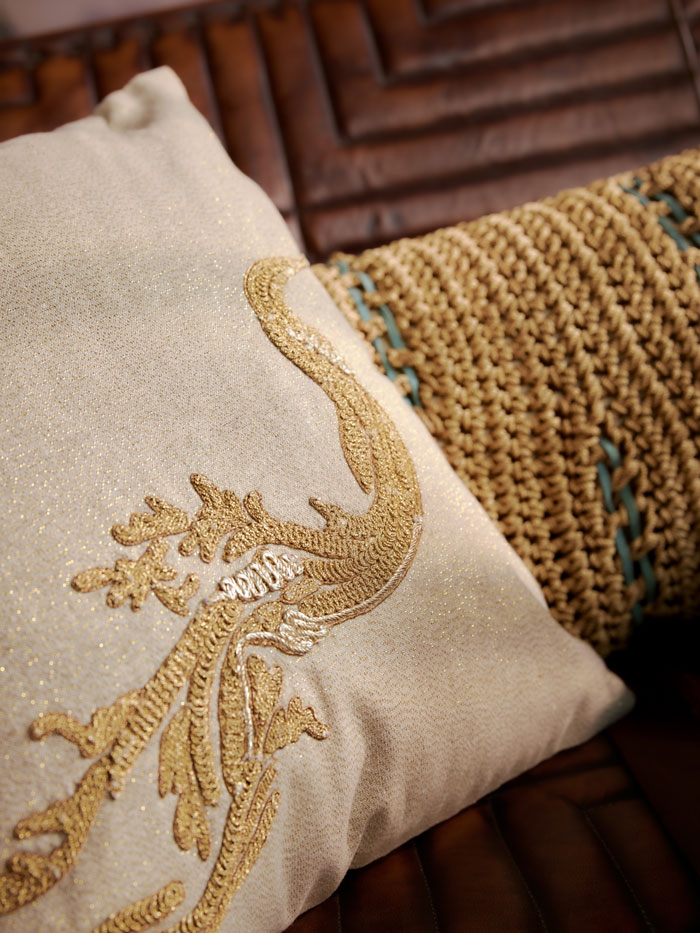
What interests me more is what happens when fabric refuses to stay on the sofa. Intricate embroidery can climb onto a lampshade, turning an everyday source of light into something almost jewel-like. A decorative textile top can transform a table into an object worth looking at before anything is placed upon it. Handworked motifs can appear on screens, panels, cushions and smaller accents, bringing the detail of couture into the room. During the festive season, I particularly enjoy this shift in scale. Instead of covering a space in obvious ornament, one exquisitely embroidered object can hold its own. The stitches catch the light, the surface reveals itself as you move closer, and suddenly fabric is no longer merely furnishing the room. It is the decoration.
Of course, the festive house is not a showroom. Someone will spill something, eventually. That reality has made the new generation of performance textiles genuinely useful. Stain-resistant velvets, hard-wearing jacquards and easy-clean chenilles allow beautiful rooms to actually host people.
I think this is where fabrics have begun to play a much larger role in festive interiors. They don’t merely decorate the celebration. They prepare the house for it. They make chairs more inviting, tables more generous, large rooms less formal and familiar corners feel slightly unfamiliar again.
After all, the best festive home isn’t the one wearing the most jewellery, but dressed as one.
About the author:
lorem ipsum dolor sit amet consectetur adipiscing elit est sunt occaecat mollit vero excepturi irure esse blanditiis sunt voluptate adipiscing minim temporibus non dolore omnis nulla consequatur et velit maxime eum dolorum odio cupidatat sint reprehenderit fugiat rerum sint laborum est distinctio optio consequat mollitia soluta accusamus officia qui ex.
Founded by designer Parisha Shodhan, Paris Haus is a love letter to the beauty that reveals itself slowly. It is a luxury home atelier where detail is not something added at the end, but the very beginning of an idea. The embroidery leads the story, one stitch at a time. Borrowing from the romance and decorative richness of the old-world, Paris Haus carries intricate handwork across lampshades, cushions, table linen and objects for the home.