


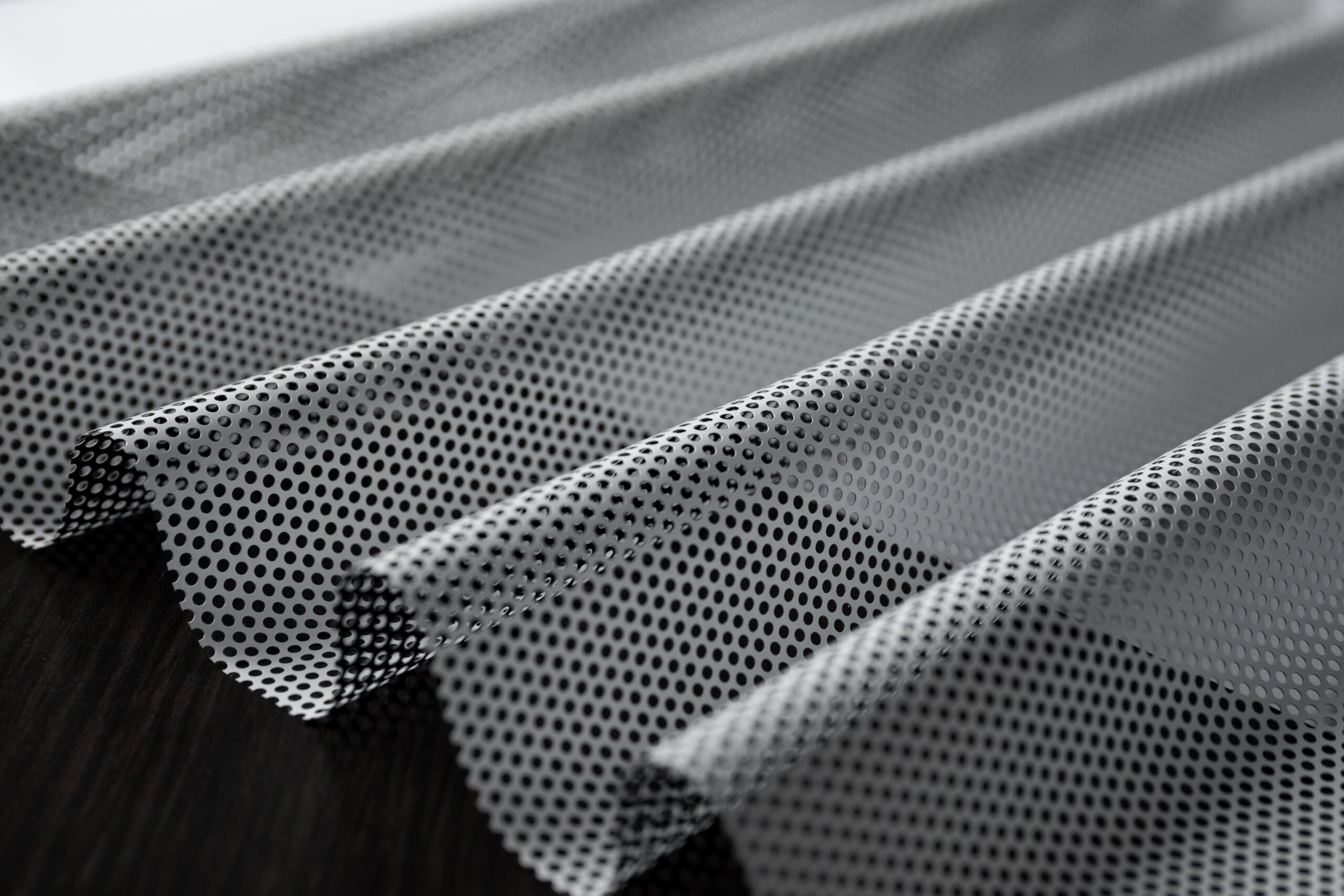
This method allows engineers to simulate complex behaviours like crack propagation, debonding, and load distribution without expensive physical prototypes, explains Dr N Gokarneshan and M Karthika.
Finite Element Methods (FEM) for Textile Reinforced Concrete (TRC) or Textile Reinforced Mortar (TRM) are numerical simulation techniques used to analyse the structural behavior, cracking, and bonding of high-performance cementitious composites reinforced with fibre textiles (e.g., carbon, AR-glass, or basalt) rather than traditional steel bars. These methods enable simulation of complex cracking behaviors and the interaction between the thin mortar matrix and the high-strength textile fibres.
Key aspects of FE modelling of Textile RCC
Element selection & discretisation
Concrete/mortar matrix: Typically modeled using 3D solid elements, such as (SOLID65(8-node with cracking and crushing capabilities in ANSYS) or C3D8Rin ABAQUS).
Textile reinforcement: Usually simulated with truss elements (LINK180) or shell elements (SHELL181), which are embedded within the matrix. The textile grid is often modeled at the mesoscale to capture individual roving interactions.
Steel elements: Traditional longitudinal bars and stirrups, if present, are modeled using 1D truss or beam elements.
Material constitutive models
- Concrete: Non-linear models like Concrete Damaged Plasticity (CDP) are commonly used to capture crack development and propagation.
- Textile: Modeled as linear elastic up to failure or with specific elastic-brittle constitutive laws based on experimental results.
Interface modeling (Bonding)
- Perfect bond: A common assumption is that no slippage occurs between the mortar and the textile, often modeled using “embedded region” constraints in ABAQUS or “node-to-node” connection.
- Slippage/Delamination: For higher accuracy, cohesive interfaces or contact elements are used to simulate the slipping/delamination of the textile, which is critical for understanding the debonding failure mechanism.
Analysis procedure
- Nonlinear analysis: Newton-Raphson methods are generally used to solve the equilibrium equations, especially when cracking leads to severe non-linearity.
- Numerical setup: The loading is applied gradually in steps, often controlled by displacement, to map the behavior post-cracking.
Applications and scope
- Strengthening: FE models are widely used for simulating TRM jackets for shear strengthening of conventional RC beams.
- Retrofitting: Used in numerical investigations of 2D/3D strengthening of slabs and columns.
- Structural optimisation: Models allow for parametric studies on fibre orientations (e.g., orientation), stacking sequences, and layer count to optimise strength.
Common software tools
- ANSYS (Mechanical APDL/Workbench): Frequently used with SOLID65 and SHELL181 elements for modeling TRM-strengthened RC beams.
- ABAQUS: Widely used for mesoscale modeling of textile composites, employing T3D2 (truss) and C3D8R (solid) elements.
- ATENA: Applied to model SHCC (Strain-Hardening Cement-based Composites) with textile reinforcement, specialised for non-linear concrete cracking analysis.
LS-DYNA: Often used for impact simulations involving TRC fabrics.
Validated FE models are often shown to be slightly stiffer than physical tests, which is often attributed to the idealised perfect bond assumption and the difficulty in capturing the exact early-age cracking behavior, but they generally yield accurate ultimate load estimations.
Finite Element Method (FEM) is a critical numerical tool for analysing Textile Reinforced Concrete (TRC), often referred to in a similar context as Textile Reinforced Cementitious (TRC) or Mortar (TRM) composites. It allows engineers to simulate complex behaviors like crack propagation, debonding, and load distribution without expensive physical prototypes.
Key modeling approaches for Textile RCC
When modeling textile-reinforced members, different elements are used to represent the composite’s distinct materials:
Concrete/Mortar Matrix: Typically modeled using solid elements (e.g., SOLID65 in ANSYS) that can handle nonlinear behaviors like cracking and crushing.
Textile reinforcement
- Truss elements: Used for 1D or 2D representations where only the longitudinal (warp) yarns carry the primary load.
- Shell elements: Better suited for modeling thin textile grids or multiple layers with varying orientations.
- Interface (Bonding): A critical factor where researchers often use contact and target elements to simulate the bond between the textile and the mortar matrix. While “perfect bond” is a common simplification, advanced models account for slippage (debonding) to match experimental failure modes.
Specialised analysis techniques
- Smeared crack model: Used to simulate the distributed multiple cracking behavior characteristic of high-performance cementitious composites like TRC and Engineered Cementitious Composites (ECC).
- Multiscale modeling: This approach uses high-resolution yarn-level architecture in critical areas (like impact zones) and simplified homogenised membrane models in far-field regions to save computational time.
- Probabilistic modeling: Accounts for the natural variability in matrix strength and fibre distribution to predict crack spacing and localisation more realistically.
Software tools
Commonly used software for these analyses include:
- ANSYS (Mechanical APDL): Widely used for shear and flexural strengthening simulations.
- ABAQUS: Preferred for detailed 3D modeling and impact simulations.
- LS-DYNA: Specifically used for high-speed dynamic events like projectile impact on textile layers.
- ATENA: Often utilised for 2D probabilistic simulations of strain-hardening composites.
About the authors:
- Dr N Gokarneshan is a Formerly Professor, Department of Textile Chemistry, SSM College of Engineering, Komarapalayam, Tamil Nadu, India.
- M Karthika is from the Department of Mathematics, SSM College of Engineering, Komarapalayam, Tamil Nadu, India.