


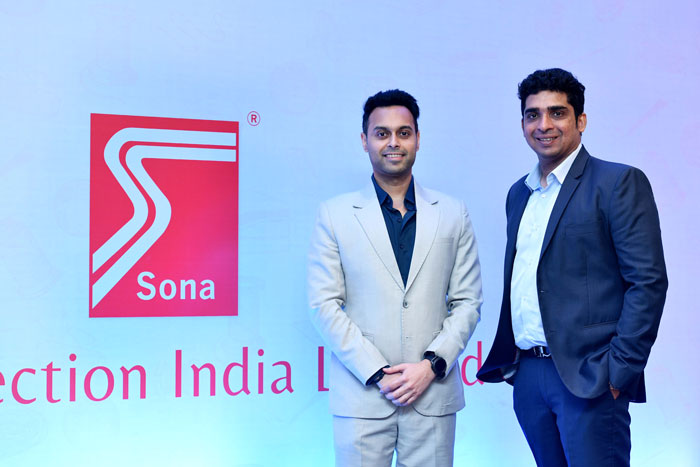
Left guy in the image is Harshil Nuwal
Sona Selection is an integrated textile supply chain player built around a lean and agile operating model. It leverages existing spinning and weaving capacities while focusing its manufacturing investments on processing and finishing, one of the most value-added stages of the textile supply chain. Positioned as a fast-fashion, brand-first company, Sona Selection works closely with garment manufacturers and brands to understand evolving market requirements and develop fabrics aligned with customer needs. Its approach combines product development, efficient turnaround times and the consistent supply of high-quality fabrics. Harshil Nuwal, Managing Director, Sona Selection, in this interview with Divya Shetty, shares about the company structure and its offerings.
When was Sona Selection founded, and could you provide a brief company overview?
The company was incorporated in 2022. Before that, my co-founder Deepank Bhandari and I had already spent about 15 years in the industry in different capacities. I was working in and around textiles, serving the fashion industry, while Deepank was building supply chain companies.
When we decided to venture into textiles, we already had a strong understanding of the ecosystem. I come from a textile background; my father has been in this industry for the last 35 years. Also, the place we come from, Bhilwara, is known for textiles, so we have seen this ecosystem all our lives.
When we decided to venture into it, we were very clear that if we could build a lean supply chain around the business and cater to brands first, the room for growth would be immense. That is something we have proved over the last three years.
In just the last four years, we have been able to achieve revenues of more than Rs 5 billion. Looking at the kind of people and companies we are working with, we see a lot of growth coming on a year-on-year basis.
What, according to you, are the current trends reshaping the textile industry, and how is your company responding to them?
The biggest trend is that fashion has become fast fashion, so turnaround time has become very critical. It is about how quickly you can adapt to the needs of the market and how quickly you can have your product ready to be displayed in the market.
This is a very critical inflection point for textiles, so to speak, we are at the forefront of it. That is one of the reasons we have been able to scale as quickly as we have, because we work with a very consistent turnaround time.
Product development is equally important. Fashion is demanding. Earlier, there used to be two seasons. Then it moved to four seasons, and now, probably every month, people need something new.
For something new to come every month, you need to make sure that your product development does not stop and that your turnaround times remain aligned with the requirements of the market.
Only when this entire process is well-oiled can you build a sustainable, high-growth company. That is where we are focused and where we have been operating at the forefront.
Since you mentioned product development, how are changing consumer preferences influencing your product development, design and sourcing strategies?
Consumer trends are evolving on a very global basis. Fashion today is not limited to one country; trends travel very quickly everywhere.
So, we keep ourselves up to date with trends, which requires us to continuously work with different blends and come up with newer textures, finishes and fabrics. That is where we have invested in technology and people for developing these products.
Because we are in constant touch with brands and the market, we are able to develop these products almost in real time. Since the development process is so rapid, and because we are not bound by very fixed capex at the backend, I can move from one fibre to another very quickly and seamlessly.
If you ask me about the trend for the coming years, it will be about working with a lot of different fibres together to keep creating different textures, feels and blends for the market.
As a company, around 70 per cent of our revenue is already coming from blends.
Sustainability is becoming increasingly important across the textile value chain. How is your company approaching sustainability?
From day one, we were very clear that we wanted to be a highly sustainable and environment-first company.
We operate on zero liquid discharge, which has been incorporated in-house at our premises. We recycle every drop of water that we use.
When it comes to air emissions, we have ESPs in place, where our carbon output is less than 100 ppm. For power, we are able to generate almost 70–80 per cent of our requirements in-house.
So, we are very clear about sustainability, and our stand is also very clear. Going forward, we feel that you need to be sustainable first in order to connect and grow. It is also simply the right way to do business.
With the global textile industry becoming increasingly competitive, what steps do Indian companies need to take to become global leaders?
For a very long period, India has primarily been a backend supplier to a lot of these brands. We have failed to create strong domestic, home-grown brands that could grow globally, and we have also lacked sufficient garmenting capacities that could serve customers at scale.
However, we have started seeing this change over the last few years, especially post-COVID. A lot of initiatives have been taken by the government to promote the sector, which is helping industries on the ground commit capital and enter this space.
Even when it comes to brands, in the last few years we have seen a lot of home-grown brands, both online and offline, showing phenomenal growth.
Considering where the country stands today, the level of consumption we have, and the global doors that have opened for us through FTAs and other developments, we feel there is a lot of room for growth.
As we mentioned earlier, if you have the right product and the right fashion, along with a good turnaround time and the ability to serve customers on time, then the sky is the limit.
People are looking at us to become reliable supply partners. Brands within the country itself are looking at suppliers to have their supply chains intact so that they can grow. So, all the right triggers are around us.
As a country, we now need to come together and make sure that we utilise this opportunity. This is a once-in-a-generation opportunity for textiles. I think this is one of the most golden periods we are entering for the next five to 10 years.
We are very confident that, with participation from across the industry, we will be able to create a very long-term, sustainable textile business for India. India needs the textile industry to work because of the kind of employment it generates, and that will ultimately help the country grow.
How are technologies such as AI, automation and digitisation influencing your operations?
Technology will always influence the industry. We are working across a lot of areas where we feel technology has enabled us to do things in a much more efficient way.
On the machine front, we see a lot of developments and plug-ins coming in that help us keep tweaking and improving the way things have traditionally been done.
Everything today is moving towards giving you more speed and reliability. As a company, we do not shy away from embracing, accepting and understanding new technologies.
The way our supply chain has been structured, and the agility that we have built into the business from day one, helps us integrate ourselves with whatever the market has to offer.
Can you tell us about the new segment you are venturing into — technical textiles?
We see significant growth potential in technical textiles. The market share of technical textiles is growing, and their use cases are also expanding considerably.
For us, we want to be present in areas where we are developing newer products and newer applications. For that, we have entered into some critical tie-ups, which are helping us from day one in gathering the right data, technology and development capabilities required to serve this market.
As we move forward, we see a substantial part of our business and revenue starting to come from technical textiles.
What are the biggest growth opportunities you see for your company, and what will be your priorities over the next three years?
We are very clear that we want to become a one-stop solution for brands.
We have already gained trust in terms of our fabric supplies, so people know our capabilities when it comes to supplying fabrics. Over the last few months, we have also been expanding our garment capacities.
Going forward, we want to become a one-stop solution for brands — essentially, a platform that can enable a lot of brands, both in India and abroad, to use our supply chain as an enabler for their growth in the market.
With technical textiles as well, the kind of products that we are currently developing are highly technical in nature. They will have their own journey in terms of verification and acceptance in the market.
However, over the next three years, we see a lot of growth coming from these two segments. Our garment supplies are expected to increase significantly, and we also expect strong growth in the supply of technical textile fabrics.