


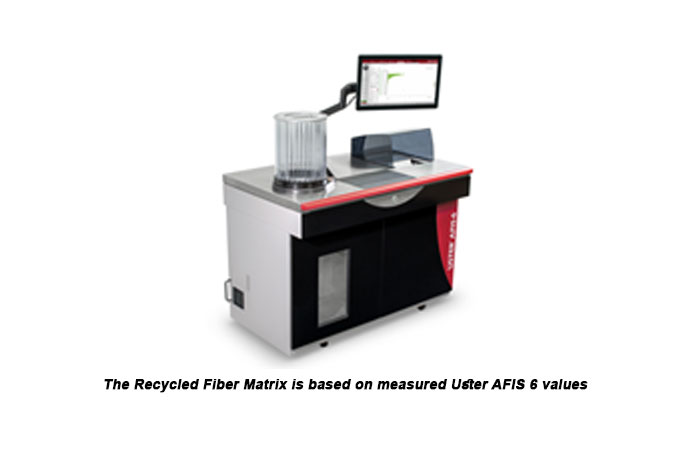
Uster has developed the Recycled Fiber Matrix, a two-dimensional assessment of mechanically recycled fibres to guide optimum processing and end-uses.
The textile industry’s commitment to circularity continues to accelerate, and mechanical recycling is viewed as a targeted approach to cutting textile waste and its environmental impact. At the forefront of this drive, Uster has developed the Recycled Fiber Matrix, a two-dimensional assessment of mechanically recycled fibres to guide optimum processing and end-uses.
Recycled cotton fibres are difficult to categorise because of their inconsistency and variability. How can the industry evaluate mechanically recycled material accurately – and match it to the most suitable spinning methods and product end-uses? Help is at hand from Uster, in the form of the Recycled Fiber Matrix. It provides an objective assessment of recycled cotton, so that recyclers, spinners and brands are guided towards what can be made from it, and how.
The concept fits perfectly with the industry’s need for greater circularity and transparency in recycling.
The facts that matter
Precise data about the physical characteristics of recycled fibres is essential to understand how they will behave in spinning and their end-use. The Uster Recycled Fiber Matrix focuses on the essential numbers – such as length of fibres (L(n)), of the longest 5 per cent fibres (5 per cent L(n)), and short fibre content (SFC(n)).
The background to the development of the Recycled Fiber Matrix involved testing of a significant number of 100 per cent mechanically recycled cotton fibre samples from key recycling regions, including China, India and Europe. Samples included greige materials, as well as colored and bleached recycled fibres. Sources were categorised as post-industrial, pre-consumer or post-consumer waste, as evenly distributed as possible.
Measurements of the recycled samples with Uster AFIS 6 were the basis of trends used in the Recycled Fiber Matrix. From this, Uster developed its application report on the Recycled Fiber Matrix. It evaluates the current state and potential challenges of using different types of mechanically recycled cotton fibres in spinning.
The Uster Recycled Fiber Matrix is an ongoing and dynamic process, with more samples being collected and analysed from global recycling hubs, to reflect variability as source materials and processing conditions evolve.
How it works
Measured Uster AFIS 6 values are presented as clear and easy-to-understand quality levels, from A to D, color-coded for intuitive practical application. The color-coded regions correlate fibre parameters with their typical raw material sources, to provide a strategic guide for optimised yarn production.
Mechanically recycled cotton cannot be accurately classified by a single fibre parameter. So the Recycled Fiber Matrix uses two-dimensional evaluation. Only a combination of these two parameters can properly determine processing behavior and yarn quality.
For example, the x-axis might represent a length parameter, such as mean fibre length, while the y-axis could be a quality-limiting factor like short fibre content or nep count. Each position in the matrix thus reflects two interacting fibre properties simultaneously. In practice, this means that two fibre lots with the same mean fibre length could behave differently in spinning if one had high short fibre content and the other low. The two-dimensional matrix makes this visible and comparable.
Benefits in industrial application
The Recycled Fiber Matrix lets customers directly translate AFIS measurements into clear quality categories. This makes the quality level and the limitations of a lot transparent.
Based on Recycled Fiber Matrix, the class can be applied to bale management and machine settings. For optimum yarn performance, the class is useful to estimate the expected short-fibre load, and to define suitable blending ratios.
Uster experts generally advise users to enhance fibre sorting by separating bales according to length, source, and color, thus reducing variability. Effective bale management helps maintain consistency in key parameters, ensuring uniform quality throughout production. It’s also recommended to enhance the spinning process by adjusting draft settings, twist, and spinning speed to suit the specific quality of recycled fibres. Increasing maintenance and cleaning frequency would also help.
Mixing recycled cotton with virgin cotton or synthetic fibres is still regarded as the best blending strategy to compensate for quality deficiencies. Uster is currently working in this field to provide benchmarks for blend levels and their subsequent influence on yarn quality.
Free application report
The Uster Recycled Fiber Matrix provides a data-driven framework for objective classification of recycled fibre lots. The application report on the Recycled Fiber Matrix is a valuable educational document, with several graphs and illustrations. It is available as a free download under www.uster.com/recycledfibermatrix. It contains shared insights empowering spinning mills, recyclers, and brands to make informed decisions about fibre suitability. It helps expand the use of recycled cotton in textile products, while optimising processing parameters.
As recycling technologies and fibre preparation methods continue to evolve, Uster is convinced that ongoing data collection and matrix updates play an important part, refining classification accuracy and supporting sustainable circularity goals in the textile industry.
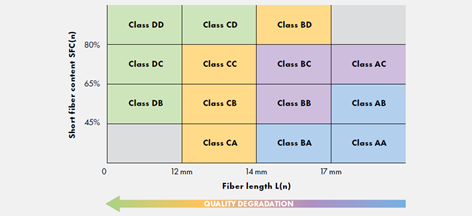
Uster Recycled Fiber Matrix for mechanically recycled cotton based on L(n) and SFC(n)
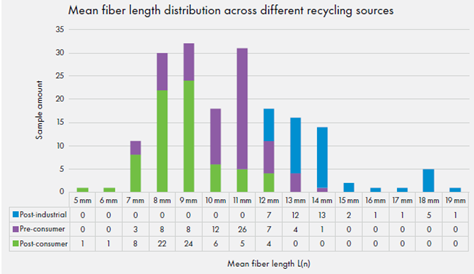
Mean fiber length distribution based on L(n) for different recycling waste types
The Recycled Fiber Matrix is based on measured Uster AFIS 6 values