



The extraordinary performance of these fibres is dictated by a hierarchical arrangement of large proteins called spidroins, informs Dr N Gokarneshan
Natural spider dragline silk, primarily produced by the Nephila clavipes (golden orb-weaver) or Araneus diadematus, represents an evolutionary marvel of structural mechanics. The extraordinary performance of these fibres is dictated by a hierarchical arrangement of large proteins called spidroins (specifically Major Ampullate Spidroins, MaSp1 and MaSp2).
The primary sequence of spidroins consists of a large, highly repetitive core domain flanked by highly conserved non-repetitive amino (N-) and carboxy (C-) terminal domains. The repetitive core is composed of specific amino acid motifs that undergo distinct secondary-structure transitions during fiber assembly:
- Poly-Alanine (A)n and Glycine-Alanine (GA)n blocks: These hydrophobic regions self-assemble into tightly packed, anti-parallel beta-sheet nanocrystals via hydrogen bonding. These crystalline domains anchor the matrix and provide the material with its high tensile strength and stiffness.
- Glycine-Proline-Glycine-X-X(GPGXX)n and Glycine-Glycine-X(GGX)n motifs: These motifs form amorphous, highly flexible \(\beta \)-turn spirals and random coil structures. Acting as molecular springs, these disordered regions are responsible for the fiber’s high elongation, elasticity, and energy-dissipating toughness.

The native proteins typically exhibit ultra-high molecular weights (UHMW) exceeding 200 to 350 kDa. Replicating these extensive, repetitive gene sequences in heterologous expression systems remains the central challenge of recombinant DNA production, as genetic instability and codon bias frequently cause premature translation termination.
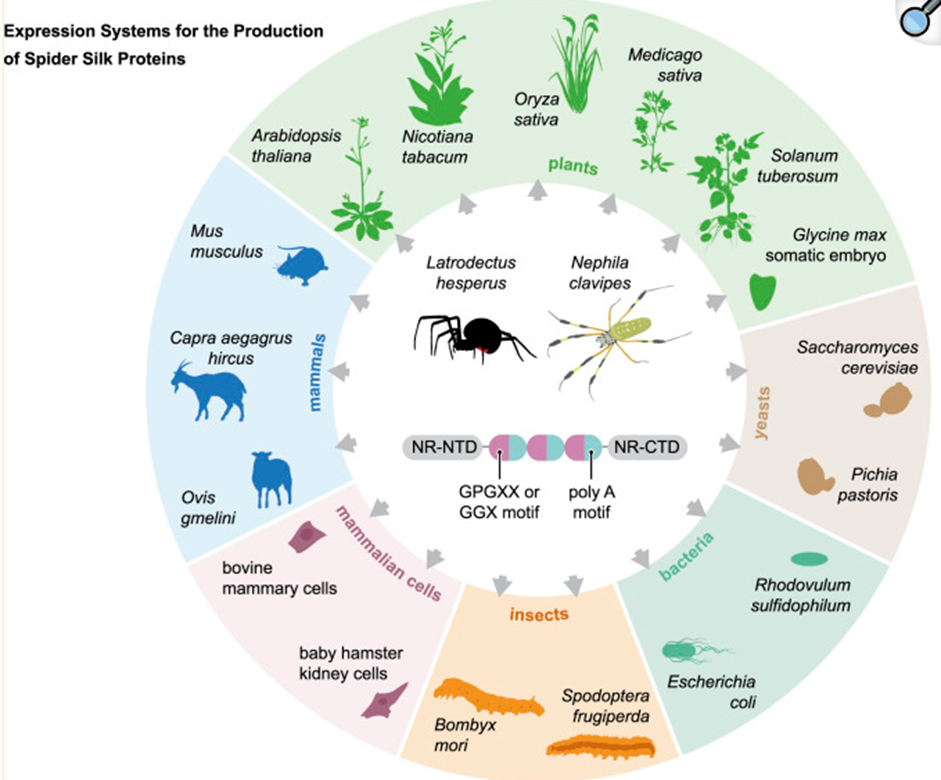
Heterologous expression systems
To synthesise recombinant spider silk proteins (rSSPs), scientists isolate or synthetically design spidroin genes, optimising them for expression within alternative host organisms. Each expression platform exhibits specific trade-offs regarding yield, cost, scaling capabilities, and molecular weight fidelity.
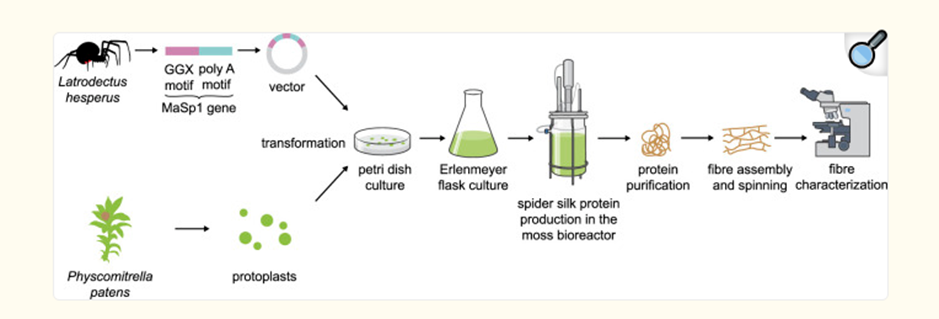
Schematic overview of spider silk protein production in Physcomitrella.
Bacterial expression (Escherichia coli)
Escherichia coli remains the primary workhorse for bench-scale and initial pilot-scale rSSP synthesis due to its rapid replication cycle and well-understood genetics.
- Advantages: High growth density, inexpensive media, and straightforward downstream processing.
- Bottlenecks: E. coli struggles with highly repetitive, GC-rich spidroin sequences. This bottleneck leads to frequent homologous recombination deletions or tRNA depletion for glycine and alanine.
- Recent Solutions: Metabolic engineering strategies—such as elevating internal glycyl-tRNA pools and using split-intein ligation techniques—have successfully yielded synthetic spidroins exceeding \(300 \text{ kDa}\) with Kevlar-like mechanical performance.
Yeast expression (Pichia pastoris)
Methylotrophic yeasts like Pichia pastoris are effective alternatives that bridge the gap between simple bacteria and complex eukaryotic systems.
- Advantages: P. pastoris offers high-density fermentation and handles repetitive sequences more securely than bacteria. Crucially, it can secrete rSSPs directly into the culture medium, streamlining purification by avoiding cell lysis.
- Bottlenecks: Post-translational hyper-glycosylation can alter protein folding, occasionally necessitating genetic modifications to humanise or simplify the yeast’s glycosylation pathways.
Transgenic silkworms (Bombyx mori)
The integration of spider silk genes into the silkworm genome represents a major breakthrough for industrial-scale manufacturing. Utilising CRISPR/Cas9 or piggyBac transposon vectors, researchers insert MaSp genes directly into the fibroin locus of Bombyx mori.
- Advantages: Silkworms act as autonomous bio-factories, executing the complex spinning process inside their spinnerets. The resulting composite cocoons are harvested using existing industrial textile infrastructure.
- Commercial milestone: By mid-2026, firms like Kraig Biocraft Laboratories scaled this technology to yield metric-ton outputs per production cycle, demonstrating the viability of agricultural molecular farming for technical fibers.
Alternative host platforms
- Plants (Tobacco, Alfalfa, Potato): Provide high biomass and low upstream costs, though extracting and purifying proteins from complex plant tissue is challenging.
- Mammalian cells: Yield high-fidelity, correctly folded proteins but suffer from slow growth kinetics and high media costs, restricting their output to specialised biomedical applications.
- Transgenic microalgae: Offer a promising sustainable frontier by using photoautotrophic growth driven by sunlight and carbon dioxide to yield cost-effective biopolymers.
Downstream processing and biomimetic spinning techniques
Isolating the raw liquid protein dope is only half the challenge; transforming it into a high-performance structural fiber requires precise biomimetic spinning. In nature, a spider stores its spidroins in a highly concentrated, liquid-crystalline state (\(>30\% \text{ w/v}\)) inside its silk gland. As the dope travels through the narrowing duct, it encounters a controlled pH drop (from 7.2 to under 6.3), changing ion gradients (\(\text{Na}^{+}\) reabsorption, \(\text{K}^{+}\) and phosphate influx), and high mechanical shear forces. This environment forces the terminal domains to lock together, prompting the repetitive core to snap into an aligned \(\beta \)-sheet structure.
[Purified rSSP Powder] ──> [Dissolution in Solvent (HFIP/Aqueous)] ──> [Extrusion via Microfluidic Nossle]
[Spooling / Finished Yarn] <── [Post-Spinning Extension (Drawing)] <── [Coagulation Bath (Alcohol/Water)
Artificial spinning methodologies attempt to mimic this micro-environment through several distinct approaches:
Wet-spinning
The purified rSSP is dissolved in aggressive organic solvents, such as hexafluoroisopropanol (HFIP), or specialised aqueous salt dopes. The liquid is extruded through micro-bore spinnerets into an anti-solvent coagulation bath (typically methanol, ethanol, or isopropanol). The solvent diffuses outward, precipitating the protein into a continuous solid filament.
Microfluidic and biomimetic channel spinning
To eliminate harsh chemical solvents, advanced spinning setups utilise microfluidic chips etched with micro-channels that replicate the exact geometry of a spider’s duct. By slowly pumping in buffer solutions that alter pH and salinity alongside the spidroin flow, these devices trigger natural phase-separation and shear-induced alignment without destroying the native protein conformation.
Electrospinning and centrifugal electrospinning
For non-textile applications, electrospinning uses high-voltage electric fields to draw a charged polymer solution into sub-micron diameter fibers. This produces fine, interconnected porous meshes rather than linear threads. To scale this up, centrifugal electrospinning combines electric fields with high-speed rotational forces, boosting throughput and enabling the rapid production of industrial filtration layers and complex tissue scaffolds.
Post-spinning drawing (The extension phase)
Freshly spun fibers are often weak because their protein chains are randomly oriented. To fix this, fibers undergo post-spinning elongation—stretching them up to 500% in a water or alcohol bath. This mechanical pulling aligns the poly-alanine segments parallel to the fiber axis, inducing crystallisation and dramatically increasing tensile strength.
Physico-chemical and mechanical properties
The unique structural arrangement of recombinant spider silk yields an impressive balance of thermal, chemical, and physical properties.
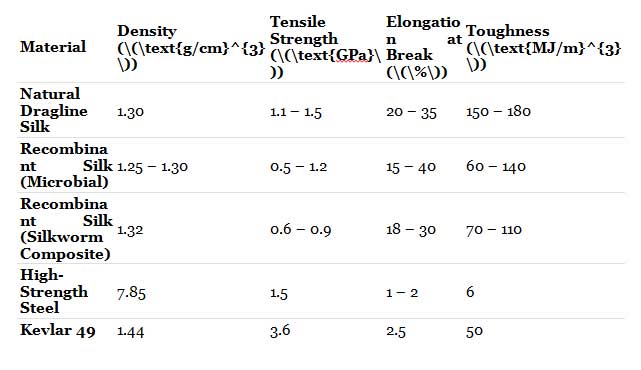
Mechanical performance comparison
Spider silk’s true advantage lies in its toughness—the total energy a material can absorb before breaking. While steel has high strength but minimal elasticity, and elastomers have high elasticity but low strength, spider silk combines both properties.
Thermal stability and degradation
rSSPs are thermally stable up to approximately 250o C to 300^ C, where the structured beta-sheet crystals begin to denature. Unlike traditional petroleum-based polymers, they do not melt into volatile microplastics. Instead, they safely char, offering intrinsic flame-retardant properties suitable for protective gear.
Supercontraction
A unique property of dragline spider silk is supercontraction. When exposed to high relative humidity or immersed in water, the fiber absorbs moisture, disrupting hydrogen bonds within its amorphous domains. This causes the fiber to shrink up to 50% of its original length while generating high contraction forces. This property is being leveraged to develop moisture-responsive smart actuators and artificial muscles.
Biomedical and advanced applications
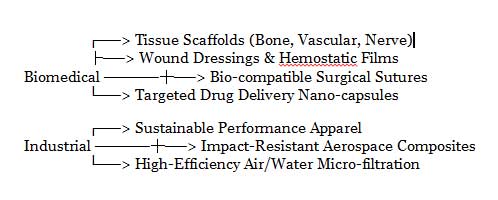
Because recombinant spider silk is free from the toxic chemical residues found in synthetics, its structural versatility has opened up new applications across several key industries.
Tissue engineering and regenerative medicine
rSSPs are highly biocompatible and feature low immunogenicity because they lack common mammalian cell-surface allergens.
- Structural scaffolding: Silk matrices can be processed into 3D porous constructs, hydrogels, and thin films that support cell adhesion, migration, and proliferation. These scaffolds are widely used in bone, cartilage, vascular, and cardiac tissue engineering.
- Surface modifications: Modifying the surface charge of rSSP films (such as eADF4 variants) allows researchers to control blood clotting. Positively charged, hydrophobic silk surfaces can accelerate clotting for emergency wound care, while neutral or negatively charged variations remain highly hemocompatible, making them ideal for coating cardiovascular implants.
Wound care and surgical sutures
Modern wound dressings use rSSP micro-nanofiber meshes to maintain a sterile, moist environment that promotes rapid dermal remodeling. These materials can be engineered with antimicrobial peptides or silver nanoparticles for self-healing, infection-resistant dressings. Additionally, high-tensile recombinant threads function as ultra-fine, biodegradable surgical sutures that minimise inflammation and break down safely inside the body as the tissue heals.
Targeted drug delivery systems
By processing spidroins into hollow nano-capsules or spherical micelles, scientists can encapsulate sensitive therapeutic payloads, including small-molecule chemotherapeutics, vaccines, and nucleic acids (mRNA/siRNA). The crystalline structure of the silk shell protects the enclosed drugs from premature ensymatic breakdown, allowing for controlled, sustained release directly at target tumor sites.
Sustainable technical textiles and industrial composites
Outside of medicine, the global textile sector is adopting recombinant silk as a bio-based alternative to petroleum-derived synthetic fibers like nylon and polyester. Woven into performance apparel, it delivers lightweight durability and breathability.
In the aerospace and automotive sectors, rSSP fibers are integrated into matrix resins to form lightweight, shock-absorbing composites. These green alternatives can absorb high-velocity impacts without shattering, making them valuable for vehicle paneling, protective armor, and impact-resistant consumer goods.
Current technical challenges and future outlook
Despite significant progress, several technical and economic hurdles must be resolved before recombinant spider silk can achieve widespread market substitution:
- High cost of purification: Isolating raw spidroins from broken bacterial cells requires expensive chromatography and costly organic solvents. Expanding secretable yeast platforms and scaling transgenic silkworm farming are critical to lowering these downstream purification expenses.
- Replicating true native toughness: While synthetic spinning can match the tensile strength of natural silk, matching its extreme elasticity and structural consistency at an industrial scale remains a challenge. Refining multi-sone biomimetic coagulation baths will be essential to consistently achieving these complex fiber properties.
- Regulatory approval for medical devices: Navigating clinical trial pathways for implantable rSSP scaffolds requires strict optimisation of batch-to-batch consistency and long-term in vivo degradation tracking.
The global market for synthetic spider silk is projected to expand significantly, driven by a compound annual growth rate (CAGR) exceeding 16% as industries shift toward sustainable, high-performance biopolymers. Continued advancements in synthetic biology—combined with automated bioreactor scaling and cleaner spinning technologies—position recombinant spider silk to become a cornerstone material for both advanced medical devices and green manufacturing.
References
- Anam, M., & Heidebrecht, A. (2022). Recombinant Spider Silk: Promises and Bottlenecks. Frontiers in Bioengineering and Biotechnology, 10, 835637.
- Chung, H., Kim, T. Y., & Lee, S. Y. (2012). Recent advances in production of recombinant spider silk proteins. Current Opinion in Biotechnology, 23(6), 957-964.
- Edlund, M., & Hedhammar, M. (2024). Review of Spider Silk Applications in Biomedical and Tissue Engineering. Molecules, 29(5), 1084.
- Jansson, R., & Rising, A. (2021). Recombinant DNA production of spider silk proteins. Biopolymers, 112(4), e23432.
- Kraig Biocraft Laboratories. (2026). Kraig Biocraft Laboratories Sets New All-Time Production Record, Delivering Nearly 2.5 Metric Tons of Recombinant Spider Silk in Single Production Cycle. Press Release, June 2026.
- Lang, G., & Scheibel, T. (2025). Fiber Processing of Recombinant Spider Silk Proteins: Mimicking Nature and Beyond. Journal of Polymer Science, 63(8), 542-559.
- Lin, S., & Huang, W. (2025). Structure, production and application of spider silks. Journal of Biological Engineering, 19(2), 112-125.
About the author
Dr N Gokarneshan is (Formerly) Department of Textile Chemistry from SSM College of Engineering, Komarapalayam, Tamil Nadu.