


Discover high-performance textiles, sustainable materials and new applications, build international contacts and open up new markets.
Bridging innovation and industry, the sixth B. K. Mehta Technology Networking Mission-2030 convened experts, researchers and students to chart the future of textile engineering. Organised by Indian Textile Accessories & Machinery Manufacturers’ Association (ITAMMA).

The Indian Textile Accessories & Machinery Manufacturers’ Association (ITAMMA), in association with the “BK Mehta Endowment Fund”, organised the sixth edition of the B. K. Mehta Technology Networking Mission-2030 at Ranbanka Heritage Hotel, bringing together academia, industry experts, researchers and students to advance innovation in textile engineering and technical textiles.
The first session, conducted virtually and open to participants online, began with a documentary on the life and contributions of textile industry luminary B. K. Mehta, highlighting his role in strengthening India’s textile engineering ecosystem and supporting ITAMMA’s initiatives.
Mission to drive innovation
In his introductory address, N D Mhatre, Director General (Tech), ITAMMA, outlined the mission’s objective to connect academia, research institutions, government bodies and industry stakeholders at national and international levels. He emphasised the importance of supporting innovation in the textile sector, developing strategic roadmaps and creating pilot projects in collaboration with stakeholders.
He noted that the initiative aims to offer students from textile institutes opportunities to interact with industry leaders, experts and policymakers, enabling them to implement innovative projects under various government schemes.
Welcoming participants, Omprakash Mantry, President, ITAMMA, said the mission is strengthening India’s textile engineering industry by enhancing technological capabilities and identifying low-cost innovations developed by students. He stressed that continuous technology development is essential for building globally competitive and self-sustained entrepreneurs.
Mantry also acknowledged the contribution of the B. K. Mehta Endowment Fund in supporting such initiatives and highlighted ITAMMA’s Technology Fund, designed to encourage institutes and students to develop innovative solutions that can be scaled into industrial production.
Strengthening industry–academia collaboration
Industry experts and academicians underscored the need for stronger research and development frameworks and closer industry engagement. Prof. (Dr) R. K. Somani, Dean at , emphasised that institutional projects must be rooted in strong R&D concepts and validated through extensive factory trials.
Prof. (Dr) Virendra Gupta of M.L.V. Textile and Engineering College highlighted the role of academic institutions in driving industrial progress. He stressed the need for highly skilled faculty with industry exposure, noting that research-oriented teaching and industry-linked projects are critical to innovation. He also called for academic promotions to be linked to industrial output and practical contributions rather than academic qualifications alone.
Recommendations for student innovation platforms
Mr. Avinash Mayekar, Managing Director of Suvin Expo LLP, praised ITAMMA’s efforts in promoting innovation through the mission but suggested further improvements to accelerate the transition from “mind to production to market.”
He recommended one-to-one feedback sessions between presenters and industry experts, pre-seminar briefings for students and extended presentation time to better articulate innovative ideas. He also proposed assigning common themes—such as sustainability—to multiple institutes and selecting the best projects competitively, encouraging students to pursue innovation beyond academic requirements and develop commercially viable technologies.
Technical textiles in focus
The second session featured presentations by shortlisted students from various institutions and discussions on the growing importance of technical textiles.
In his opening remarks, Mhatre pointed out the global shift towards man-made fibre textiles and emphasised Bhilwara’s potential to expand into engineered and technical textile production. He called for a structured roadmap to guide the transition and bring together experts in product development, machinery, marketing and project implementation.
Mantry noted that India is currently the world’s fifth-largest technical textiles market and highlighted the government’s support through policy initiatives. He described the sector as a sunrise industry offering significant opportunities for innovation and business development.
Mr. Dayal Mehta, CEO and Business Evangelist at The Alliance of Indian Technical Textile Industries & Start-ups (AiTTiS), discussed opportunities for start-ups and new investors in technical textiles. He emphasised the availability of government support for innovation and offered assistance to students in project development, implementation and funding.
Market outlook and investment opportunities
Mayekar also presented a market analysis highlighting the importance of indigenous textile machinery development to strengthen India’s competitiveness. He noted that despite strong capabilities in spinning, weaving and processing, India continues to rely heavily on imported machinery, increasing capital costs. He stressed that local manufacturing of textile machinery could significantly reduce costs and improve technological self-reliance.
He further highlighted rising demand for technical textiles and identified key growth segments for Bhilwara, including industrial textiles, buildtech, sportswear, automotive textiles, geotextiles, hygiene textiles and agro textiles.
Mr. Laxmikant Rathi, President of Mewar Chamber of Commerce and Industry, urged industry players to focus on value-added products rather than volume production. He noted that Western economies dominate global technical textile markets, particularly in medical, defence and automotive applications, and stressed that India must capitalise on opportunities emerging from infrastructure development, healthcare expansion and industrial growth.
Mr. Rohit Parmar of KHS TECH TEX Pvt Ltd shared insights on machinery development and retrofitting innovations, highlighting opportunities to adapt existing looms for technical textile production.
Strategic partnerships and industry engagement

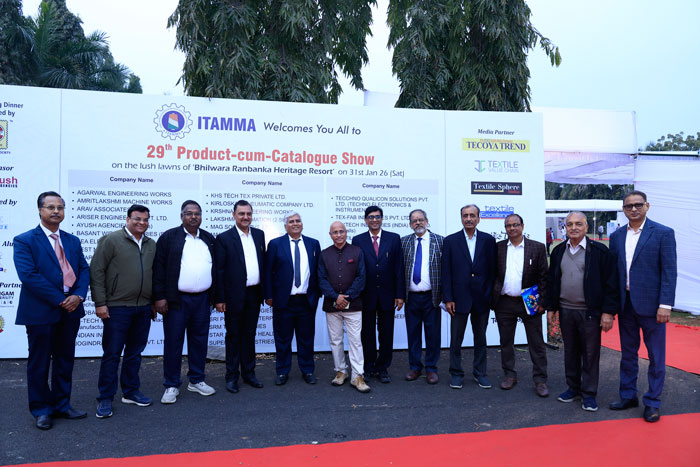
ITAMMA has also organised its 29th edition of Product-cum-Catalogue Show
A major highlight of the event was the signing of multiple memoranda of understanding to strengthen collaboration across the textile ecosystem. Partnerships were formalised with SANGAM University, M.L.V. Textile and Engineering College, Mewar Chamber of Commerce and Industry, the alumni body Thriving Engineers Alumni of MLVTEC (TEAM), The Alliance of Indian Technical Textile Industries & Start-ups (AiTTiS) and Suvin Expo LLP to promote technical training, research projects, awareness programmes and turnkey solutions for technical textile manufacturing.
The programme also featured the 29th Product-cum-Catalogue Show, which connected over 500 decision-makers, manufacturers and traders from across the textile value chain. The exhibition was inaugurated by Dr S. N. Modaniji, Vice-Chairman and CEO of Sangam India Ltd., and Dinesh Nolkhaji, Chairman and Managing Director of Nitin Spinners Ltd., who commended ITAMMA’s efforts in building an integrated platform linking academia, industry and stakeholders.
Driving future-ready textile growth
Overall, the B. K. Mehta Technology Networking Mission-2030 highlighted the growing importance of innovation, industry-academia collaboration and technological self-reliance in India’s textile sector. By fostering partnerships, promoting research-driven development and encouraging student participation, the initiative aims to strengthen India’s position in technical textiles and create a sustainable, globally competitive textile engineering ecosystem.