


Dry wipe FiberTect is an important component of the improvised decontamination process, which was developed at the Nonwovens and Advanced Materials Laboratory at Texas Tech University, informs Dr Seshadri Ramkumar.
Modernised decontamination procedure emphasises dry decontamination procedure involving dry nonwoven textile wipes.
Skin friendly adsorbent-absorbent nonwoven wipe, FiberTect is a part of default dry decontamination procedure recommended in guidelines such as Primary Response Incident Scene Management (PRISM). In the field of textile materials, to have a technology recognised in such influential reports is a translational milestone.
On December 16, 2025, about 155 people representing defense, national security, emergency preparedness, and medical response, attended a presentation by Corey Collings, Director, Technical and Training at First Line Technology (FLT), LLC on dry decontamination. Dry decontamination is receiving much attention as this field is in the modernisation phase.
The presentation revealed information in the field of decontamination which was not widely known, and the talk provided status of the field. Highlighting the lack of substantial developments in decontamination for 100 years from 1918 to 2018, efforts that led to improvement in decontamination have brought dry decon as a priority protocol for personnel and sensitive equipment decontamination. FLT is advocating “Hybrid Decon,†which has dry wipe and a chemical formulation.
Improvised dry decontamination is the default if the contaminant is non-caustic liquid according to the PRISM guidelines (Volume 2), which came out of a project funded by the Office of the Assistant Secretary for Preparedness and Response, BARDA, USA with technical contributions from Public Health England and other institutions.
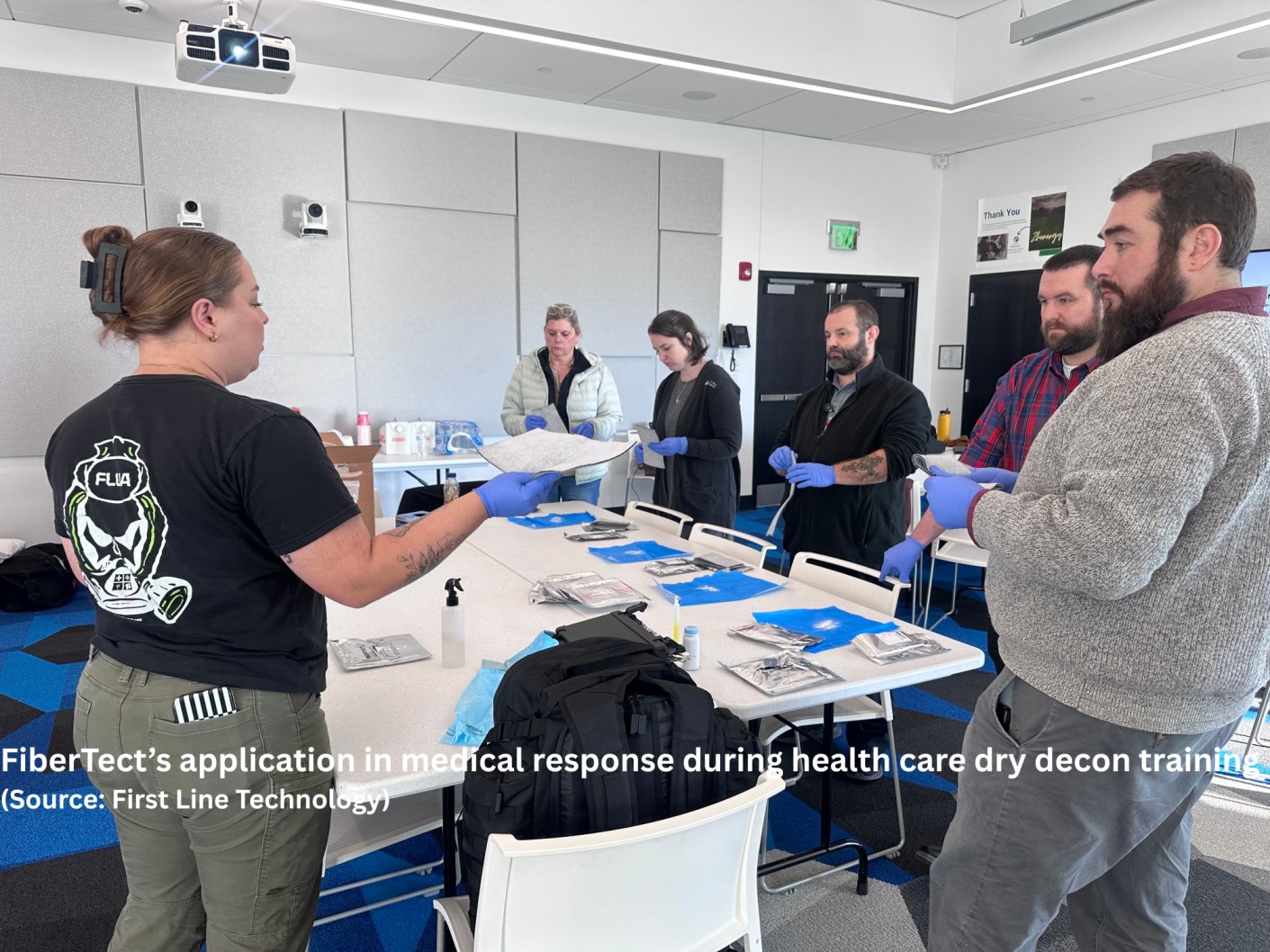
FiberTect wipe also finds applications in the medical field during decontamination in the case of mass casualty situations. Results from a U.S. Army laboratory shows that FiberTect dry wipe can wipe away ultrafine particles like fentanyl from skin and other contaminated surface. The dry wipe is found to be more effective than vacuum process, proving the multifunctionality of layered nonwoven wipe.
“FiberTect represents the state-of-the art in dry decontamination technology, with its unique ability to remove, trap, absorb, and adsorb all types of contamination, whether it be powder, liquid, or gas,†stated Corey Collings.
Dry wipe FiberTect is an important component of the improvised decontamination process, which was developed at the Nonwovens and Advanced Materials Laboratory at Texas Tech University. Originally developed as a toxic chemical countermeasure’s technology funded by the United States’ Department of Defense, it is a platform technology that finds applications in oil spill clean-up, emergency, and medical response.
FiberTect invention is backed by peer-reviewed science and is a model for translation research from lab to reality, saving lives, protecting the environment, and contributing to national security.
Commenting on breakthroughs in science in a recent meeting, Dr Sudip Parikh, CEO of the American Association for the Advancement of Science stated that breakthrough research reflects work of decades in science and technology. FiberTect invention fits this view as it involved years of work since its invention. Since its public launch in 2005, it has taken two decades to be recognised as a default dry decon for contaminants as guided by the PRISM report.
FiberTect technology exhibits collaboration between academia and industry, which is important to take lab inventions to real world applications.
About the author:
Dr Seshadri Ramkumar is a Professor, Nonwovens & Advanced Materials Laboratory in Texas Tech University, Lubbock, TX, USA. You can contact him on Email: s.ramkumar@ttu.edu