Close Menu
Indian Textile Journal
  • Home
  • Market and Economy
    • Apparels & Garments
    • Fibres & Raw Materials
    • Home Textiles
    • Industry Update
  • Textile Machinery
    • Allied Equipment and Accessories
    • Automation
    • Dyeing, Processing & Finishing
    • Knitting
    • Printing
    • Spinning
    • Weaving
  • Tech Textiles
  • Sustainability
  • Resources
    • Trade Fair
    • Events
    • Videos
  • Interview & Opinion
  • Subscribe Now
  • Advertise
  • Digital
Facebook X (Twitter) Instagram
Thursday, May 28
Facebook X (Twitter) Instagram
Indian Textile Journal
Epson Advertisement
  • Home
  • Market and Economy
    • Apparels & Garments
    • Fibres & Raw Materials
    • Home Textiles
    • Industry Update
  • Textile Machinery
    • Allied Equipment and Accessories
    • Automation
    • Dyeing, Processing & Finishing
    • Knitting
    • Printing
    • Spinning
    • Weaving
  • Tech Textiles
  • Sustainability
  • Resources
    • Trade Fair
    • Events
    • Videos
  • Interview & Opinion
  • Subscribe Now
  • Advertise
  • Digital
Indian Textile Journal
Home » Fibertect wipe promotes new decontamination process
Technical Textiles

Fibertect wipe promotes new decontamination process

By August 22, 20252 Mins Read
Share Facebook Twitter LinkedIn
Share
Facebook Twitter LinkedIn Pinterest Email Copy Link

FiberTect decontamination wipe was invented at the Nonwovens and Advanced Materials Laboratory at Texas Tech University, informs Prof Seshadri Ramkumar.

Hybrid decontamination is catching up fast to be an established decontamination method to protect warfighters and defence equipment.

Blot, apply and remove is the concept proposed by Fredericksburg, Virginia-based First Line Technology. Dry wiping followed by chemical application enables successful decontamination.

FiberTect decontamination wipe was invented at the Nonwovens and Advanced Materials Laboratory at Texas Tech University. It is finding broader applications in not only cleaning-up toxic chemicals such as mustard gas, but also it is able to adsorb finer particles like synthetic opioids. The United States’s Army’s recent evaluation report shows the advantages of such dry decontamination wipes.

Technology enables us to use different fibres as absorbent layers, while the core is high surface area nonwoven material. If raw cotton is used as an absorbent layer, it becomes oleophilic while bleached cotton provides different functionality.

Interest in using FiberTect wipe, and the hybrid decontamination technology is growing all over the world according to First Line technology.

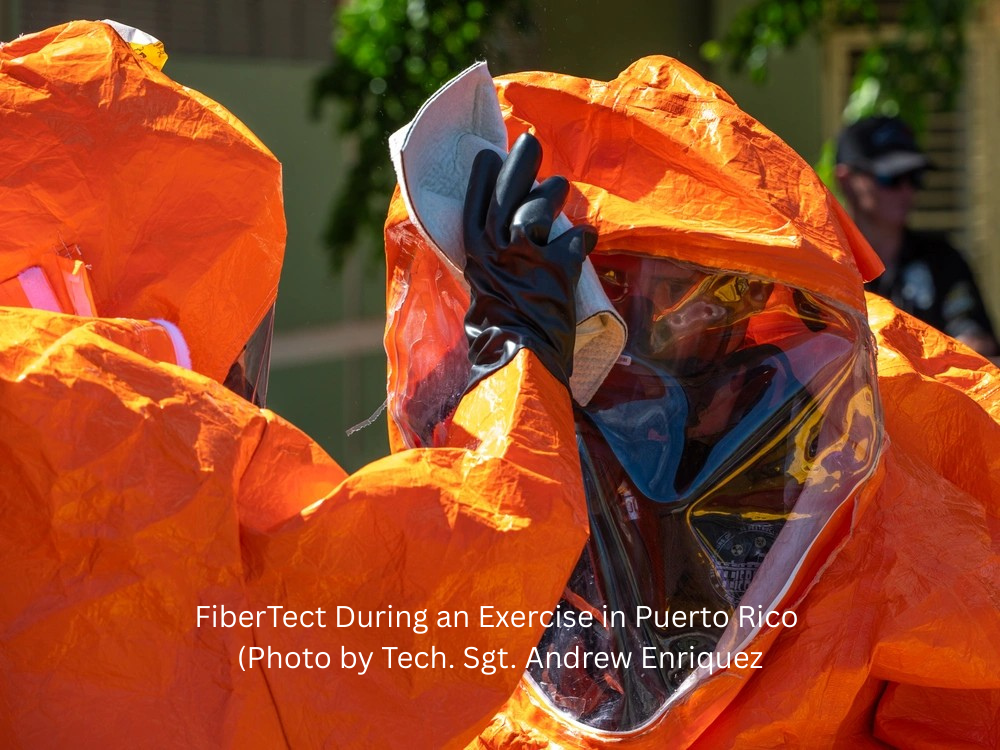
Recently, Washington D. C.’s 33rd Civil Support Team conducted advanced training in Ponce, Puerto Rico, alongside federal partners and the D.C. Fire Department. This training featured hybrid decontamination technology involving FiberTect dry nonwoven wipe.

According to First Line Technology, the training exercise involved surveying, sampling, and analysing pharmaceutical and nerve agent hazards, decontamination procedures, and contaminated personnel recovery. The appended photo shows how FiberTect is flexible enough to be used to clean complex surfaces and body parts.

The hybrid decontamination process proves to be effective, efficient and economical, avoiding excessive use of chemicals and many countries are adopting this decontamination concept.

“FiberTect is the best choice for an all-hazards Dry Decon solution. From dry particulate to liquid chemical threats FiberTect has a 95 per cent threat removal rate and is effective against CWA, TIC’s, and radiological contaminants,” stated Reggie Norton, Decon Tect Product Manager, First Line Technology.

FiberTect is a good example of “Mind to Market,” concept which demonstrated the value of translational research at university with the support of federal government.

About the author:

Dr Seshadri Ramkumar is a Professor, Nonwovens & Advanced Materials Laboratory in Texas Tech University, Lubbock, TX, USA.

33rd Civil Support Team DC Fire Department FiberTect FiberTect wipe Hybrid decontamination Nonwovens And Advanced Materials Laboratory Prof Seshadri Ramkumar Texas Tech University
Share. Facebook Twitter Pinterest LinkedIn Tumblr Email Copy Link
Previous ArticleAn evaluation of retail fashion brands – A personality perspective
Next Article Intelligent Rieter Compact-Spinning System for Highest Performance

Related Posts

New Standards in Nonwovens

May 19, 2026

Outlast Technology redefines thermal comfort with proactive cooling

May 12, 2026

Arvind Advanced Materials enters US market with acquisition of Dalco-GFT

May 8, 2026
Recent Posts
  • CAI estimates cotton crop at 334 lakh bales
  • Nesterra’s At Home series crosses 100M views
  • Groz-Beckert to showcase textile innovations at ITM 2026
  • Improve Competitiveness with Low Investment using Gentle Spinning
  • Certified or Compromised?
  • Jason Kent: The India-UK coalition is the enabler to turn talk into real action
  • Elastic Yarns Reinvented
  • Rahul Bhajekar: Industry bodies are all showing growing interest in traceability
Facebook X (Twitter) YouTube LinkedIn
  • About us
  • Contact us
  • Privacy Policy
  • Terms and Conditions

SISTER PUBLICATIONS

Construction World Equipment India Industrial Product Finder Infrastructure Today
© 2026 Indian Textile Journal. All rights reserved.

Type above and press Enter to search. Press Esc to cancel.