


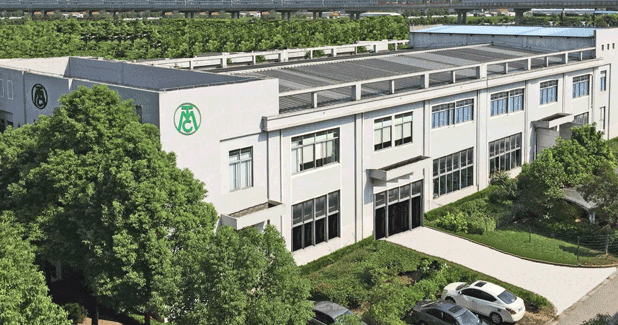
The Pakistan weaving industry is currently seeing Mayer & Cie. China (MCN), a subsidiary of the German circular knitting machine manufacturer Mayer & Cie. (MCT), headquartered in Albstadt, assembled its 1,000th circular knitting machine recently. Since autumn 2012, MCT works in Shanghai have handled the final assembly of selected machines and machines specially developed for the Chinese market. The 1,000th machine is an MSC 3.2 II, the best-selling model in the Chinese product line-up. Along with this single jersey machine, two other models are currently assembled in China. An electronic model is due to join them in 2019 as part of MCT’s plan to further develop its position in the Chinese market.
“The assembly of the 1,000th machine at our Chinese works is impressive testimony to the positive progress MCN has made in recent years,†says Benjamin Mayer, Managing Director of MCT. “Our Shanghai site and our business in China will continue to grow. Our Chinese subsidiary is an important building block for achieving our Group objectives in the years ahead.â€Â
The MCN success story
MCT began assembling machines in Shanghai in 2012. It was a “real ‘garage solution,’ “Benjamin recalls. The circular knitting machine manufacturer had maintained a Sales & Service unit there since 2003, but “we decided to assemble machines there in 2011. It was an experiment for us. We wanted to see whether machines developed specially for China would be accepted there.â€Â
The adventure got off to a good start. The first model, the MSC 3.2 or “Mayer Single Chinaâ€Â, was well received. In late 2014 it was replaced by its successor, the MSC 3.2 II. The MDC 2.2, a double jersey machine, has also been assembled and marketed by MCN since 2014. In autumn 2017, the company launched the Relanit 3.2 SC at the Shanghaitex trade fair. A member of the well-known Relanit family, it is characterised by high productivity and process reliability.
The knitting heads for all models are imported, but MCN’s 40 or so employees manufacture many of the components required themselves. The machines are all assembled on-site. “In that way we can offer selected models in the price-sensitive Chinese market at a competitive price,†says Mario Kaden, Managing Director of MCN, explaining a key benefit of the company’s Chinese presence. It also boosts the flexibility and the speed at which MCN can respond to domestic demand.
The MSC 3.2 II is the most popular model in the Chinese portfolio. The 1,000th machine is also an MSC 3.2 II. It is used especially to manufacture fabrics for leisure- and sportswear. “We have a customer here who has built up a machine park in which 130 machines of this type operate,†Kaden says, citing an example of how popular the MSC 3.2 II is.
Growth strategy for China
As machine production reaches four figures Kaden looks back proudly on what has been achieved. He has worked for MCT in Shanghai since 2003 and he is well aware of the opportunities and challenges in the Chinese market. “To gain a foothold in the world’s largest textile market you must have a presence here,†he says. “Our customers are not going to buy imported machines if we in China can deliver the same quality. We have succeeded in doing that in spite of tough competition and are very proud of our achievement. We have progressed from a ‘garage solution’ to becoming an important building block of the Mayer Group.â€Â
Based on this experience, MCT has identified significant growth potential in China – and beyond. From 2019, an electronic model will join the portfolio of machines assembled in Shanghai. As with the Relanit 3.2 SC, MCT hopes that it will increasingly attract the higher end market segment. In the future, the models assembled in Shanghai will also be available in neighbouring countries. The MSC 3.2 II has already been sold in Bangladesh for several years, and since the beginning of this year, it has also been possible to order MCT machines from India, Thailand, Taiwan and Vietnam. The overall export potential is significant. In 2017 alone, China exported over 10,000 large circular knitting machines. “We must grasp this opportunity and export our quality to other Asian markets,†Mario Kaden says.