


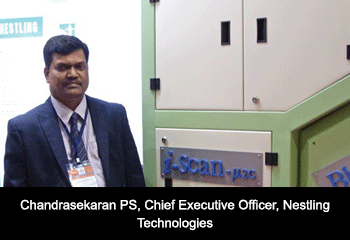
Established in 1996, Coimbatore-based Nestling Technologies is one of the leading providers of up-gradation of machinery like carding, open-end and spinning, etc. Apart from other products and services for the textile industry, Nestling´s main focus in on providing solutions for contamination issues. Nestling has recently come out with I-SCAN, which has been creating new benchmarks everyday in the field of textile.
When ITJ Senior Sub Editor Karthik Muthuveeran met Chandrasekaran PS, Chief Executive Officer, Nestling Technologies, at the recently held ITMACH event in Gandhinagar, Gujarat, the latter spoke on issues like market awareness and quality consciousness that are getting top priority among the end users nowadays.
Excerpts…
Karthik Muthuveeran (KM): Please give some background information about the company. How it has evolved over the years?
Chandrasekaran PS (CPS): Nestling was started in the year 1996 in a small way by providing electronic solutions to all the machines. We have primarily focused on providing quality service and have established our relationship with the customers based on the values which have been created out of our services.
After 5-6 years, we have taken up to up-gradation of machinery like carding, open-end and spinning, etc. with latest technologies.
KM: What are the wide range of products offered by the company? What makes these products different from that of the competitors?
CPS: Apart from other product & services, our main focus is on contamination issue. We are on the right track to position I-SCAN – series to be the best among all other brands, manufactured in India. It is touching the benchmark. We want to co-work with the customers where the quality conscious is high. So we mainly concentrate on people who wants to compete the world market with its quality end product.
KM: How big is the market for contamination products in India?
CPS: It depends upon the market awareness and quality consciousness. I feel , it´s very encouraging in India because the level of quality awareness among the end users is more nowadays.
KM: What are the various services offered by the company?
CPS: Apart from I-SCAN series, we have been into quality improvement retro-fits, process control equipment, up-gradation of OE & spinning machines and providing the dedicated service for some import-substitute controls.
KM: Are you planning you expand your footprints in foreign countries?
CPS: Yes. It will happen probably in the next financial year. Currently our focus is only on the domestic market. This is because contamination problem is comparatively more in India and we could learn more from different verities of raw material. Moreover the potential is huge in domestic market itself.
But in future we will definitely plan to expand our footprints in foreign countries as well. This is happen in a phased manner.
KM: What is the current status of Indian textile industry?
CPS: The market is currently down. In textile industry, there will be always some fluctuations. We should be aware and equipped for the changes in the industry. In other industries like automobile, IT, etc. the changes will be far less as compared to the textile industry. In textile space the magnitude of the change will be severe as well as period of change will be vast. We have to plan accordingly for this ever changing scenario.
KM: What are the major challenges did the company face before cementing as one of the leading providers in India?
CPS: We have faced many challenges in quality trusting and performance evaluation. We have