


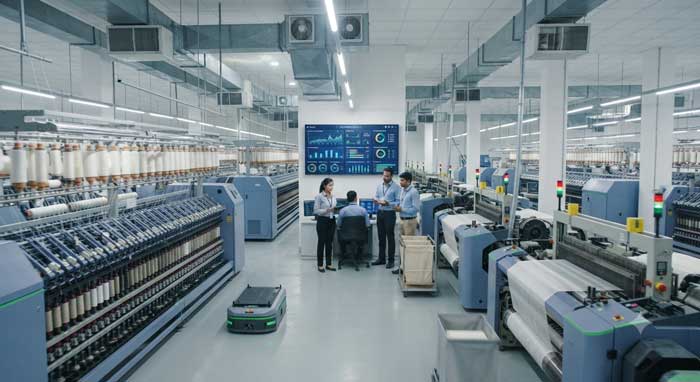
The ability to optimise energy, enhance uptime, and maximise asset performance will determine how effectively the industry navigates future challenges and captures global opportunities, says Pradip Roy.
India’s textile sector has long been a global powerhouse, built on scale, labour strength, and export competitiveness. Today, however, the industry stands at a pivotal inflection point. The drivers of growth are evolving, focussing on capacity expansion as well as operational efficiency, cost optimisation, and asset performance.
From my perspective, having spent considerable time in the textile machinery and engineering ecosystem, this trend is both visible and accelerating, reshaping how textile facilities are designed, operated, and optimised.
Cost pressures are driving a structural shift
Textile manufacturers are navigating a significant rise in input costs, ranging from raw materials, manpower, energy and other associated costs. With input costs increasing by 20–25 per cent and freight rates rising sharply, margins are under sustained pressure.
In such an environment, incremental inefficiencies in uptime, energy consumption, or process control can materially impact profitability.
As a result, the industry is focussing more on modernisation, prioritising optimisation of existing assets, seeking higher throughput, lower energy consumption, and improved reliability from current infrastructure. It is also driving a deeper engagement with AI-led interventions.
Energy efficiency as a core operational lever
Energy is one of the largest cost components in textile manufacturing, accounting for nearly 10–15 per cent of production costs across segments.
With volatility in energy prices and increasing sustainability expectations from global buyers, energy efficiency has emerged as a strategic imperative rather than a compliance requirement.
Across textile facilities, we are seeing a clear shift toward:
- High-efficiency motors
- Automation led monitoring & control
- Data-driven predictive maintenance
In our experience working closely with textile plants, even targeted improvements in airflow management, humidity control, and system balancing can significantly enhance both energy performance and product quality consistency.
Importantly, even marginal gains in efficiency translate into meaningful cost savings at scale-making engineering-led optimisation a high-impact, outcomes-driven investment.
Universal MEP Projects & Engineering Services offers solutions to the textile industry in this direction in terms of mPAI (Mill Performance Assessment and Improvement), Energy audits etc.
Need for asset modernisation
Today, the investment lens is changing. Manufacturers are increasingly adopting a lifecycle approach to asset management, focusing on:
- Retrofitting and modernisation of existing equipment
- Upgrading utility infrastructure
- Enhancing automation and process control
- Improving maintenance strategies to minimise downtime
We are seeing growing interest in retrofitting and system upgrades that extend asset life while significantly improving performance.
Sustainability and efficiency are converging
Sustainability expectations from global brands and supply chains are reshaping sourcing decisions. Textile manufacturers are now evaluated not only on cost and quality, but also on:
- Energy efficiency
- Emissions footprint
- Process reliability
- Resource utilisation
In this context, efficiency and sustainability are no longer parallel goals—they are deeply interconnected.
From an engineering standpoint, interventions such as energy-efficient system design, optimisation of utilities, and intelligent monitoring frameworks are enabling manufacturers to simultaneously reduce costs and improve environmental performance.
Enhancing India’s global competitiveness
India’s textile sector operates within a highly competitive global landscape, with countries such as Bangladesh and Vietnam benefiting from higher labour productivity and cost advantages.
To strengthen its position, India must compete on:
- Reliability of supply
- Consistency of quality
- Energy and cost efficiency
- Responsiveness to global demand
This is where operational excellence becomes a key differentiator.
Facilities that are supported by robust engineering systems, optimised utilities, and reliable maintenance frameworks are better equipped to deliver consistent performance, an increasingly critical expectation in global supply chains.
A structural shift, not a cyclical response
Current cost pressures have accelerated the shift toward efficiency-led growth.
The future of India’s textile industry will be defined not just by scale, but by:
- Engineering precision
- Process efficiency
- Energy optimisation
- Asset reliability
This evolution is also redefining the role of engineering and technical service partners, from solution providers to long-term enablers of productivity, performance, and sustainability across the textile value chain.
Conclusion: Operational excellence as a strategic imperative
India’s leadership in textiles has historically been anchored in scale and cost competitiveness. Going forward, it will increasingly be defined by scale as well as efficiency, quality, and resilience.
Operational excellence is no longer a supporting function; it is a strategic lever.
The ability to optimise energy, enhance uptime, and maximise asset performance will determine how effectively the industry navigates future challenges and captures global opportunities. Enabling this transformation will require deep engineering expertise, integrated solutions, and a lifecycle approach to performance, areas that are becoming central to the industry’s next phase of growth.
About the author:

Pradip Roy is the Head – Textile Machinery Division Universal MEP Projects & Engineering Services (UMPESL), a Wholly Owned Subsidiary of Voltas Limited. With over 35 years of experience in the textile engineering and machinery industry, Pradip Roy heads the Textile Machinery Division at Universal MEP Projects & Engineering Services Limited (UMPESL), a 100% wholly owned subsidiary of Voltas Limited, a Tata Group company.