


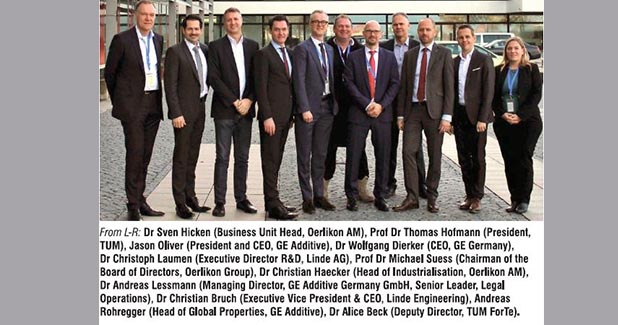
The Technical University of Munich (TUM), Oerlikon,
GE Additive and Linde are collaborating to create an additive manufacturing cluster. This cluster
is a grouping of companies and organisations that will conduct research on and develop additive manufacturing technology from
a single hub location.
The collaborative efforts will help integrate AM into the manufacturing process and enable companies to use the technology in their production. The open cluster also includes academic institutions (TUM) researching and educating on AM and regulatory authorities responsible for overseeing and regulating the use of the technology in industries. The cluster will be open to additional participants in the future.
“By having all of the players located in a single hub, we are accelerating the development and application of the technology for the various industries,†commented Prof Dr Michael Suess, Chairman of the Board of Directors of the Oerlikon Group. “Bavaria is the perfect place for us to house this initiative as it promotes energy and production efficiency, which supports Germany’s sustainability goals and the country’s desire to incorporate new technologies.â€Â
“The project is an excellent example of close collaboration between industry, academia and politics
to innovate and industrialise a technology like additive manufacturing,†commented Dr. Roland Fischer, CEO
of the Oerlikon Group. “AM is a technology that
supports our aim of providing sustainable solutions
for all industries.â€Â
Jason Oliver, President and CEO of GE Additive, added: “Bavaria already enjoys a stellar reputation as a global hotspot for additive technology – with a thriving ecosystem and a rich seam of talent. We’re excited to be part of this initiative from the very beginning and look forward to building on that solid foundation and driving tangible impact both for the region itself and further afield.†“We see this opportunity to collaborate as a win for the companies and TUM, as well as for the region,†said Dr Christian Bruch, Executive Vice President & CEO of Linde Engineering. “We expect the new hub will bring jobs to the area, while also delivering new technologies and capabilities to the companies located here.â€Â
As one of the first initiatives enabled by the AM cluster, Oerlikon and TUM are creating a new research institute. The Additive Manufacturing Institute will focus on interdisciplinary research in raw material powders, optimised AM production and end-to-end process integration, including automation and AM digitalisation. Oerlikon engineers and scientists will work hand in hand with researchers and students at various TUM faculties (mainly mechanical engineering, but also chemical engineering, the physics department and informatics) to address all aspects of AM research and production. This will include the verification and qualification of products and the development of new AM business models.
“An integrated collaboration between powerful partners from industry and science is necessary for the industrialisation of additive manufacturing processes,†explains Prof Dr Thomas Hofmann, President of TUM. “This is the only way we will be able to overcome technological obstacles and find answers to unresolved issues in the field of standardisation.â€Â
GE Additive and Linde are collaborating to create an additive manufacturing cluster. This cluster
is a grouping of companies and organisations that will conduct research on and develop additive manufacturing technology from
a single hub location.
The collaborative efforts will help integrate AM into the manufacturing process and enable companies to use the technology in their production. The open cluster also includes academic institutions (TUM) researching and educating on AM and regulatory authorities responsible for overseeing and regulating the use of the technology in industries. The cluster will be open to additional participants in the future.
“By having all of the players located in a single hub, we are accelerating the development and application of the technology for the various industries,†commented Prof Dr Michael Suess, Chairman of the Board of Directors of the Oerlikon Group. “Bavaria is the perfect place for us to house this initiative as it promotes energy and production efficiency, which supports Germany’s sustainability goals and the country’s desire to incorporate new technologies.â€Â
“The project is an excellent example of close collaboration between industry, academia and politics
to innovate and industrialise a technology like additive manufacturing,†commented Dr. Roland Fischer, CEO
of the Oerlikon Group. “AM is a technology that
supports our aim of providing sustainable solutions
for all industries.â€Â
Jason Oliver, President and CEO of GE Additive, added: “Bavaria already enjoys a stellar reputation as a global hotspot for additive technology – with a thriving ecosystem and a rich seam of talent. We’re excited to be part of this initiative from the very beginning and look forward to building on that solid foundation and driving tangible impact both for the region itself and further afield.†“We see this opportunity to collaborate as a win for the companies and TUM, as well as for the region,†said Dr Christian Bruch, Executive Vice President & CEO of Linde Engineering. “We expect the new hub will bring jobs to the area, while also delivering new technologies and capabilities to the companies located here.â€Â
New additive manufacturing Institute
As one of the first initiatives enabled by the AM cluster, Oerlikon and TUM are creating a new research institute. The Additive Manufacturing Institute will focus on interdisciplinary research in raw material powders, optimised AM production and end-to-end process integration, including automation and AM digitalisation. Oerlikon engineers and scientists will work hand in hand with researchers and students at various TUM faculties (mainly mechanical engineering, but also chemical engineering, the physics department and informatics) to address all aspects of AM research and production. This will include the verification and qualification of products and the development of new AM business models.
“An integrated collaboration between powerful partners from industry and science is necessary for the industrialisation of additive manufacturing processes,†explains Prof Dr Thomas Hofmann, President of TUM. “This is the only way we will be able to overcome technological obstacles and find answers to unresolved issues in the field of standardisation.â€Â