


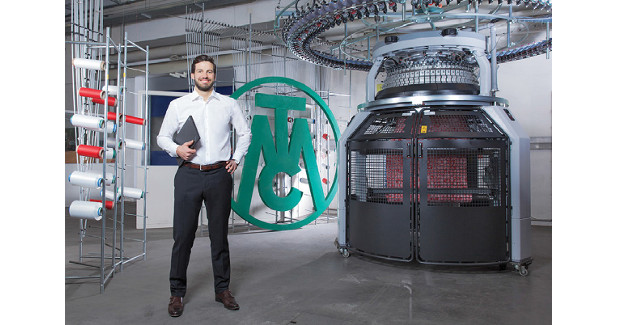
Mayer & Cie. is working on the right solution.
The experts are agreed that every company, regardless of its size, must deal with the subject of digitisation and find its own approach to it. Mayer & Cie. sees in smart solutions an opportunity to continue to be a step ahead of the competition. The circular knitting machine manufacturer is tackling the resulting tasks successively and with clear priorities. Its customers are to benefit first and foremost. That is why Mayer & Cie. is working on collecting and bundling machine- and quality-relevant process data. At the same time, a continuous data flow must be ensured across all interfaces. Initial measures are already being implemented.
“There is no such thing as digitisation per seâ€Â
Sebastian Mayer, a member of the Mayer & Cie. management, is in charge of corporate development at the circular knitting machine company. Digitisation is an important part of his remit, but Mayer is reluctant to leave it at that. “There is no such thing as digitisation per se,†he says. “There are different areas in which it can be of relevance for us as an engineering company. They include, for example, digitisation of production and the value chain, better known as Industry 4.0, digitisation of the organisation and of collaboration, and digitisation of the product itself. Each angle has different challenges and benefits. Within this framework every company must decide for itself what makes sense and when.â€Â
A key concern at Mayer & Cie. is to take a closer look at existing processes and see how they can be mapped more efficiently and at less expense. There is nothing new about this approach as such. Regularly undertaking a critical appraisal and improving existing processes has always been firmly embedded in Mayer & Cie.’s DNA. “We would otherwise not be where we are today,†Mayer says.
Digitisation at a circular knitting machine company
Until now, Mayer & Cie. feels, the need for digitisation in manufacturing has not been as urgent as in other industries, especially the media. But that is no reason to take it easy, says Sebastian Mayer. Technical and mechanical leads are not infinite. He sees in digitisation the potential to continue to set Mayer & Cie. apart from the competition.
Mayer & Cie. has already taken the first step: identifying approaches that are meaningful and relevant for the company. They consist mainly of ensuring data quality and continuity on the basis of sustainable future-oriented technologies. Specifically that means, for example, systematically collecting circular knitting machine data. With which machine parameters is which quality of knitwear produced? What are the differences if a machine is running one revolution faster or slower per minute or if the yarn is a little finer or a slightly different fibre mixture?
Data continuity and the seamless automated flow of collected data to its destination without perceptible interruptions play a special role. “The classic example of discontinuity is the Excel spreadsheet that one employee feeds with data he has collected from an existing database in order to send it to a colleague who then inputs it by hand into another system,†Mayer says, describing a practice that is far from uncommon.
There is also a very much Mayer-specific component where data continuity is concerned. The company can pride itself on a high level of employee loyalty; 40 years with the firm is not unusual. So there is an enormous amount of “head knowledge†around. “Think of employees who started at the firm as fitters over 30 years ago and are now performing management tasks,†Sebastian Mayer says. “They are walking encyclopaedias of machine and customer knowledge. This valuable knowledge ought to be readily accessible for all employees.†This approach makes all the more sense because the digitisation endeavours at Mayer & Cie. aim mainly to benefit one group: the customers. They are to benefit from a better overall customer experience and from even more specific advice.
Digital specifics: measures & challenges
Mayer & Cie. has laid the technical groundwork for change by introducing a new ERP system. It is the indispensable basis for all other services that the company would like to provide. Sebastian Mayer describes it as the company’s “digital spinal cord,†the central hub for all data and information flows.
Mayer & Cie.’s next target is specific measures to improve customer satisfaction. They include ways to provide remote technical support, better known as Remote Services. Knitting machines from Mayer & Cie. are all over the world. Even though the circular knitting machine manufacturer has about 80 agencies around the world it can take days for the nearest service engineer to call on the customer. That is too long and is often not necessary. “We are working inter alia on solutions that involve Mixed-Reality glasses,†Mayer explains. “They enable us to see what the customer sees without the need for protracted explanations. Everyone who has ever described a technical problem over the telephone knows just how arduous that can be.†Using these glasses, customers can be shown remotely how to carry out regular maintenance work and even simple repairs. A Web shop from which customers can order consumables and spare parts irrespective of opening hours or language barriers is also about to be launched.
In future, all these measures will lead to a comprehensive customer portal where customers can access centrally anything they need to know about their machines and communicate with Mayer & Cie. or its representatives. Maintenance might also be managed via this portal, with predictive maintenance as the keyword. “We see a great deal of potential.†Sebastian Mayer says, “and have every intention of putting it to use, albeit with moderation and targets.â€Â
Mayer & Cie. (MCT) is a leading international manufacturer of circular knitting machines. The company offers the entire range of machines required for making modern textiles. Fabrics for home textiles, sportswear, nightwear and swimwear, seat covers, underwear and technical uses are made on MCT knitting machines. Furthermore, Mayer & Cie. regularly develops new approaches underlining its leadership in technology. spinitsystems is the latest example in this field.
Since 2019, Mayer & Cie. has augmented its portfolio by braiding machines which produce sheathings for hydraulic tubes used in aviation, automotive industry as well as in further, very specific fields of applications.
Founded in 1905, Mayer & Cie. generated sales of EUR 110 million in 2018 with about 500 employees worldwide, according to preliminary figures. In addition to its headquarters in Albstadt, Germany, where around 370 people work, and subsidiaries in China and the Czech Republic, sales partners for circular knitting and braiding machines in around 80 countries represent Mayer & Cie.