


Switzerland, the largest producer of textile machinery, is recognised worldwide for its outstanding quality and innovative products in textile machines.
The Swiss textile machinery industry is strongly export-oriented and has a presence with its own companies, sales and service organisations in all the world’s key markets. Consistent customer focus, innovative overall solutions and state-of-the-art technologies are the guiding lines, the unique “FACTOR+â€Â, what makes these companies global leaders in their sector.
Some of the over 30 companies, which exhibited at ITMA Asia+CIME 2018, include: Amsler Tex AG, Bräcker AG, Heberlein AG, Saurer, Rotorcraft, Uster, SSM, Staubli, Autefa, Habasit, Benninger, Jakob Muller, Retech, Jactex, Santex, Polytex, Sedo Engineering, Loepfe, Luwa, Polytex, etc.
Switzerland, the largest producer of textile machinery, is recognised worldwide for its outstanding quality and innovative products in textile machines. The country plays a leading role in textile machinery world with an estimated global market share of 33 per cent. With Swiss textile machinery companies, the ‘inventor gene’ leads to added value for customers.
Over the centuries, the sheer innovative spirit of the Swiss has been demonstrated many times through inventions spanning various fields of human experience. Their impact on the global textile industry has been among the most notable, with continuous and significant developments. Swiss textile machinery companies have been at the core of this naturally-evolving tradition of inventiveness. Today, the producers of machines and components and service providers in Swiss Textlile Machinery sustain that heritage by a commitment to ongoing innovation that will influence the textile industry worldwide in future.
A single click and an application starts, another one and a file opens, or closes… Nowadays, hardly anyone remembers how we managed before the mouse made computer interactions so easy, quick and intuitive. In fact, it was a Swiss, Daniel Borel, whose inventiveness first brought the PC mouse to series production in 1982, launching a mass-market driver of progress that has been literally life-changing.
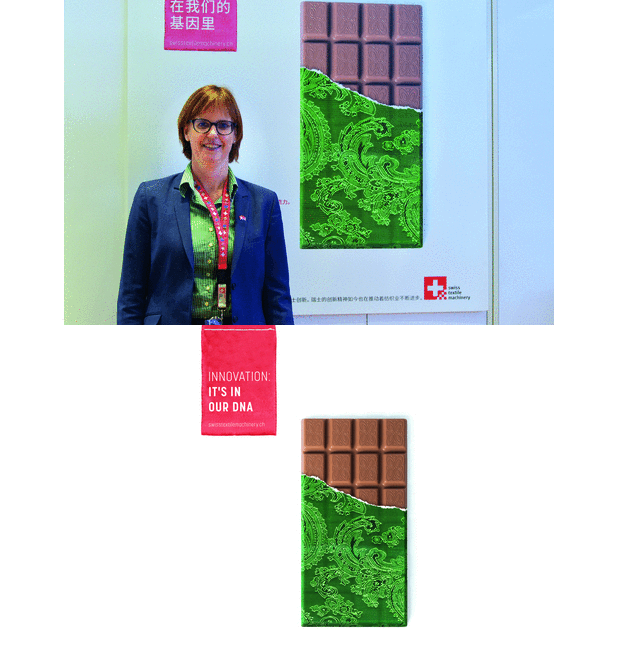
Life is also sweeter today thanks to pioneers from Switzerland in the world of chocolate: their ingenuity perfected the exquisite taste we know today, and in 1819 François-Louis Cailler devised the now-familiar tablet format which made chocolate more available and affordable worldwide.
These are just two examples among many – proving that the innovative spirit is in the DNA of the Swiss people. Some such developments have impacted on our individual lives, others on a particular business or industry. Looking back in history, Swiss inventions have repeatedly energized the global textile industry. The list includes: Caspar Honegger’s weaving loom (1842), Georges Audemars’s rayon artificial silk (1855), Isaak Groebli’s shuttle embroidery machine (1863), Karl Friedrich Gegauf’s hemstitch sewing machine and later inventions such as Othmar Winterhalter’s zip (1923) and George de Mestral’s Velcro fastener (1951). From the more recent past, there’s no need to elaborate on the successful advances of Swiss Textile Machinery members, which will surely be well-known to most readers.
The inventing tradition
Years ago, most enterprises were family businesses, often built on the founders’ invention of a technology or machine which was then further developed and improved over generations. Many Swiss textile machinery companies have a history dating back more than a century – and some are still family-owned.
The tradition of innovation evolved naturally over decades for the Swiss textile machinery manufacturers, component producers and service providers. Inventing is still a way of life today, and the fruits of this philosophy were again demonstrated at ITMA Asia + CITME 2018, where 30 members exhibited.
The sheer power of Swiss innovation in textile technology is founded on a combined total of 3968 years of experience by these companies. It’s a continuous commitment to in-depth R&D over those years, equating to the time-span between the world’s first multicolored fabrics in Ancient Egypt around 2000 BC and the modern age of advanced technical textiles. From pyramids to high-tech fabrics integrated in walls, ceilings and flooring.
Building customer trust
Across the generations of Swiss textile machinery firms, expertise has been handed down – along with the ‘inventor gene’. Driving it all, however, has been a recognition that customer requirements are the priority. Meeting those needs through innovative solutions is the real goal. “The years of experience and heritage of innovation definitely bring added value for our customers, who trust Swiss Textile Machinery members to help them build their own business success,†says Cornelia Buchwalder, Secretary General of the association.
Some of the standards set by the Swiss textile machinery companies have been established for decades – as readers might know from textbooks during their studies. As ‘Industry 4.0’ progresses, even more new technologies and standards can be expected. “I am confident that Swiss Textile Machinery members will continue to introduce innovations which will influence the worldwide textile industry in future – and I look forward with great anticipation to ITMA 2019 in Barcelona,†says Buchwalder.