


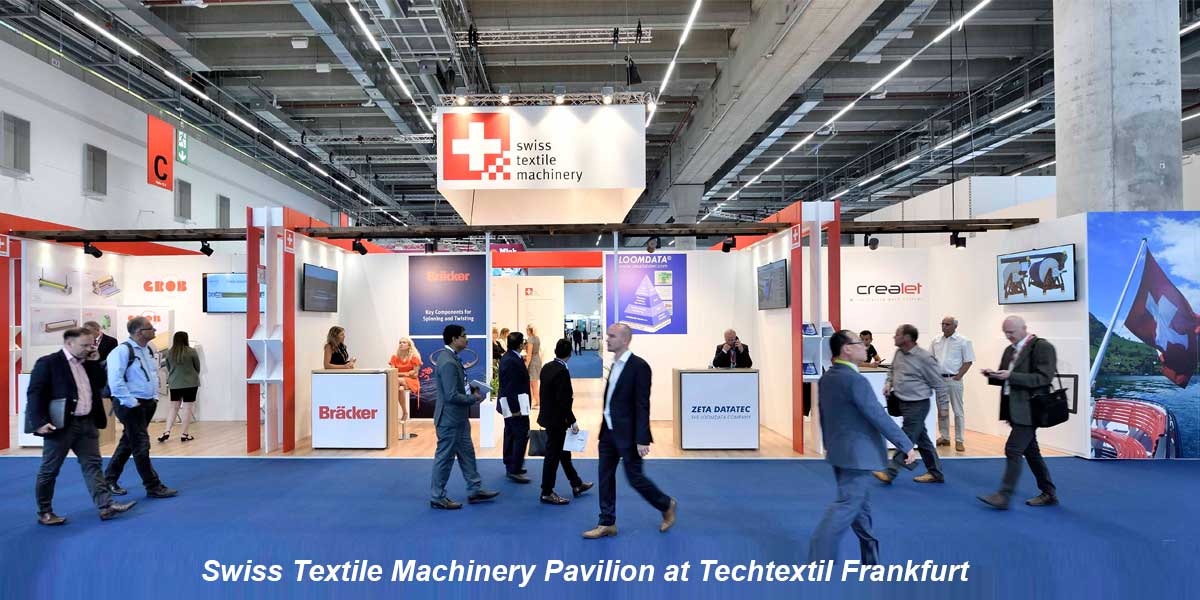
The Swiss companies have the engineering know-how and process expertise to foster genuine application development.
Switzerland
Visitors to the Swiss Textile Machinery Association Pavilion at Techtextil Frankfurt were definitely in the right place to find technology partners for their future projects. They could also see inspiring textile machinery solutions, as association members always make the most of such events as a platform for real innovation and strong partnerships. The Swiss companies have the engineering know-how and process expertise to foster genuine application development.
Technical textiles cover a vast range of applications, and it’s still growing thanks to intensive research byspecialist institutes and universities. Many members of the Swiss Textile Machinery Association maintain long-standing partnership with such bodies. Innovations are often joint efforts, building on the DNA of Swiss textile machinery companies – another characteristic which makes them attractive partners for their customers.
Feel-good technical fabrics
Some technical textiles feel like a second skin. A well-known example is activewear from the ‘sport tech’ field. Activewear includes breathable clothing, usually consisting of a three-layer-laminate:an inner lining, a breathable membrane in the center, and an outer fabric. The challenge is to bond the individual layers without losing breathability or softness, while meeting technical requirements such as resistance toa number of wash cycles.
Bonding solutions meeting top quality requirements, as well as ambitious standards for environmental protection and sustainability, were reinvented by the Cavitec brand from the Santex Rimar Group. This company’s hotmelt technology uses one-component polymers applied to textiles in a hot, molten state. Bonding based on hotmelts is both water- and solvent-free. Drying and exhaust air cleaning are not necessary, which is an ecological advantage. Energy consumption is also significantly lower. Cavitec hotmelt technology is also developed for laminated medical protection fabrics which are safe, high-quality and sustainable. These fabrics can be washed, sterilized, and used again.
A second skin with added value is the result of Jakob Müller Group’s cooperation with an institute for an established outdoor fashion brand. They have devised a heating mat applied as an inner jacket. Outdoor gear with a heated inlay offers the wearer a comfortable feeling even in a cold climate. The heating mat is particularly light, breathable, flexible and adjustable to three temperature levels.
Fabrics with these advantages are now possible thanks to multi direct weaving (MDW) technology from the Jakob Müller Group. A lacquer-insulated heating strand is inserted into the base textile as a ‘meander’ using MDW technology. The technology is offered with both label weaving machines and the latest generation of ribbon weaving machines. The textile pocket calculator is another MDW based future-oriented application developed in cooperation with a textile research institute.
Safety and health
Life-saving reliability is a must for vehicle airbags. They have to fulfil high security aspects, and must remain inflated for several seconds when an accident occurs. Airbags made of flat-woven fabric – cut and seamed – can show weakness at seams during the inflation phase. Latest Jacquard technology by Stäubli enables one-piece-woven (OPW) airbags to be produced, creating shape and structure in a single process. The final product is an airbag consisting of a sealed cushion with woven seams. OPW airbag weaving reduces the number of production steps, and increases the security aspects.
Another big advantage of Stäubli’s new weaving technology is the flexibility in formats required in today’s mid- and upper-range cars, where lateral protection (in the seat or in the roof over the door) has become standard and is designed in line with the car shape. Safe airbags are woven on modern high-speed weaving machines. The warp material, the variety of fabric patterns, and the importance of precisely shaped airbags require the use of a robust and reliable Jacquard machine.
A revolution for orthopaedic patients is a knitting machine from Steiger Participations, which uses compressive yarns developed to meet the needs of the specific health market. This machine model was exclusively designed for production with inlaid elastic yarns and offers optimum performance with guaranteed final product quality.
In the orthopaedic field, many Steigerflat knitting machines have already been operating as automatic, custom-made production systems. For example, the dimensions of an injured limb are taken by the doctor and fed into a web-based application. The doctor selects the compression class in the various sections of the item and a data file created by the software automatically applies a preconfigured program. With no human intervention required, the program is generated and produced on the machine, precisely matching the patient’s dimensions. Each product is different, and generally available within 48 hours.
Market ready technical textiles
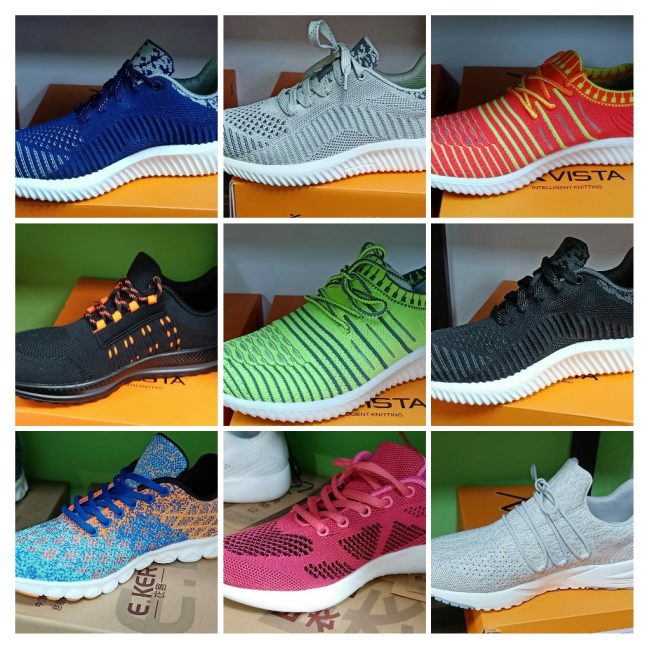
Caption for the image: Technical textiles in sport tech: Knitted upper material for sneakers.
Technical textiles have a compelling aura.“We observe markets and companies being keen on developing in the technical textile industry. It’s challenging to establish successful business with new applications,†says Cornelia Buchwalder, Secretary General of the Swiss Textile Machinery Association. “Technical textiles developments areextremely time- and cost-consuming until a product is ready to be launched. So partners can sometimes expect learning periods and uncertain ROI.â€
But Swiss Textile Machinery companies have expertise spanning many decades – in some cases over a hundred years – and have the proven track record of innovation which enabled them to survive the many difficult phases the textile industry has experienced.
New ideas were exchanged, brainstormed, and discussed freely at members’ booths at the Swiss Textile Machinery Pavilion during the recent Techtextil in Frankfurt.“Customers and researchers met Swiss textile machinery companies to explore the possibility of the not-yet-invented. “We regard our pavilion as the place where future innovations catch a spark,†says Buchwalder. Further developments in the field of hybrid yarns were a hot topic. One example of this involves producing a yarn which has all the typical characteristics and advantages of carbon – but which also prioritises careful use of resources, combining carbon fibres with thermoplastics.
About Swissmem and the Swiss Textile Machinery Association
Swissmem is the leading association for SMEs and large companies in Switzerland’s mechanical and electrical engineering (MEM) industries and related technology-oriented sectors. Swissmem enhances the competitiveness of its 1,200 or so member companies both at home and abroad by providing needs-based services. These services include professional advice on employment, commercial, contract and environmental law, energy efficiency and technology transfer. Swissmem operates a number of strong networks, including 27 specialist groups. The Swiss Textile Machinery Association is the oldest division, founded in 1940. It represents the interests of the Swiss textile machinery manufacturers. Swissmem and the Swiss Textile Machinery Association are headquartered in Zurich.