


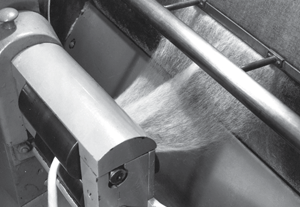
Stäublis SAFIR S30 automatic drawing-in machine is a mobile drawing-in machine that travels along the stationary warp beam as it draws the filament yarn into the healds and reed.
With the recent introduction of the SAFIR S30 automatic drawing-in machine, which is especially suited to the filament market, Stäubli is successfully following up the era of DELTA drawing-in machines. The SAFIR S30 is a mobile drawing-in machine that travels along the stationary warp beam as it draws the filament yarn into the healds and reed. This new method of operation has proven highly advantageous.
A flexible concept
The concept allows flexible layout planning of the drawing-in room. Thanks to the mobility of the SAFIR S30 , many different types of equipment arrangements are possible. Depending on the existing situation, the stationary warp beam locations can be arranged in linear succession or e.g. opposite on another. U-form arrangements are also possible, in case the existing context requires.
This establishes a clear spatial separation between the actual drawing-in process and the delivery and removal of the warp beams.
Optimal material flows to prevent logistics glitches and to improve workplace safety are important to users. The compactness and low height of the overall drawing-in machine enhance good ergonomic working conditions. The capability to draw in the healds with closed end eyes precisely and according the repeat pattern on up to 12 heald carrier rods covers every need, especially for filament weaving mills.
High drawing-in rates
Stäublis customers expect from the automatic drawing-in specialist convincingly high performance and error-free drawing-in. The SAFIR S30 has been in successful use for over two years in China, Taiwan, Japan and other southeast Asian markets, and the production figures achieved in practice give concrete proof: Depending on the application, the drawing-in capability significantly exceeds 200,000 ends per 25 hours. And this, nota bene, is the standard.
Also for high-end applications
Thanks to the optimised yarn separation principle, the processing of ultrafine filament yarns (mono- or multifilament) presents no problem. Filament warps with or without lease and with a warp density exceeding 100 yarns per cm e.g. for a two-thread reed stitch, are no problem to draw in according to the desired repeat problem.
Great savings potential
Optimum integration of all components of the drawing-in machine results in an extremely low error rate. Under normal conditions, this measures at the most 0.5 errors per 1,000 draw-ins. Thanks to this reliability, it is possible for just on person to operate and monitor up to three drawing-in machines. This very good functional behaviour directly influences the entire weaving mill. Users report significant improvement of the utilisation rate of their weaving machine-up to 10 per cent-in comparison with manual drawing-in. The use of plastic healds instead of steel ones lends additional savings. The rapid and uncomplicated changing to other heald lengths or reed density greatly reduces setup times.
High-tech for sophisticated yarn material
Yarn materials and woven fabrics that are increasingly more diverse and more delicate significantly increase the demands on thread separation. The SAFIR S30 handles this task without the use of conventional separation needles; rather, with suction nozzle or lease tubes, depending on the physical properties of the warp.
If the warp sheet has a lease, the yarns are separated from the yarn layer by means of lease tubes. If no lease is present, the vacuum gripper is used. Thus, for example, even warps with mixed yarn fineness within the same warp sh