


The Hohenstein Institute tests antimicrobial products and hygiene precautions for their effectiveness and benefit in the context of preventive health care and the fight against pathogens.
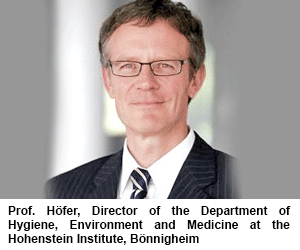
According to a study by the European Centre for Disease Prevention and Control, every year about 3.2 million people fall ill with a hospital acquired infection. For that reason, hygiene plays a very important role, both in healthcare institutions and in private households, in preventing illness and infection. Germs such as fungi or bacteria can survive on surfaces for several months. That is why it is important to take measures to combat them in order to break the chain of infection. Antimicrobial products can play an important role here. In an interaction, Prof. Hofer, Director of the Department of Hygiene, Environment and Medicine at the Hohenstein Institute, Bonnigheim, talks on the use and effectiveness of antimicrobial products.
At your institute, you test the antimicrobial effect of products. What do your tests consist of?
We test products that incorporate antimicrobial technologies for their compliance with international standards and certify their effectiveness on the basis of type testing. Textile and non-textile products with an antimicrobial function are tested and evaluated in standardised, independent test procedures. In addition to this kind of certification, we also offer our customers realistically designed tests so that the effectiveness of the product in question can be tested in use. In a number of different studies, we are also researching specific issues relating to antimicrobial effectiveness using specially adapted practical trials.
Which sectors do the products come from that you test?
The range of sectors from which products are tested is very wide. In general, we test all textiles, surfaces, consumer goods and other products, which claim to contain substances that combat micro-organisms. Products with an antimicrobial effect may be hygiene products, cleaning materials, outdoor products, functional textiles, workwear and personal protective equipment. However, domestic and wellness textiles, technical textiles, healthcare products, paints and varnishes, coatings and plastics may also contain antimicrobial substances.
In what kind of areas can antimicrobial textiles be used?
These products are often used in infection prevention, but also in industrial and domestic hygiene, or to reduce odours or prevent corrosion. Using antimicrobial textiles is an option anywhere where it is important to avoid infection by pathogens, so especially in the healthcare and personal care sectors. In those contexts, antimicrobial textiles may be used for bed-linen, towels or the uniforms of doctors and care workers. If surfaces and objects in communal facilities have an antimicrobial function, this can help reduce the transmission of pathogens by killing or deactivating the micro-organisms.
How is the antimicrobial effect achieved in products?
In the case of antimicrobial textiles, these are normally products containing biocides. Biocides are substances that inhibit the growth of micro-organisms or kill them. Such biocides include, for example, silver and copper, because silver ions and certain copper alloys are toxic to micro-organisms. Products with an antibacterial effect kill bacteria.
Antimycotic substances inhibit the growth of fungi, while antiviral substances have a deactivating effect on viruses. Textiles incorporating antimicrobial technologies can therefore certainly help combat bacteria, viruses and fungi.
But don´t antimicrobial products that kill bacteria also damage our health?
In order to help our customers assess the quality of an antimicrobial treatment and develop new products, we also offer them, in addition to the effectiveness tests, safety testin