


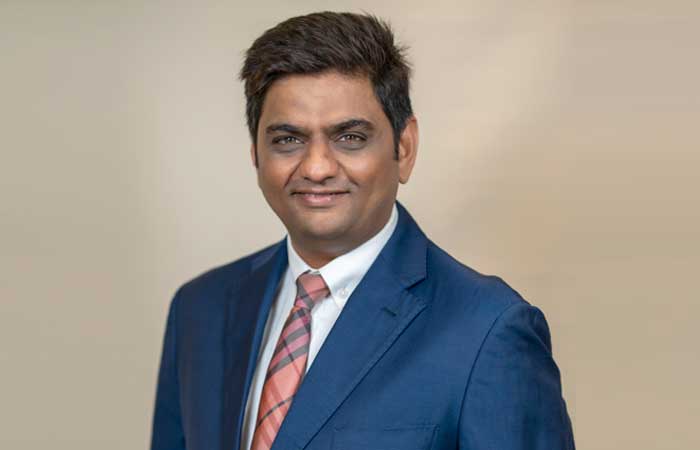
MATEXIL, formerly known as The Synthetic & Rayon Textiles Export Promotion Council (SRTEPC), was set up in 1954. It is one of the oldest Export Promotion Councils in India. The Council has played a transforming role over the years, inculcating export culture and promoting exports of Indian man-made fibre and textiles. Bhadresh Dodhia, Chairman, MATEXIL, shares his views on the current state of the Indian man-made fibre and technical textile industry with Divya Shetty.
Could you provide insights into the current trends driving the increasing demand for man-made fibres globally, and how is MATEXIL addressing these trends?
The man-made fibres share in world fibre consumption has grown up by 7 per cent during the last decade. The consumption is expected to grow further by 5 by 2030. This indicates that there is an emerging shift in global demand from conventional fibres to man-made fibres. MMF represents 70 per cent of the world’s total fibre production whereas in India, MMF occupies only about 40 per cent of the production share. However, India has started to focus more on man-made fibres. The world, today, is witnessing the increase in demand for segments like performance wear, athleisure, technical textiles, etc. These segments are the growth drivers in the uplifting demand of Man-made Fibres. Owing to the lesser consumption of natural resources and wide range of possibilities in terms of design, texture and functionality, Man-made Fibres are considered today as the major flag bearer of Sustainability and Innovations. The Council is designing and delivering awareness programs to impart the technical know-how and knowledge on industry trends to our Members. Recently, we have concluded Bharat Tex with about 60 Knowledge Sessions, some of which focused on such topics. The Council is in extensive interaction with the various Ministries to
How does MATEXIL envision India’s role in meeting the growing demand for technical textiles worldwide, particularly in the context of man-made fibres?
India is the second largest producer of major man-made fibres in the world and India will soon be the second largest manufacturer and supplier of Technical Textiles as well. This will be leveraged by the various flagship initiatives taken by the Government of India. One of such impactful initiatives is National Technical Textiles Mission (NTTM). The NTTM will surely fill the gaps in the Technical Textiles Sector of India by aiding the R&D and skill level of the sector. Another one is, Production Linked Incentive (PLI) Scheme which focused on establishing large export centric units pertaining to MMF Textiles and Technical Textiles. The PLI Scheme have the potential to create 6 million new jobs for period of 5 years, post gestation period. Another such Scheme is PM MITRA Parks Scheme which will decrease the logistics cost in India. This will aid employment generation activities in the states itself. Export promoting strategies including Trade agreements with UAE, Australia, etc. has aided the exports growth of the textiles sector. Thus, with the support of NTTM, PLI scheme, PM MITRA and various Trade Agreements, India’s MMF Textiles and Technical Textiles industry anticipates a 75 per cent export surge to $ 11.4 billion and $ 10 billion by 2030.
What specific strategies or initiatives have MATEXIL undertaken to promote Indian technical textiles on a global scale, and what results have been achieved so far?
After receiving the mandate from the government, the council worked upon creating a vision and an action plan to promote exports of technical textiles by constituting a sub-committee for technical textiles consisting of representatives from leading technical textiles companies having rich experience in the field of technical textiles to guide the council and its members. The council has identified a list of additional 200 HS codes which comes under the Category of Technical Textiles and has represented it to the Government to notify them as Technical Textile items. The Council has prepared and released a Dossier on Export Potential of Technical Textiles to create awareness on Technical Textiles. The Council is interacting with manufacturers / exporters extensively to understand their constraints and represent it to the Government for resolution. The Council has been facilitating participation of Indian companies in various Leading Global Technical Textiles exhibition like Advanced Textiles Expo in US, Techtextil North America, TITAS in Taiwan, etc. The Council organised a successful Technical Textiles Delegation Visit to the US led by Rajeev Saxena, Joint Secretary, Ministry of Textiles. Following this delegation, The Nonwoven Institute in US has signed MoU with the IIT, Delhi. One of the recent initiative which came into recognition by the Technical Textiles industry is inclusion of FIBC Bags under the RoSCTL scheme.
With the rise of sustainability concerns, how is MATEXIL promoting eco-friendly practices and products within the man-made fibre segment of the textile industry?
Climate change and sustainability issues are top of the Council’s social and economic agenda. Consumers, today, wants to make a difference in saving the planet for future generations. Leading Global & Indian Brands and Retailers today prioritises sustainability by using organic cotton, non-toxic wool, non-toxic hemp, recycled nylon, recycled polyester and other recycled materials to manufacture clothing. They seek manufacturers and exporters that lead in ethical and sustainable sourcing, emphasising fair trade, renewable energy, and community engagement. The Council is extensively disseminating the information on Eco-friendly practices and Leading Buyers & Retailers’ requirements to its Members. The Council also promotes the use of Man-made fibres to the Textiles industry as these are more Sustainable and Recyclable as compared to conventional fibres.
In what ways is MATEXIL leveraging technological advancements and innovation to enhance the quality and competitiveness of Indian man-made fibre products in global markets?
The Council is analysing the market intelligence data and disseminating the information among its members monthly basis. The Council is in the process of introducing a Trade Dashboard at its webpage. With this dashboard, the Council will embark on a journey that brings together an ocean of information on global competitive market and quality norm, insights and resources with simple clicks for our members in a very easy to operate and understand mode. The innovative Trade Data Dashboard will be the first of its kind among the entire Textiles and Apparel related Councils. The Council is also in the process of creating a modern, efficient, and transparently managed B2B marketplace for MMF Textiles & Technical Textiles that will allow reliable buyers and quality manufacturers / exporters to interact with each other. Additionally, to aid technological advancement for the Textiles industry, the Council is recommending the Ministry to revamp ATUFS benefits to the industry.
What new initiatives or projects is MATEXIL currently focusing on to further boost the growth and expansion of the Indian textiles sector, particularly in the realm of man-made fibres and technical textiles?
The Council is primarily focusing on its upcoming proposed initiative to organise an India Day Event at Techtextil Germany 2024. The initiative to organise an India Day Business Meet in Frankfurt, Germany is a part of the Council’s effort of promoting Exports of Technical Textiles from India. The main objective of the India Day is to Explore the Possibilities of Trade and Technical Alliance between Indian and European Organisations. The Council is also organising participation in Various Forthcoming Leading Global Exhibition for its Members. Additionally the Council is also planning to conduct a Conferences on Export Potential of MMF Textiles & Technical Textiles and creation of Trade Dashboard, B2B Marketplace, and many more focused projects to boost the exports of MMF Textiles and Technical Textiles from India.
What was your experience like serving as the Co-chairman of the recently concluded Bharat Tex event? Additionally, could you provide any updates on when the next edition of Bharat Tex is scheduled to take place?
It was really a very challenging task to organise such an event in such a short span of time and serving as a Co-Chairman for Bharat Tex was a huge responsibility to make it a grand success. Lots of planning and execution regularly from conducting Roadshows to Event was done. I thank Hon’ble Union Minister of Commerce & Industry, Textiles, Consumer Affairs and Food & Public Distribution, Shri Piyush Goyal ji for his supervision and the Ministry of Textiles & all the EPCs for extensive monitoring of the entire Event till execution. The proposed next edition is scheduled to be held during October 2025, however the exact dates are yet to be finalised.