Close Menu
Indian Textile Journal
  • Home
  • Textile Machinery
    • Allied Equipment and Accessories
    • Automation
    • Dyeing, Processing & Finishing
    • Knitting
    • Printing
    • Spinning
    • Weaving
  • Tech Textiles
  • Sustainability
  • Resources
    • Trade Fair
    • Events
    • Videos
  • Interview & Opinion
  • Subscribe Now
  • Advertise
  • Digital
  • Apparels & Garments
  • Fibres & Raw Materials
  • Home Textiles
  • Industry Update
Facebook X (Twitter) YouTube LinkedIn
Indian Textile Journal
Epson
  • Home
  • Textile Machinery
    • Allied Equipment and Accessories
    • Automation
    • Dyeing, Processing & Finishing
    • Knitting
    • Printing
    • Spinning
    • Weaving
  • Tech Textiles
  • Sustainability
  • Resources
    • Trade Fair
    • Events
    • Videos
  • Interview & Opinion
  • Subscribe Now
  • Advertise
  • Digital
  • Apparels & Garments
  • Fibres & Raw Materials
  • Home Textiles
  • Industry Update
Indian Textile Journal
Home » Kapangan to revive silk industry
Industry Update

Kapangan to revive silk industry

By March 7, 20171 Min Read
Share Facebook Twitter LinkedIn WhatsApp Copy Link
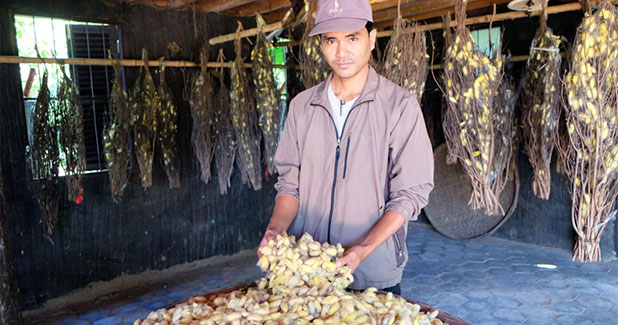
Kapangan started engaging in silk in the 1970s, rekindled in 2005 which eventually became the town’s one town, one product and has the widest mulberry production area of 15.75 hectare is hoping to revive the silk industry in the municipality. Kapangan is situated on the northern part of Benguet province in the Cordillera Administrative Region of the Philippines. 
As the industry slowly dwindled because of the lack of raw silk, which also slowed down the production of silk products despite the aim to be known as the silk capital of the country in 2007. The town was earlier known as one of the country’s largest cultivation areas for marijuana but due to government and non-government organisation’s efforts, Kapangan transformed its mountainside growing mulberry trees, the main food of silk-producing worms from China and Japan, after sericulture was introduced in nine of Kapangan’s 15 villages in late 2004.
The municipality has coordinated with the Department of Science and Technology (DOST) and the Department of Tourism Cordillera for the silkworm operations. DOST Regional Director Venus Tan acknowledged the enthusiasm of Kapangan to focus in planting mullberries.
Previous ArticleTianhai Lace?s new skin-friendly collection
Next Article Picanol posts strong 2016 results

Related Posts

FICCI TAG 2026 focuses on scaling up India’s textile ecosystem and global competitiveness

October 7, 2026

VDMA Textile Machinery re-elects Janpeter Horn as Chairman

October 7, 2026

Rieter announces leadership transition

October 6, 2026
Recent Posts
  • Lenzing debuts with REMOD denim collection
  • Karl Mayer to showcase textile innovations at India ITME 2026
  • India’s apparel market to grow from $96 bn to $146 bn by 2029
  • India drives initiative for sustainable, high-productivity cotton at 5th global summit
  • TMAS members drive sustainability and automation in textile machinery for 2026
  • FICCI TAG 2026 focuses on scaling up India’s textile ecosystem and global competitiveness
  • Maspar debuts Imperial Grace Collection of premium cotton home furnishings
  • VDMA Textile Machinery re-elects Janpeter Horn as Chairman
Facebook X (Twitter) YouTube LinkedIn
  • About us
  • Contact us
  • Privacy Policy
  • Terms and Conditions

SISTER PUBLICATIONS

Construction World Equipment India Industrial Product Finder Infrastructure Today

© 2026 Indian Textile Journal. All Rights Reserved.

Type above and press Enter to search. Press Esc to cancel.