Close Menu
Indian Textile Journal
  • Home
  • Market and Economy
    • Apparels & Garments
    • Fibres & Raw Materials
    • Home Textiles
    • Industry Update
  • Textile Machinery
    • Allied Equipment and Accessories
    • Automation
    • Dyeing, Processing & Finishing
    • Knitting
    • Printing
    • Spinning
    • Weaving
  • Tech Textiles
  • Sustainability
  • Resources
    • Trade Fair
    • Events
    • Videos
  • Interview & Opinion
  • Subscribe Now
  • Advertise
  • Digital
Facebook X (Twitter) YouTube LinkedIn
Indian Textile Journal
Epson
  • Home
  • Market and Economy
    • Apparels & Garments
    • Fibres & Raw Materials
    • Home Textiles
    • Industry Update
  • Textile Machinery
    • Allied Equipment and Accessories
    • Automation
    • Dyeing, Processing & Finishing
    • Knitting
    • Printing
    • Spinning
    • Weaving
  • Tech Textiles
  • Sustainability
  • Resources
    • Trade Fair
    • Events
    • Videos
  • Interview & Opinion
  • Subscribe Now
  • Advertise
  • Digital
Indian Textile Journal
Home » 1st high-performance fibre from date palm by-product!
Industry Update

1st high-performance fibre from date palm by-product!

By July 23, 20202 Mins Read
Share Facebook Twitter LinkedIn WhatsApp Copy Link

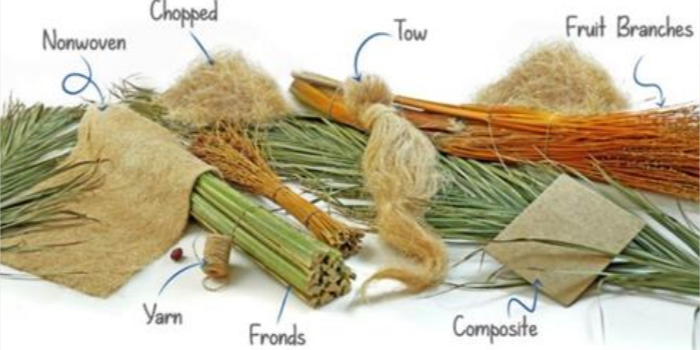
Five Egyptian researchers recently claimed to have developed the world’s first high performance fibres and reinforcements from by-products of date palm pruning like frond and fruit stalks, also called PalmFil. The sustainable and economical fibre is compatible with textile and composite processing and offers the properties needed for future lightweight cars.

“In the 1980’s the shift from natural fibres to manmade fibers was mainly to bridge the gap between the increasing demand for textile fibers and the limited supply of natural fibers,” says Dr. Mohamad Midani, partner, PalmFil Consortium.

Also read: Demand for sustainable action has grown

There are more than 140 million date palms mostly concentrated in the Middle East and North Africa, generating more than 4.8 million tonnes (dry weight) of by-products of pruning every year that is regarded as agriculture waste. These by-products can be transformed into 1.3 million tonnes of natural textile fibres annually, ranking third after cotton and jute, said Mohamad Midani, partner, PalmFil Consortium. PalmFil consortium succeeded in extracting the first long textile fibre from such by-products and converted it into fibre tow, chopped fibre, spun yarn/roving, non-woven mat, woven fabric and unidirectional tape, according to reports in textile trade websites.

Also read: Accelerating sustainable textile manufacturing

The new product can be used in natural reinforcements for composites in automotive and sporting goods, plaster reinforcements in construction, burlap sacks for packaging, ropes, twines, non-wood papers and other consumer products. The fibre is cent per cent biodegradable and compostable and has a specific tensile strength five times higher than structural steel, and equal to those of flax, hemp and sisal. Its vibration damping and acoustical insulation is higher than those of glass and carbon and thermal insulation higher than carbon.

Moreover, it can be easily blended with other long fibres like flax, sisal and abaca, or it can be chopped and blended with hemp, kenaf and jute. The PalmFil consortium has more than 50 years of experience in fibre science, textile technology and composite engineering. It is now seeking partnership to further develop, scale up and commercialise the technology.

Previous ArticleSpinning: A comeback tale
Next Article Spinning: A comeback tale

Related Posts

PDS earns Great Place to Work recognition in 10 countries

June 2, 2026

Bharat Tex 2026 mobile app launched

June 2, 2026

Turkmenistan sees focus on high-tech Italian textile machinery

May 29, 2026
Recent Posts
  • Trützschler IDF 3 unlocks short fibre processing potential
  • World Environment Day 2026 – 5 wardrobe choices combining style and sustainability
  • MiRooh unveils cosmic candy bedroom collection
  • CMAI hosts AI Masterclass to guide clothing businesses into the digital era
  • PDS earns Great Place to Work recognition in 10 countries
  • NITMA welcomes cotton import duty waiver
  • Cotton imports exempted from customs duty
  • Trident Group and ICAR-NINFET explore tie-up for natural fibre home textiles
Facebook X (Twitter) YouTube LinkedIn
  • About us
  • Contact us
  • Privacy Policy
  • Terms and Conditions

SISTER PUBLICATIONS

Construction World Equipment India Industrial Product Finder Infrastructure Today

© 2026 Indian Textile Journal. All Rights Reserved.

Type above and press Enter to search. Press Esc to cancel.