


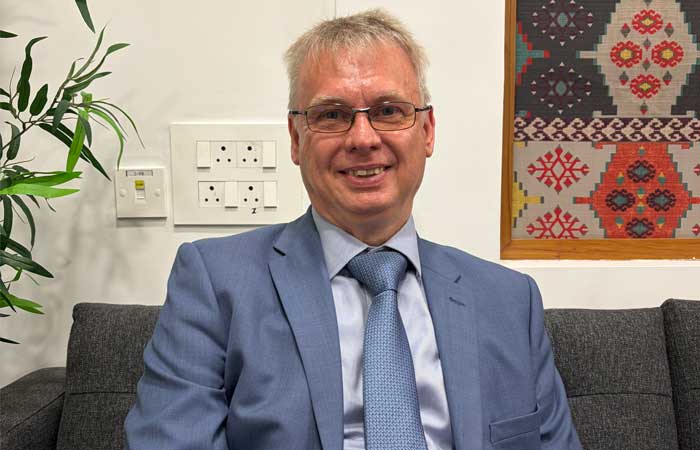
The India–UK textile machinery partnership is poised for a new era as a soon-to-come Free Trade Agreement eases trade barriers and opens fresh opportunities. The coalition is moving beyond talk, enabling manufacturers to navigate regulations, boost capabilities, and secure first-mover advantages. After years of disruption and ongoing geopolitical uncertainty, strategic collaboration, innovation, and flexibility are key. With high-value technical textiles and advanced machinery at the forefront, Jason Kent, CEO, British Textile Machinery Association (BTMA), in this interaction with Divya Shetty shares how this renewed partnership is set to reshape the textile machinery landscape and drive resilient, future-ready growth.
Could you share some insights on the India-UK coalition and the benefits of the FTA, for which you were here?
The coalition is an enabler. It is a strategic way of joining the dots and enabling dialogue between the two countries on areas that often become challenging when the UK and India do business together.
Our members are engineers, while Indian textile manufacturers are manufacturers. They are not necessarily exporters, nor are they always proficient in understanding legislation and policy. We are here to help bring all of that together and enable those who can deliver the right knowledge, succinctly, without bringing consultants on board who may use it simply as a vehicle for generating money.
We are here for true success. We want India to succeed, and we want to be part of that success. It is really important for us to grow the coalition with a vision where we make a difference. I think that is where we have failed before—we do too much talking. Now, we need to act and make a difference. We will be judged on outcomes, not on what we say, and those outcomes will be profound.
Coming to the benefits of the India-UK FTA, how has the FTA progressed, and how do you see it moving ahead?
It is for real. It is going to happen. It has already been signed and ratified, and it is expected to come into effect within the next two or three months.
Our members already have orders on board, anticipating the first-mover advantage of the FTA. This is giving them a little more financial flexibility to deliver a more enriched service to customers in terms of knowledge exchange, trading and support going forward.
There is a lot of interest because tariffs have almost been used as a weapon of trade over the past year or so. This agreement is like a huge burden being lifted between the two countries, enabling us to simply get on with business. That is all we want to do. We want to manufacture products, be successful and be world leaders in what we do. So, it is a big congratulations to both sides.
What has been the impact of the West Asia crisis and other ongoing geopolitical issues?
The impact of ongoing geopolitical issues comes after nearly six years of disruption to the industry. What we are seeing now is a growing realisation in business that there needs to be greater flexibility in anticipation of such black swan events.
While one cannot predict when something is likely to happen, businesses need to build the capability to react quickly and swiftly to deal with the consequences of such disruptions.
How do you view the Indian textile machinery market?
I see great things for both countries. It is well known that India’s economy is growing at 6.5 per cent a year, well ahead of many economies in the world, and on a scale that is unprecedented for the UK.
We have seen the coming together of both industry and academia to bring forward a powerful innovation proposition that will help support entrepreneurial businesses in India in their future development.
How do the British and Indian textile machinery sectors complement each other, and what unique strength does this partnership bring?
There is a heritage that goes back decades between the UK and India in textile machinery. We heard today that a number of British textile machines are still in operation in mills and universities in India, even after 60–70 years.
The future is now perfectly aligned with the growth we are seeing in India towards higher-value technical textiles, composites and advanced fibre production. That is what our members are aligned to. We work very closely with universities in the north of the UK on innovating advanced, high-value products that have traditionally been manufactured in Europe.
We now see India as the new superpower, with the resource capability, finance and passion to make this happen on a large scale. The coalition serves as the glue to bring all of this together. We are often guilty of talking too much, attending events and networking without facilitating real action. The coalition is there as the enabler to make that happen.
We will be judged on our actions, not on what we say. We are in a privileged position because we have a good relationship with India and Indian manufacturers. We also have a strong relationship between the two governments, first through the FTA and second through the attention we have received from the Honourable Textile Commissioner of India and our South Asia Textile Commissioner. They are very serious about helping us succeed in achieving this.
Indian companies were earlier more reliant on British textile machinery but gradually transitioned towards German textile machinery. What is your strategy to rebuild trust among Indian textile manufacturers?
I do not think the trust has gone away. There has always been trust, and there has always been a desire to buy British machinery. We have simply not been competitive enough in being able to offer it.
The UK has always been strong in innovation, but in recent decades, it has been less strong in industrialising and scaling up. The markets were not right for us in India because the UK has been focused on high-value technical products rather than commodity textiles.
Now, we see two opportunities. The first is in high-value textiles and final products, where India has a strong ambition to succeed. The second is in upgrading existing machinery within mills. A lot of equipment, particularly among SMEs in India, is fit for purpose but may not be energy-efficient. It may also not fully comply with legislation or meet sustainability requirements.
Digitalisation and technology can be applied to these machines quite easily with minimal investment. Not every manufacturer can invest in an expensive new machine to meet sustainability and policy requirements, especially when the new machine may still be producing the same products as the old one.