

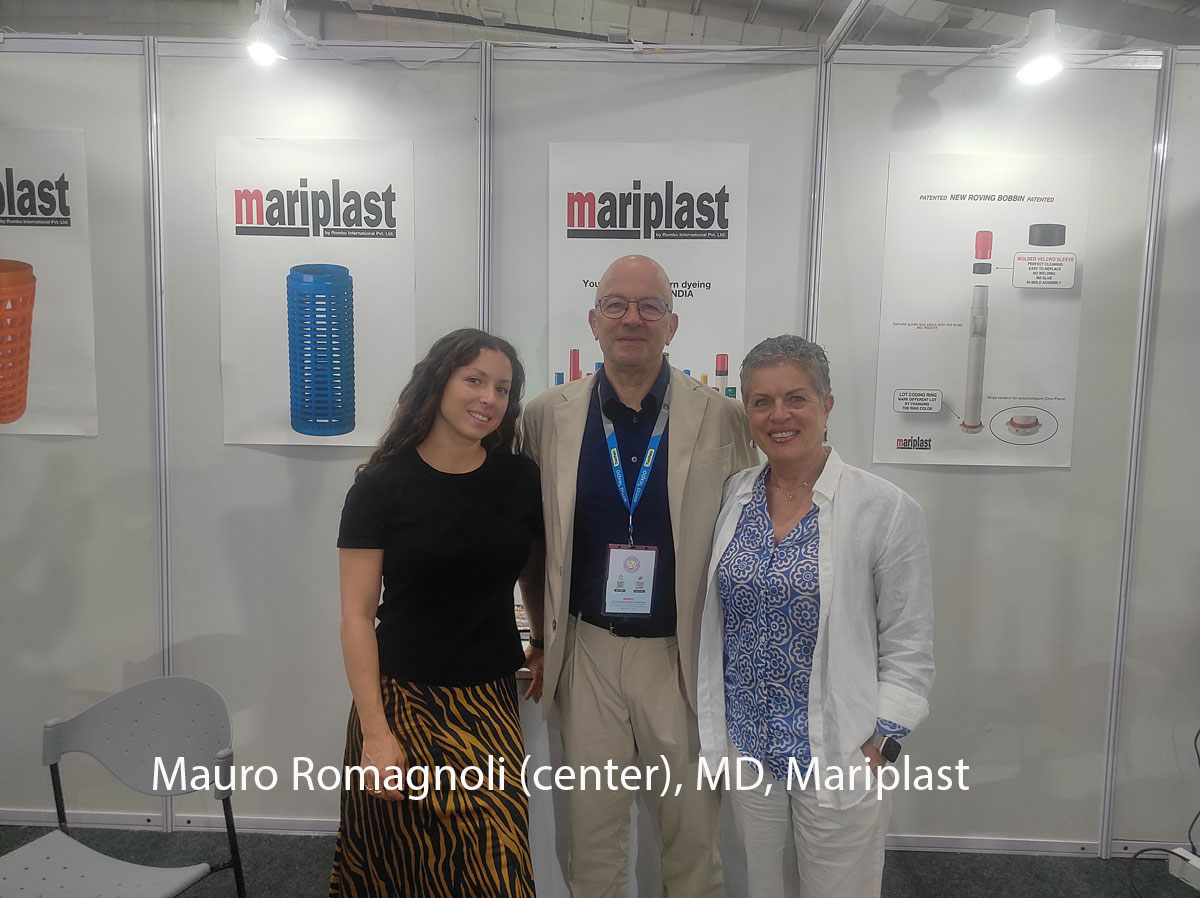
Italy’s Mariplast expands India presence with local production of dye tubes
Mariplast is establishing local manufacturing in India to enhance supply chain efficiency, expand its product portfolio and better serve the evolving needs of spinning and dyeing units, writes Rakesh Rao.
Italy-based Mariplast, a global manufacturer of plastic tubes, cones and carriers for the textile industry, is strengthening its presence in India with local production aimed at serving spinning and dyeing units more efficiently. The company has initiated operations in India as part of its strategy to be closer to customers and improve supply chain responsiveness in one of the world’s largest textile markets.
“Our philosophy has always been to stay close to customers and serve them through local manufacturing wherever possible. Even though we are an international company, producing locally helps us provide better logistics, quicker deliveries and improved technical support,” said Mauro Romagnoli, Managing Director, Mariplast, while speaking exclusively to ITJ’s Rakesh Rao.
Founded more than 60 years ago in Italy, Mariplast specialises in plastic injection-moulded accessories for the yarn industry, including dye tubes, cones and carriers used in spinning and dyeing processes. The company operates manufacturing facilities across several countries including Italy, the United States, Turkey, Spain, Egypt and Central America.
India represents a significant opportunity for the company, which has been supplying products to the market for over three decades through imports from Europe. “Mariplast has been present in the Indian market for around 35 years, but until now we were supplying mainly from Italy. Local production allows us to expand our product range and serve customers more effectively,” Romagnoli said.
The first phase of Mariplast’s India operations will focus on dye tubes, including both single-use and reusable variants suitable for cotton as well as synthetic yarn processing. In subsequent phases, the company plans to expand its offering to include ring spinning accessories such as cones and carriers, catering to the broader spinning sector.
“India is a very important textile market, and we believe local production will enable us to bring more solutions to customers while improving delivery times and cost efficiency,” Romagnoli added.
Currently, the company is working closely with customers to conduct product trials and industrial testing before scaling up volumes. Initial feedback from dyeing and spinning units has been encouraging, though large-scale orders are expected once testing phases are completed. “We are now conducting industrial trials with customers. This process takes time because every mill has different operational requirements and we must ensure the product fits their process perfectly,” he explained.
The company also sees opportunities to introduce single-use dye tubes, which are widely used in international textile markets but less common in India where reusable tubes are still prevalent. “In many international markets, mills increasingly prefer single-use dye tubes because they simplify the process and eliminate additional handling steps such as rewinding,” Romagnoli said.
Looking ahead, Mariplast aims to expand its product portfolio in India in line with its global offering, which includes more than 1,000 products for cotton, wool and synthetic fibre processing. “Our goal is not just to supply products but to help customers solve operational problems through better engineering, higher quality and longer product life,” Romagnoli said.
The company is currently operating with a small team as it builds its India operations but expects to scale up gradually as production expands. With India continuing to modernise its textile manufacturing sector, Mariplast sees strong long-term potential for advanced yarn carriers and dyeing accessories designed to improve efficiency, durability and process reliability.
