


The Institut für Textiltechnik of RWTH Aachen University (ITA), presented its expertise in the field of ambient lighting at Techtextil 2019 on the Elmatex stand. The Institute presented a Demonstrator Light Textiles that shows a new type of energy storage system for furniture applications, a range of textile products and new materials for aerospace applications.
With the Demonstrator Light Textiles, ITA shows an illuminated textile by using light-guiding fibres and polymer optical fibres (POF). The polymer optical fibre (POF) demonstrator was developed as part of an ongoing cooperation between Mentor and the ITA. This is an R&D model that offers ITA’s industrial partners the opportunity to conduct targeted research in a specific field and to train qualified employees.
It is suited to design illuminated surfaces in the interior, for example, in the automotive or home sector. This textile solution is designed to offer a flexible, drapable surface with a soft, pleasant feel in a limited space. ITA provides the fibre and process development.
Novel energy storage for mobility applications
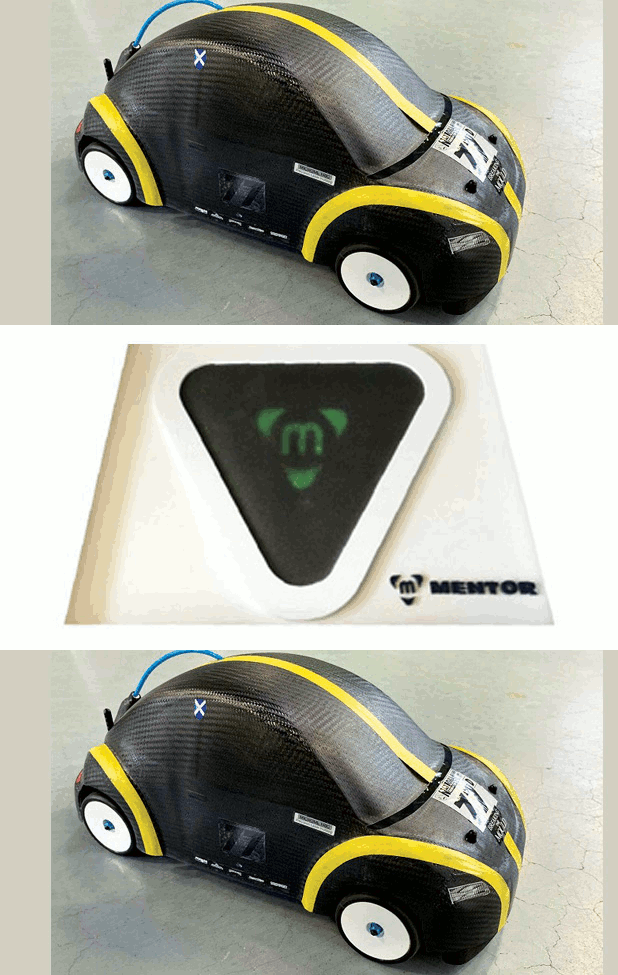
The remote-controlled model vehicle with fuel cell drive (RC-Car) is an emission-free model car with lightweight tanks and body made of fibre composite plastics (FRP). It consists of kits from Tamiya-Carson Modellbau and Horizon Fuel Cell Technologies.
The pressure vessels (Composite Pressure Vessel-CPV) of the RC-Car were manufactured by ITA with a new winding technology for pressure vessels with carbon fibres on a machine from Murata, Japan. The CPVs are produced by multifilament winding, which promises a higher productivity than conventional wet winding. They CPV can withstand high pressures, for example, 700 bar, and are said to offer significant weight savings compared to batteries.
The CPVs are said to enable emission-free, long-range, hydrogen-based propulsion that can be refuelled quickly and represents ITA’s contribution to mobility and energy revolution. “The CPVs contribute to a sustainable energy balance, since, for example, rare earths are not required as in battery production,†the company reports.
“The target group for the CPVs is the transport sector. In the automotive industry, CPVs provide the basis for a lighter drive concept, as they can be charged more quickly and offer greater lightweight potential than batteries. For the aerospace sector, the new winding technology represents an alternative, faster manufacturing process to wet-willing pressure vessels.â€Â
Efficient textile production
With its new sports bra, ITA shows a newly-developed innovative process for the highly productive manufacturing of 3D knitted fabrics on large circular knitting machines without additional separating and joining steps. Large circular knitting is significantly faster and more efficient than flat knitting which was previously used.
The garments can be tailored seamlessly and individually to size in a single step and are thus an example of a store-factory approach, i.e., customer-specific just-in-time production in a specialist shop on site. “This new process is patented and forms the basis for licensing this technology to new business fields and other industries,†the Institute adds.
MoonFibre
Many nations are toying with the idea of setting up a lunar station and to use the moon as a source of raw materials, a research site, a stepping stone into the solar system and a tourist destination. But the transport of the material for a lunar station is very costly: to bring material from the earth to the moon costs up to EUR 1 million per kg. For a lunar station, at least 450 tonne are needed.