Close Menu
Indian Textile Journal
  • Home
  • Market and Economy
    • Apparels & Garments
    • Fibres & Raw Materials
    • Home Textiles
    • Industry Update
  • Textile Machinery
    • Allied Equipment and Accessories
    • Automation
    • Dyeing, Processing & Finishing
    • Knitting
    • Printing
    • Spinning
    • Weaving
  • Tech Textiles
  • Sustainability
  • Resources
    • Trade Fair
    • Events
    • Videos
  • Interview & Opinion
  • Subscribe Now
  • Advertise
  • Digital
Facebook X (Twitter) YouTube LinkedIn
Indian Textile Journal
Epson
  • Home
  • Market and Economy
    • Apparels & Garments
    • Fibres & Raw Materials
    • Home Textiles
    • Industry Update
  • Textile Machinery
    • Allied Equipment and Accessories
    • Automation
    • Dyeing, Processing & Finishing
    • Knitting
    • Printing
    • Spinning
    • Weaving
  • Tech Textiles
  • Sustainability
  • Resources
    • Trade Fair
    • Events
    • Videos
  • Interview & Opinion
  • Subscribe Now
  • Advertise
  • Digital
Indian Textile Journal
Home » Inkjet printing shows promise for making E-textiles
Industry Update

Inkjet printing shows promise for making E-textiles

By June 17, 20212 Mins Read
Share Facebook Twitter LinkedIn WhatsApp Copy Link

North
Carolina

According to a study by North Carolina State University
researchers, layers of electrically conductive ink can be printed on polyester
fabric to make an e-textile for using in the design of future wearable devices.
The printing method can be completed at room
temperature and in normal atmospheric conditions. Researchers believe that
inkjet printing could offer a simpler and more effective method of
manufacturing electronic textiles, also known as e-textiles and they could also
extend techniques common in the flexible electronic industry to textile
manufacturing.

In the study,
researchers described the use of a FUJIFILM Dimatix inkjet printer to create a
durable and flexible e-textile material, to reliably create the e-textile, and
its properties. Part of the challenge was to find the right composition of
materials so the liquid ink would not seep through the porous surface of the
textile materials and lose its ability to conduct electricity.

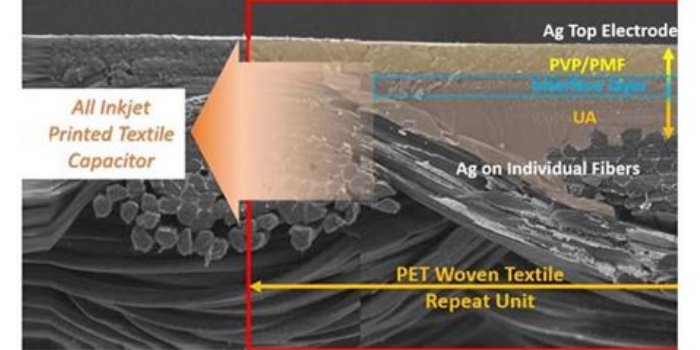
They created the
e-textile by printing layers of electrically conductive silver ink like a
sandwich around layers of two liquid materials, which acted as insulators and
printed those sandwich layers on top of a woven polyester fabric. After
printing the layers of silver ink and insulating materials, made of
urethane-acrylate, and poly(4-vinylphenol), they monitored the surface of the
material using a microscope. They found that the chemical properties of the
insulating materials, as well as of the textile yarns, were important to
maintaining the ability of the liquid silver ink to conduct electricity, and
prevent it from penetrating through the porous fabric.

The researchers
evaluated the electrical performance of the e-textile after they bent the
material multiple times and tested more than 100 cycles of bending, to find
that the e-textile did not lose its electrical performance.

Eventually, they
want to use the printing method to create an e-textile that could be used in
wearable electronics such as biomedical devices that could track heart rate, or
used as a battery to store power for electronic devices.  Everything was
done with an
inkjet printer without any lamination
or other methodologies.

Source: NC
State University Press Release

Also Read:

https://indiantextilejournal.com/latest-textile-industry-news/sima-requests-withdrawal-of-import-duty-on-cotton

https://indiantextilejournal.com/latest-textile-industry-news/wsu–itc-infotech-join-hands-for-apparel-retail-program


Previous ArticleStrong demand and high price of cotton despite lockdown
Next Article Strong demand and high price of cotton despite lockdown

Related Posts

RSWM retains IND A rating as outlook turns stable

June 12, 2026

Meenakshi India reports FY26 revenue at Rs 1.58 billion

June 9, 2026

Training undergraduate and school students in textiles research

June 9, 2026
Recent Posts
  • RSWM retains IND A rating as outlook turns stable
  • Mumbai welcomes back HGH India 2026
  • Vipul Organics teams up with OMYA for European pigment distribution
  • ITM Istanbul 2026: ColorJet’s visibility extends across the entire exhibition
  • CMAI kidswear fair sees record participation 
  • Clean energy shift may save Tamil Nadu textiles Rs 32.50 billion
  • Spykar plans pan-India offline expansion with 100 new stores in two years
  • Meenakshi India reports FY26 revenue at Rs 1.58 billion
Facebook X (Twitter) YouTube LinkedIn
  • About us
  • Contact us
  • Privacy Policy
  • Terms and Conditions

SISTER PUBLICATIONS

Construction World Equipment India Industrial Product Finder Infrastructure Today

© 2026 Indian Textile Journal. All Rights Reserved.

Type above and press Enter to search. Press Esc to cancel.